GEO Audit, AEO Audit, or AI Visibility: which to launch and what to do after the report
An AI can cite you as a source, judge you poorly, and recommend someone else: which SEOZoom tool to run, where the problem starts, and what to do after the report.
You ask ChatGPT about your brand and it comes back with a location you don’t have, a competitor in a completely different tier, a tone more hostile than you expected. You spot the error right away, but the conversation doesn’t tell you where it came from, and without knowing that, you don’t know what work to do or how long it will take to see the effect.
A brand’s presence in AI isn’t a single metric. You can show up in plenty of answers, be described consistently, and still be judged poorly on the one aspect that matters most for sales, or be the source behind a recommendation that goes to someone else.
With GEO Audit, AEO Audit, and AI Prompt Tracker you can see where the problem starts: in the model’s memory, in what search engines find on the web while answering, or in your own pages ending up among the sources. From there you know what work is ahead of you, and whether the timeline is up to you.
What are you looking for when you talk about AI visibility
You want to know what happens when someone asks ChatGPT, Gemini, or AI Mode which product to choose in your industry, which service is worth it, what to think of your brand. You care whether your name shows up in the answer, what words the assistant uses to describe it, whether your site is among the sources, and whether the final recommendation goes to you or to a competitor.
The answer comes from what the model learned during training, and working on that layer is GEO: it builds the image the AI has of you without opening the web. Then there’s what the assistant finds when it searches the web while answering, and that’s the territory of AEO. These are the two pillars of what we call SEO for AI.

Inside Google Search, AI Overviews and AI Mode run through the same systems as organic search and stay SEO. And when an assistant searches live, it often starts from traditional search engines, Google first: without presence in the index and organic visibility, those searches won’t surface your pages. SEO for AI works on what goes beyond that: model memory and the assistants that don’t depend on Google Search.
When you open the SEO for AI section
You often open SEO for AI without a precise question in mind. You want to understand how AIs talk about your brand, maybe you asked ChatGPT something and the answer didn’t convince you, but you still don’t know whether the problem is what the model remembers about you, the judgment search engines make when they search, or the pages from others that get picked to answer.
With the tools in this section you look at brand visibility from different angles: the model’s memory, live search, the site’s presence among the sources, a single customer query. To choose where to start, you just need to recognize the situation you’re in, even when you’ve noticed very little so far.
| Your situation | SEOZoom tool | What you find out |
|---|---|---|
| You haven’t noticed anything specific and want a starting snapshot | AI Visibility | Which responses from AI Mode, ChatGPT, Perplexity, Gemini, and AI Overview include your site, and with which pages |
| An assistant describes you with an industry, an offer, or competitors that aren’t yours | GEO Audit | What the model remembers about you when it answers without searching, field by field, and where it diverges from the web |
| You want to know how search engines judge you when they search, and whether they see you as a leader or an alternative | AEO Audit | How ChatGPT, Perplexity, and Gemini recognize you, judge you, and place you in the market, with the reasoning behind it |
| You have a customer question you want to show up for, and you don’t know what the AI looks for to answer it | AI Prompt Research | The searches that question triggers, grouped by topic, with content recommendations |
| You want to see if, week after week, your site makes it into the answer to that question | AI Prompt Tracker | Text and sources for each answer, with citation, mention, and brand recommendation |
A closer look at the tools
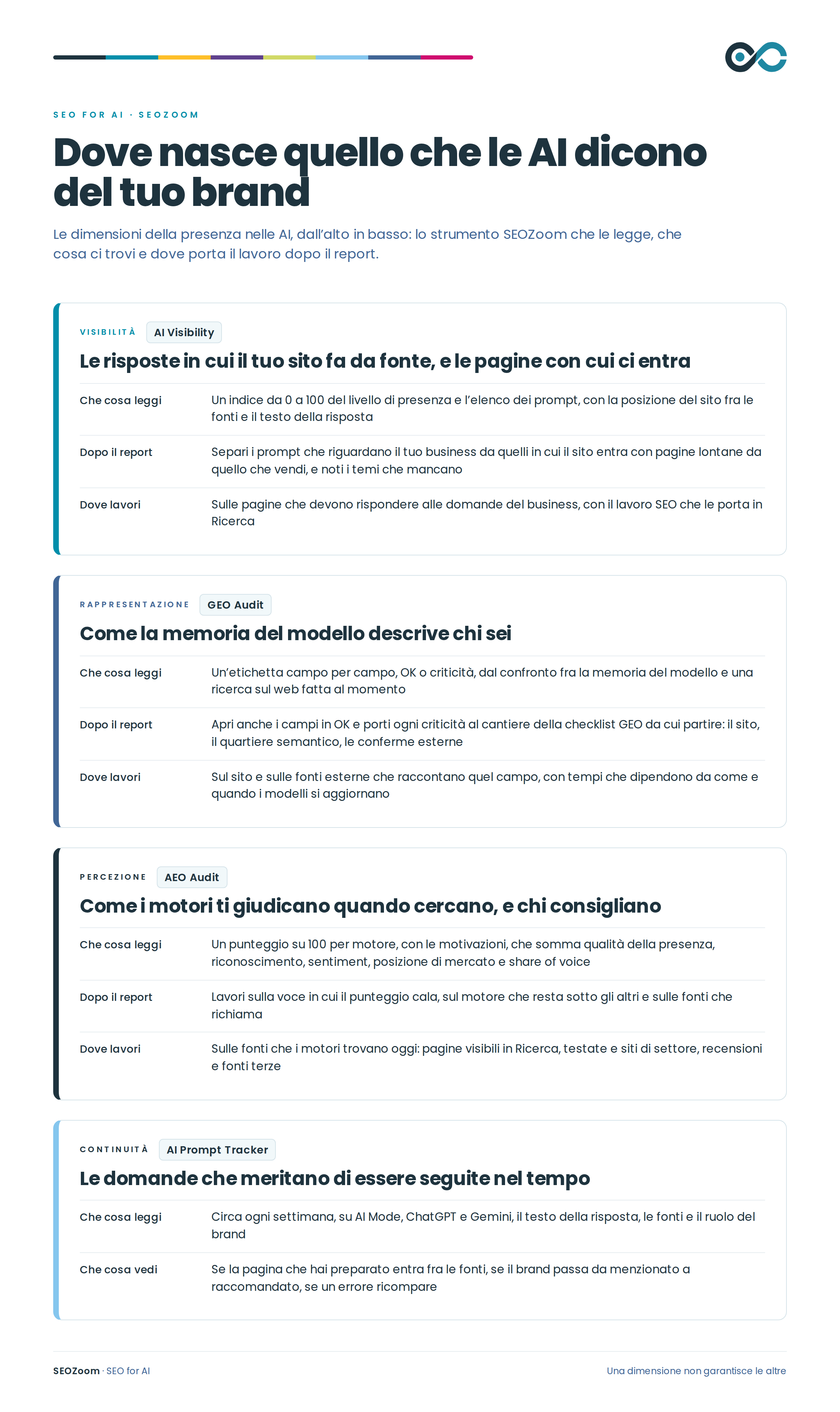
Your brand’s presence in AI covers several different dimensions. Visibility concerns the answers where your site acts as a source and the pages it enters with; representation is how the model’s memory describes who you are; perception is the judgment search engines give you when they search and the brand they end up recommending. You can do well on one and poorly on another, and doing well on one doesn’t guarantee the others.
The tools in this section put one dimension in front of you at a time, which is why each result takes a different shape. In the GEO Audit you read representation, with a label field by field, because there you compare the model’s memory against the web; in the AEO Audit, perception, with a reasoned score per engine, because you’re measuring how engines recognize and judge you when they search; in AI Visibility, visibility, with an index of how present the site is among the sources. The boundaries aren’t sharp, since the GEO Audit also reports sentiment and the AEO Audit also reports quality of presence, but the starting question for each is the one described.
With AI Prompt Research and AI Prompt Tracker you work instead on individual questions, and you get searches, answers, sources, and metrics. If you read an index as a judgment, or a label as a score, you end up working on the wrong problem.
Which responses your site shows up in
In AI Visibility you find the answers from AI Mode, ChatGPT, Perplexity, and Gemini where your site appears among the sources, plus the AI Overviews where it appears for a given keyword. The prompts come from SEOZoom’s database, which matches them to your market, so you don’t need to pick them yourself: just enter the domain, using the host the site actually runs on, with or without www, because with the other one the dashboard can come back nearly empty.
At the top there’s an index from 0 to 100 for the level of presence, split into bands: very low under 10, low up to 30, medium up to 50, high up to 75, very high above that. Below it, for each engine, you see how many prompts the site appears in, how many times it’s the first source, and with how many pages; then the list of prompts, each with the site’s position among the sources, the text of the answer, and the other sources cited.
The index gives you the level of presence, but you make decisions by reading the prompts. Group them by topic and separate the ones related to your business from the ones where the site shows up with pages unrelated to what you sell; the topics you expected and don’t find are something you’ll notice yourself, by comparing the list against your offering. Also keep in mind that the answers in the database were recorded at different times, and an answer from a few months ago describes that moment.
What a model remembers about you
The GEO Audit queries the models without web search and reconstructs the brand as they remember it: industry, mission, vision, values, geographic relevance, main topics, competitors, strengths, sentiment, topics, audience, and buyer persona. It then compares each field against a web search done in real time and assigns a label: OK when memory and web match, medium or high concern when they diverge. You run it on the domain, the report arrives in a few minutes, and it stays in your history with date and time, ready to reopen whenever you want.
Next to each flagged field there’s a “See issue” button: opening it shows you the data retrieved from the web search and the problems to fix, that is, the web’s version and the point where the model’s memory departs from it.
The label measures consistency between memory and web. If the model and the web search agree on something that’s wrong, the field still shows OK; and this consistency can also apply to a negative judgment, like a sentiment marked OK despite recurring negative keywords. So when you see an OK, open the field and read what’s inside.
How search engines judge you when they search
The AEO Audit asks ChatGPT, Perplexity, and Gemini to describe and evaluate the brand by searching the web as they answer. You launch it by entering the brand name, country, industry, product or service, and language, and those parameters act as the prompt: if you change the industry or product, the engines look for confirmation elsewhere and the result changes. Enter the product or service you want to know how it’s seen, and write down the parameters, because to compare one audit with the next you’ll need to repeat them exactly.
For each engine you get a score out of 100 that adds up quality of presence (up to 20 points), recognition (20), sentiment (40), market position (10), and share of voice (10); at the top is the average across engines. Below you’ll find the reasoning: the recognition value, market position (leader, challenger, niche), the archetype, identity traits, strengths, growth areas, trajectory, and, engine by engine, sentiment with opinion polarization and source analysis. That’s where you see which item is dragging the score down, and why.
If the identity traits are generic concepts, the brand’s positioning is weak. Growth areas mix insights drawn from what the engines found with generic advice that would apply to any brand, and you’re the one who spots and discards the latter. As for the listed sources, read them alongside the text of the reasoning, because an engine can reference a source in the text without listing it.
The AI Visibility index also runs from 0 to 100, but it measures the site’s presence among the sources, while the AEO score measures how the engines recognize and judge you. If the score is high and the index is low, the engines think well of you but pick other people’s pages to answer with, so you work on your pages; if the index is high and the score is low, the site is present and you work on brand perception.
The searches behind a customer’s question
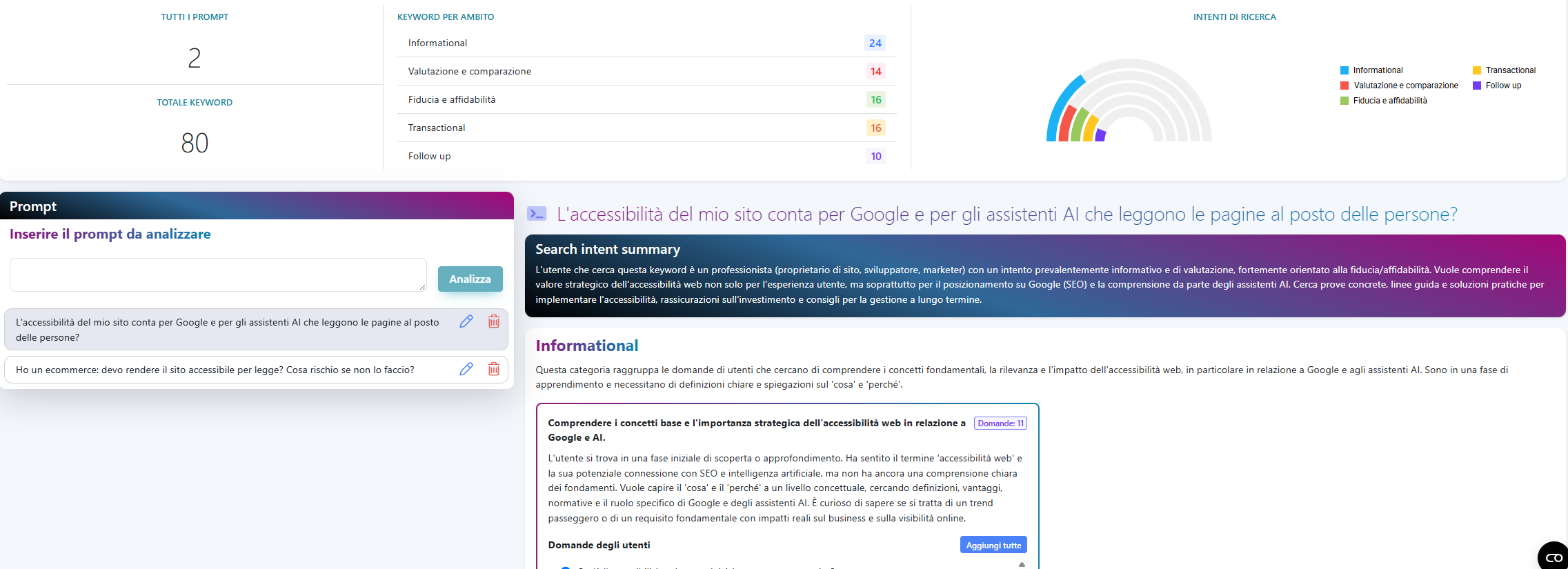
In AI Prompt Research you write a question the way a customer would, maybe the very one you’re afraid you don’t show up for, and you get the searches the models run to answer it, grouped by area: information, evaluation and comparison, trust and credibility, purchase, and follow-up research. For each area you’ll find the users’ questions, the keywords, and content recommendations, with a summary of the asker’s intent at the top.
When we used it to prepare an article on web accessibility, 2 prompts produced 80 keywords: 24 informational, 14 evaluation and comparison, 16 trust-related, 16 purchase, and 10 follow-up. This way you see the whole need behind a question, and you understand which pages on the site should answer it and which ones are missing. With “Add All” you bring the questions into the Tracker.
The answer, week after week
In AI Prompt Tracker you add, within your site’s project, the questions you want to track. The Tracker reruns them roughly every week on AI Mode, ChatGPT, and Gemini, and for each answer it records the text, the sources with URL and position, and the brand analysis: whether you’re named, how prominently, with what sentiment, in what role, and alongside which other brands.
In the executive summary you’ll find the measures broken out separately: the site being cited as a source, the brand being mentioned in the text, the recommendation, the sentiment, the Positioning Index, which shows the role the AI assigns you, and the Defensive Ratio, which shows whether you’re named on your own merits or because of a competitor’s limitations. In the Trend, Prompt Competitors, and Fan Out Coverage tabs you track these over time and compare them against other brands.
Each scan replaces the previous one’s text, while the history keeps the measures. If a response matters to you, save it when you read it. In the Tracker you see whether the page you prepared makes it into the sources and whether the brand moves from mentioned to recommended; the reasoning behind why is yours to work out, based on what you know about what you changed and what changed around it.
The path we recommend, and why in this order
If you’re starting from scratch, we recommend moving from the big picture to specific questions: AI Visibility, then GEO Audit and AEO Audit, and finally AI Prompt Research and AI Prompt Tracker. In this order, each tool tells you what to ask the next one, and getting started costs little: AI Visibility doesn’t use credits, while GEO Audit, AEO Audit, and AI Prompt Research use the credits included in your plan, making them essentially free.
AI Visibility opens the path because all you need is the domain. From the prompts where the site shows up, you get the topics you’re present for, the ones where you show up with the wrong pages, and the ones you expected and don’t find, and those are the topics you then run through the audits.
The GEO Audit comes right after because it works on the layer that’s slowest to fix, the models’ memory. If you’re placed in the wrong industry there, or next to the wrong competitors, everything you do afterward rests on that error, so it’s worth knowing upfront.
You launch the AEO Audit once you know which product or service you want feedback on, and the topics that came out of AI Visibility help you pick which industry and product to enter. Reading it alongside the GEO Audit, you see whether a judgment lives only in the sources the engines find today or also in the model’s memory: if it’s only in today’s sources, the fix is working on those sources; if it’s also in memory, it takes more time, and you’re not the one who decides how much.
From AI Visibility and the audits you get the questions that matter: the one where the engines judge you poorly, the purchase-related one where you don’t show up. You run these through AI Prompt Research to see what they trigger, and add them to the Tracker to follow, scan after scan, whether the pages you prepare make it into the answers. If instead you started from a specific symptom, open the tool for the situation you recognized and pick up the path from there.
Issues by tool, and how to fix them
Each tool flags a different kind of problem, and each one points you to a different fix: the model’s memory, the sources engines read today, or the pages on your site. Mix them up and you’ll wait for a model to update when the problem actually sits in today’s sources, or rewrite a page’s copy when engines can’t even find it.
| Tool | What you see | What it means | Where to start |
|---|---|---|---|
| GEO Audit | Medium or high issue on a field | The model remembers that field differently from how the web describes it today | From the pages and outside sources that describe that field, knowing that the model’s memory timeline is not something you control |
| GEO Audit | Field marked OK with negative keywords | Memory and the web agree on a judgment you don’t like | From the negative topic: on-site answers, reviews, digital PR |
| AEO Audit | Low recognition | Search engines know little about the brand | From your presence in the sources search engines find when they search |
| AEO Audit | Low or polarized sentiment | Search engines know the brand and judge it poorly on one topic | From the topic that keeps coming up in the reasoning, on the site, and in third-party sources |
| AEO Audit | One search engine scoring far below the others | Perception isn’t consistent across ecosystems | From that search engine’s reasoning and sources |
| AI Visibility | Low index, or presence on topics unrelated to your business | The site barely shows up in answers about your market, or shows up with the wrong pages | From the pages that need to answer business-related questions, with the SEO work that gets them into Search |
| AI Prompt Tracker | Brand mentioned but not cited, or cited but not recommended | The brand enters the narrative through someone else’s pages, or appears without becoming the choice | From the page that needs to serve as a source, or from the reasons an assistant should choose you |
A field flagged as an issue in the GEO Audit
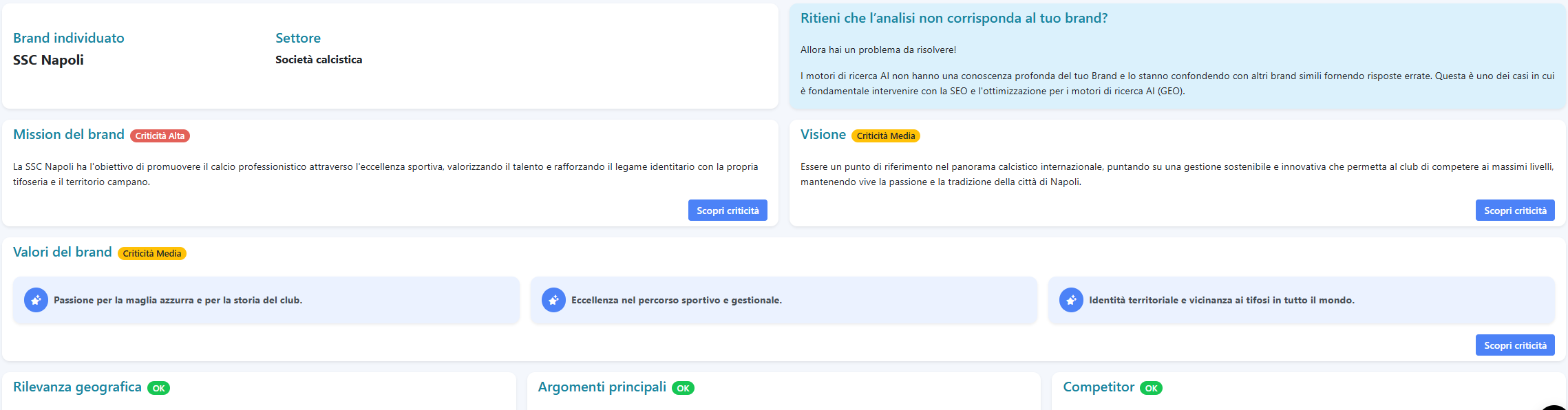
On October 1, 2026, we launched the GEO Audit on SSC Napoli’s website. Geographic relevance, topics, and competitors came back OK, mission showed high risk, and vision and values showed medium risk. The model describes a sporting and territorial mission: promoting soccer and strengthening ties with fans and with the Campania region.
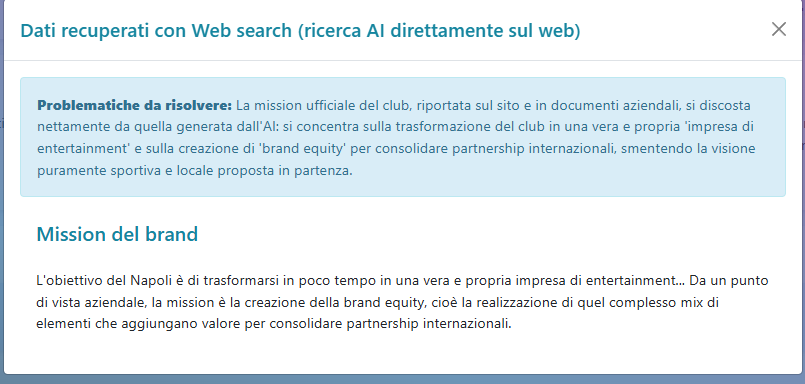
Opening “See issues” shows you the web’s version. The club’s official mission, taken from its site and corporate documents, talks about turning Napoli into an “entertainment business” and building “brand equity” to cement international partnerships, “contradicting the model’s purely sporting and local view.” The model’s memory holds a soccer club tied to its city; the official version is a business building a brand worldwide.
Facing a flagged issue, the first thing to decide is which version you want to win out: the report shows you the gap, but only you know which story is right for the brand. For Napoli, the official version is the club’s own, and the work is about the sources that tell it.
The flagged issue also tells you which part of the GEO checklist to start with. A sector, mission, or set of values described generically or differently from yours points you to the site, which needs to state clearly who you are in plain words. Competitors and topics that don’t belong to you point to the semantic neighborhood. An official version that lives only on your own site, or a sentiment resting on other people’s reviews and articles, points to external validation. When you rerun the GEO Audit, check whether the gap has narrowed. Timing depends on when and how the models update, and in the meantime engines that search the web may already be reading the right version. You can check that with the AEO Audit or by adding the question to the Tracker.
Points lost in the AEO Audit
In the AEO Audit, each metric that drops points to a different piece of work. Low recognition means engines know little about the brand: work on your presence in the sources they find when they search, meaning pages visible in Search, mentions on publications and industry sites, and up-to-date listings. Low or polarized sentiment means they know you but judge you poorly on a specific topic: start from that topic, address the objection on your site, and work on the reviews and third-party sources feeding it.
Low market position and share of voice mean other brands are occupying the answer space, and the work is about the topics that justify choosing you: use cases, proof points, comparisons. If one engine lags well behind the others, perception isn’t consistent across them: read its reasoning and the sources it cites, and work on those.
High presence on the wrong questions
In AI Visibility, the problem can be a low index, or an index built on questions far from your business while the purchase-intent questions you expected are missing. Either way, the fix starts with the pages that need to answer your business’s questions.
AI Overview and AI Mode live inside Google Search, so getting a page into the source list there is SEO work. The same holds for assistants that, when searching, draw on traditional engines. Pass the questions where you’re missing to AI Prompt Research to reconstruct the searches that trigger them, and to the Tracker to follow them over time.
Brand mentioned but not cited in the Tracker
In the Tracker, the issue lies in the gap between the metrics. If the brand is mentioned often but rarely cited as a source, it enters the narrative through other people’s pages. If it’s mentioned but rarely recommended, it shows up without becoming the pick.
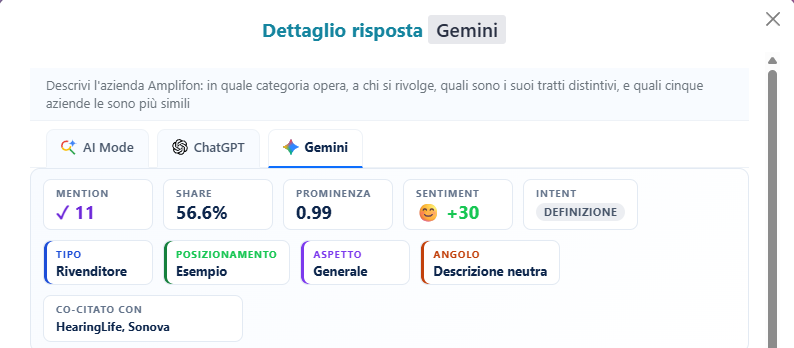
When a classification alarms you, reread the question you put into the Tracker, because classifications depend on it too. In our project on Amplifon, the Tracker follows a single prompt: “Describe the company Amplifon: what category does it operate in, who is its audience, what are its distinctive traits, and which five companies are most similar to it?” Amplifon is mentioned in 3 out of 3 scans, cited as a source in 0 out of 3, and recommended in 0 out of 3. The Positioning Index classifies it as “just an example or commodity,” and the Defensive Ratio flags it as fragile. For the sector leader that looks like a serious signal, but the question asks for a definition and a list, and in that kind of answer the brand naturally shows up as an example. What’s worth working on is that engines rely on third-party sites, not Amplifon’s own, to describe it.
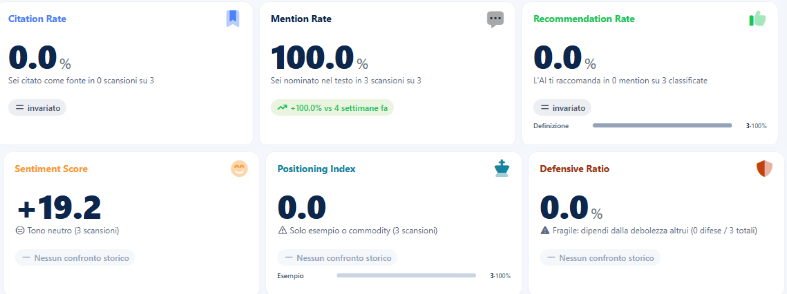
If the citation is missing, the page meant to serve as the source isn’t among those engines retrieve, and the work is on that page’s content and its ranking performance in Search. If the recommendation is missing, the work is on the brand’s positioning, meaning the reasons an assistant should pick you.
On the descriptive prompt the Tracker follows for Amplifon, Gemini’s answer changes from one scan to the next. On September 17, 2026, it had Amplifon founded in Milan in 1949, and among the sources was Tracxn, a company-profile database that attributes to the brand the founding year and founders of GAES, the Spanish company that joined the group decades later. On September 30, the date was correct, 1950, but the founder’s name was garbled. On October 1, the answer no longer contained either detail, and Tracxn was back among the sources, still showing 1949 as it had the day before. In the latest scan, read on October 14, the answer names neither the year nor the founder, and Tracxn doesn’t appear at all.
A correct answer in one scan doesn’t close out the work. As long as the listing carrying the error stays online, the engine can go back to using it. The fix is on that listing, and you check the Tracker to see whether the error resurfaces.
Why reading the tool isn’t enough
SEO for AI tools query models and engines, compare the answers with the web, measure your presence among the sources, and show you in minutes where the brand shows up, how it’s described, and how it’s judged. Brand knowledge, though, is something only you have, and that’s what turns an index, a label, or a score into actual work.
The work starts when you open the details. With attention you spot the negative keywords hiding inside a field marked OK, or the criticism an engine writes in the text without listing it among the sources. With experience you tell a correct role apart from an error, and an area for growth that comes from what the engines found apart from generic advice that would apply to any brand. Knowing what each value actually measures keeps you from reading an index as a verdict, and reminds you to factor in the parameters you launched the audit with and the moment a given answer was recorded. Knowing the brand, you know which page should appear among the sources, and you’re the one who notices when it’s missing. And with a strategy you decide, among the problems you’ve found, which one to fix first, based on how much it weighs on your business.
Amplifon and the question about price
On September 30, 2026, we tracked the process we recommend using Amplifon, the hearing aid brand, as a case study. AI Visibility scored it 62, in the high range, and with a score like that the temptation is to move on.
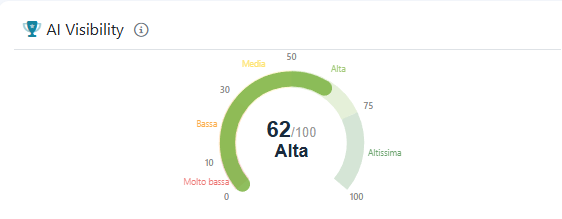
Read by topic, the 213 AI Mode prompts where the site showed up told a different story than the index suggests. Only 13 were about hearing aids: cost, reimbursement from the Italian national health service and supplementary insurers, free options, the best device, Amplifon’s pricing. About 25 were about listening, sound, and headphones, and all the rest were about health, with questions like which is the most effective treatment for an ear infection or for loosening mucus. The most cited page explained how to remove earwax buildup.
In the answers about hearing aids, Amplifon ranks among the top 3 sources in 8 out of 13 cases, and first in 4. Even there, though, AI Mode gives it a specific role. Asked about the best hearing aid, in an answer recorded on September 17, 2026, Amplifon is the second source, but the recommendation goes to the manufacturers: Phonak, Oticon, Signia, Widex, ReSound, and Starkey. Amplifon shows up among the specialized centers where you can compare them. The site serves as a source, and the recommendation goes to others, but if you know the market you won’t read that as a mistake: Amplifon is a network of centers, and the answer describes it for exactly that.
One of those questions was “Why does Amplifon cost so much?” In the answer recorded on March 12, 2026, AI Mode starts from a Fortune Italia article about the Italian antitrust authority’s investigation and from a summary of the investigation itself, opens a section titled “Market Issues and Investigations,” and writes that “many operators, including Amplifon, don’t publish transparent price lists online.” Amplifon makes the source list in third position, with its AmpliCards services page, and the page where the brand explains its pricing is nowhere among the 22 sources. To notice that, you need to know the page exists and go looking for it: the list shows you the sources that are there, and only someone who knows the site can spot the ones that aren’t.
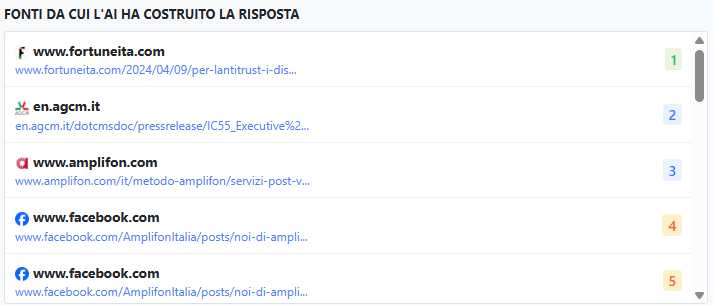
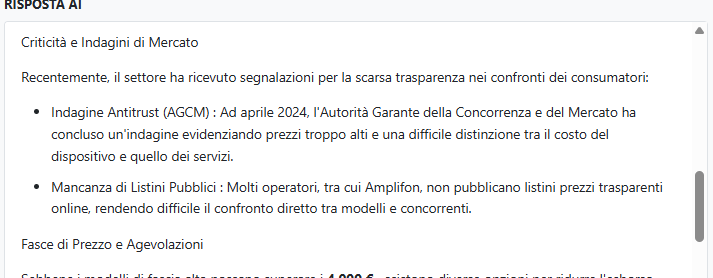
In the answers about how much an Amplifon hearing aid costs, recorded on July 14 and 22, that same page is the top source instead. These are answers from different months to different questions: in March, on why the price is what it is, the page was missing; in July, on what the price actually is, it topped the source list.
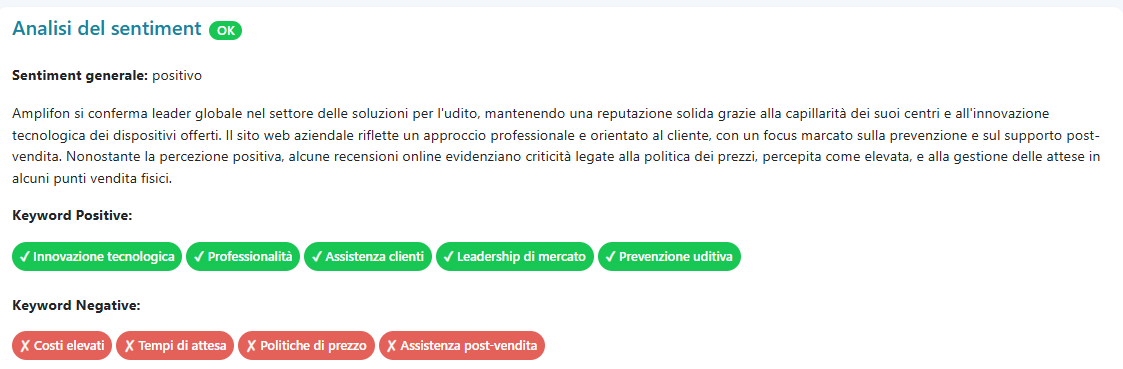
The GEO Audit, launched the same day, had every field marked OK. The sector was correct, “Hearing aid provider and hearing care solutions,” and the overall sentiment was positive. In the sentiment field, though, the negative keywords “high costs,” “wait times,” “pricing policies,” and “post-sale support” showed up, along with a line about reviews criticizing the pricing policy as “perceived as high.” Model memory and the web agreed, pricing included.
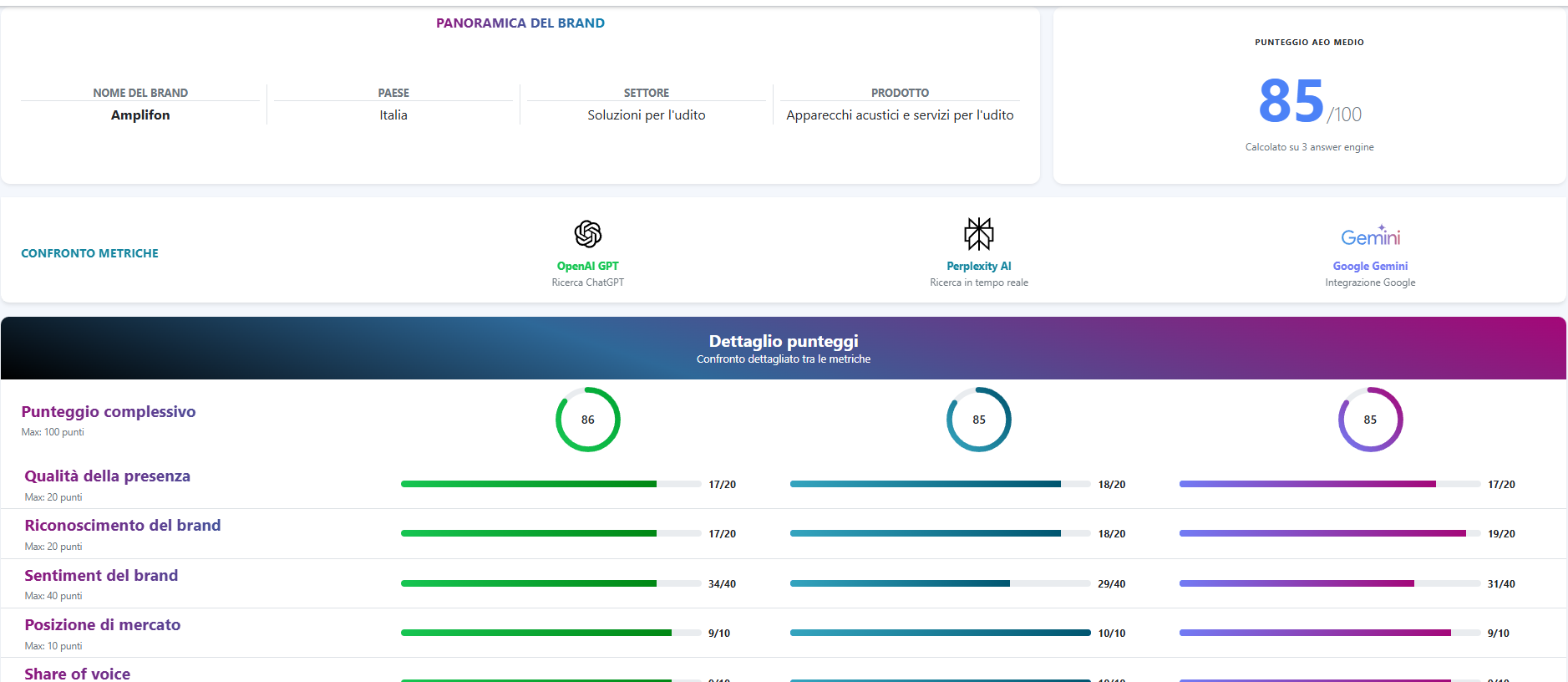
The AEO Audit, launched with country set to Italy, sector “Hearing solutions,” and product “Hearing aids and hearing care services,” closed with an average of 85, with recognition scores of 95, 94, and 95 out of 100, and the brand positioned as a leader by every engine. Nearly all the points lost fell under sentiment, and pricing came up again in 3 of the 7 identity traits associated with Amplifon: hearing aid pricing, price and customization, price and cost transparency.
| Item | ChatGPT | Perplexity | Gemini |
|---|---|---|---|
| Score | 86 | 85 | 85 |
| Quality of presence (out of 20) | 17 | 18 | 17 |
| Recognition (out of 20) | 17 | 18 | 19 |
| Sentiment (out of 40) | 34 | 29 | 31 |
| Market position and share of voice (out of 10 each) | 9 e 9 | 10 e 10 | 9 e 9 |
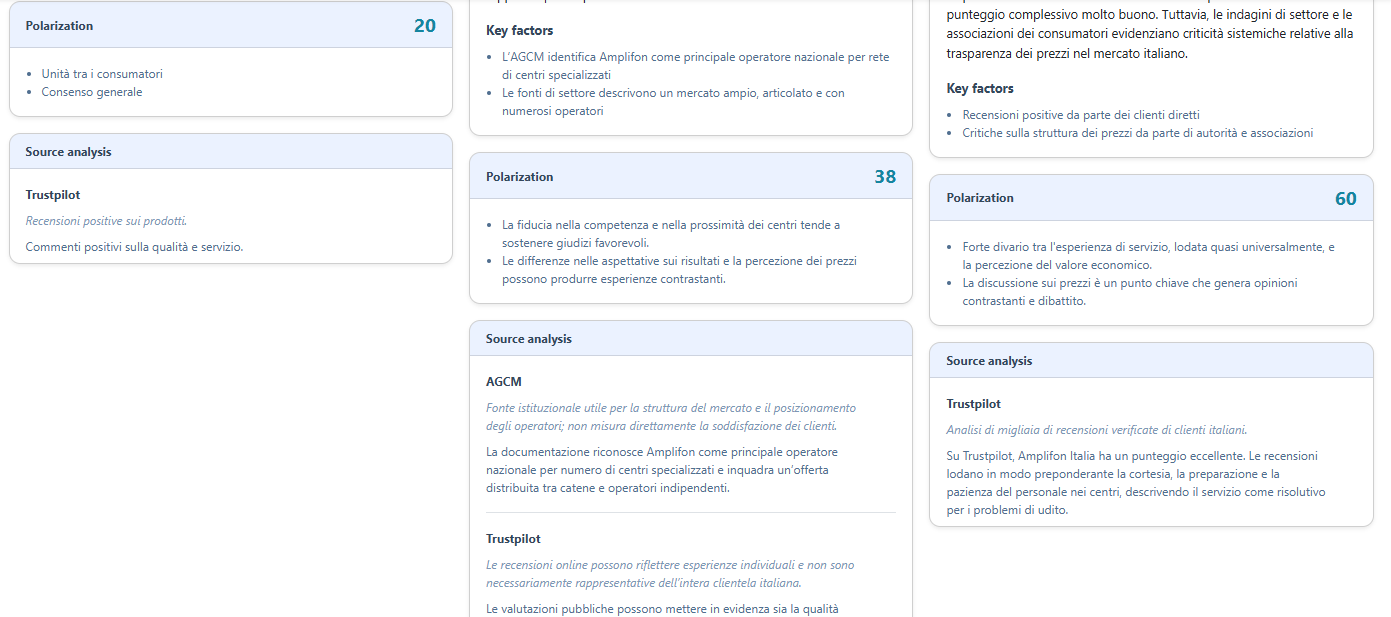
| Opinion polarization (out of 100) | 20 | 38 | 60 |
| What it says about price | Nothing: the sentiment line is generic | “The cost of the solutions, however, can raise concerns” | “Recurring criticism about high prices,” with a reference to the Italian antitrust authority’s investigation |
| Sources listed | Trustpilot | Italian antitrust authority and Trustpilot | Trustpilot |
ChatGPT, the most generous engine, writes the least of all: a one-line sentiment summary and a single source. Gemini talks about a “wide gap between the service experience, praised almost universally, and the perception of economic value,” and measures a polarization score of 60; in the text it references the AGCM investigation, but among the sources it lists only Trustpilot. If you stop at the source list, you won’t see where the price criticism actually comes from.
The growth areas vary a lot in quality. ChatGPT suggests Amplifon expand into new regions, innovate, and “increase brand recognition through marketing campaigns,” advice that a recognition score of 95 already contradicts. Perplexity calls for “a clear, comparable breakdown of price tiers, included services, warranties, and follow-up costs”; Gemini calls for pricing transparency following the AGCM investigation and for the brand to “communicate the value of services included in the price more effectively.” Perplexity’s and Gemini’s points come straight from what the engines wrote about the brand, and those are the ones worth acting on.

For Amplifon, the work starts on the site: content that answers why the price is what it is, covering the items Perplexity lists. Today the pricing page has a “What’s included in the price?” section, with periodic checks, adjustments, maintenance and cleaning, and support; we don’t know if it was there when the March response came in. Off the site, the work concerns third-party sources and reviews that shape the price narrative, because engines build their answers from other sites’ pages too. And since we found the “why” question in AI Mode, inside Google Search, getting the pricing page cited as a source is SEO work too. The same question then goes into AI Prompt Research and the Tracker, to follow which pages the answer uses, scan after scan.
Repubblica and the product flagged in the audit
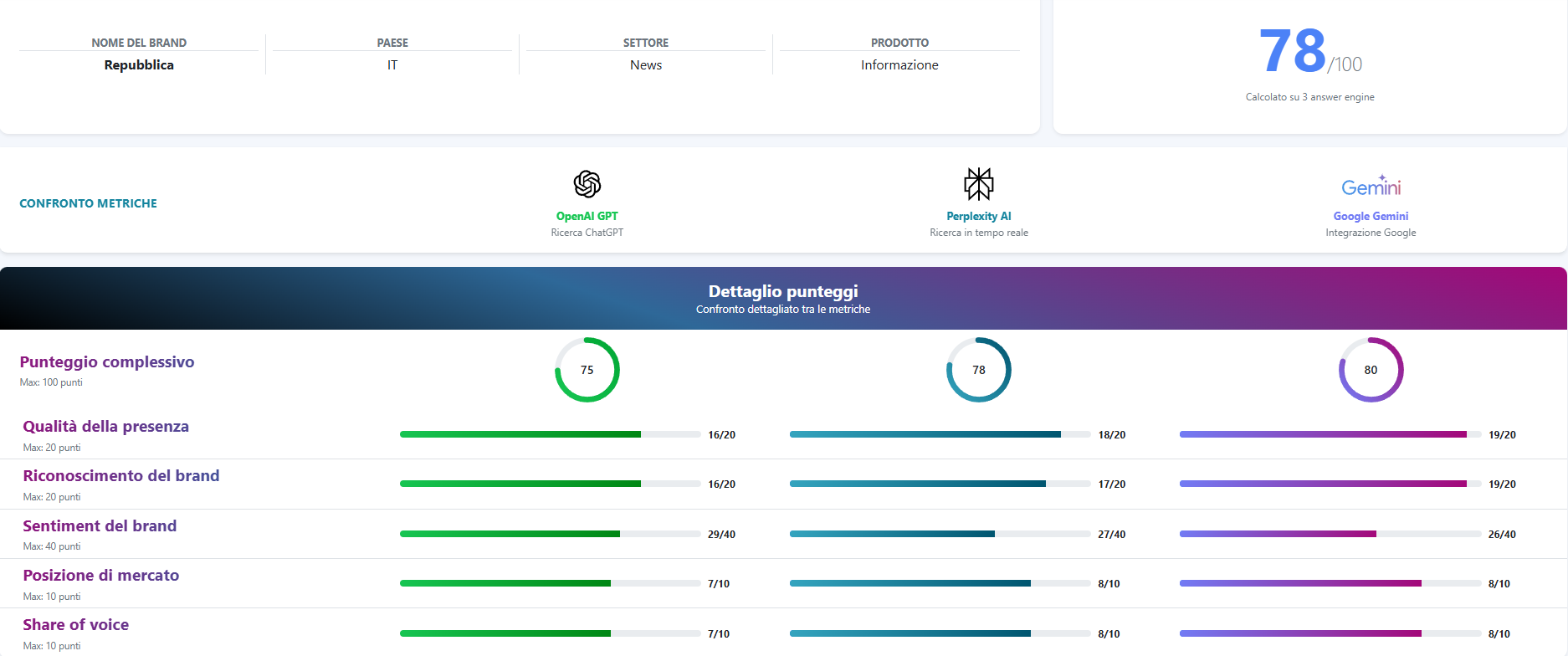
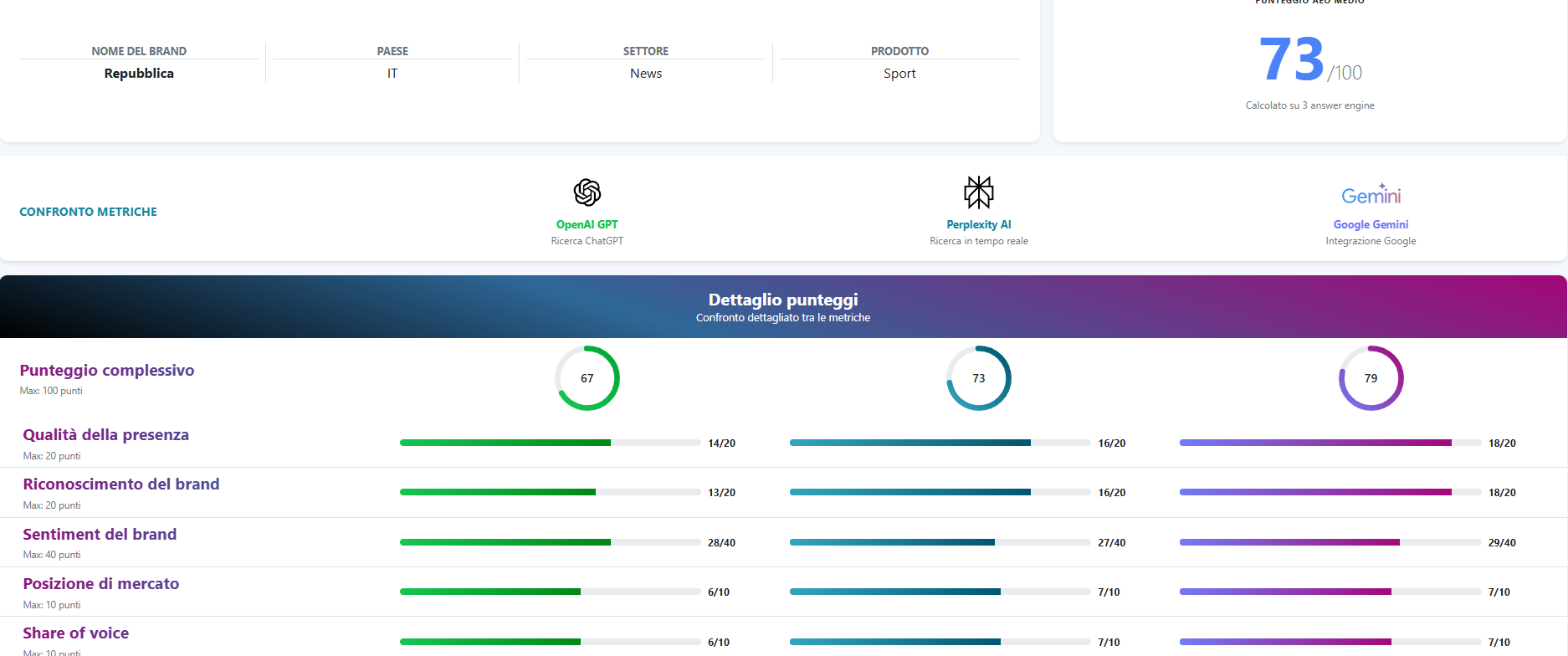
On October 13, 2026 we launched the AEO Audit on Repubblica at 9:40 AM with the “News” product and at 9:41 AM with the “Sports” product, keeping brand, country, and industry identical. With “News” the average is 78, with “Sports” it’s 73, and every engine scores it lower.
| Item | “News” product | “Sports” product |
|---|---|---|
| ChatGPT / Perplexity / Gemini score | 75 / 78 / 80 | 67 / 73 / 79 |
| Average | 78 | 73 |
| Recognition value (out of 100) | 85 / 92 / 92 | 75 / 88 / 75 |
| Quality of presence (out of 20) | 16 / 18 / 19 | 14 / 16 / 18 |
| Market position (out of 10) | 7 / 8 / 8 | 6 / 7 / 7 |
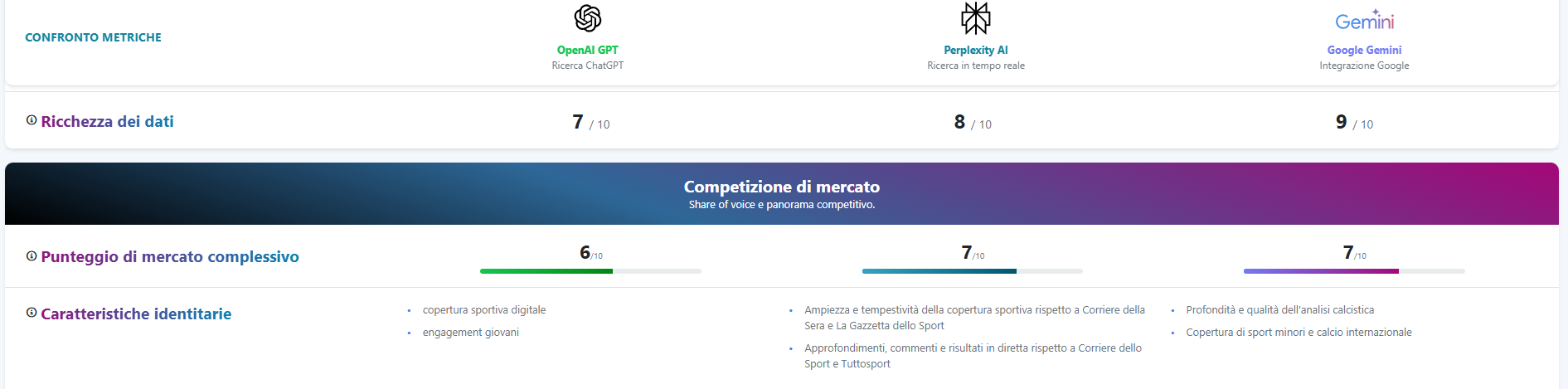
| Identity traits, among others | Journalistic coverage, news reliability, breadth and timeliness of coverage | Digital sports coverage, engagement among younger audiences, comparison with Gazzetta dello Sport, Corriere dello Sport, and Tuttosport |
The steepest drop is in the recognition score, which loses 10 points on ChatGPT and 17 on Gemini, and the identity traits show why. With “Sports,” Perplexity measures Repubblica’s sports coverage against Corriere della Sera and Gazzetta dello Sport, and its in-depth pieces and live results against Corriere dello Sport and Tuttosport: for the engines, the same outlet is a different brand in a different market, where it’s less recognized. If you want to know how you’re seen outside your main market, you change the product on purpose, knowing you’re asking a different question and that the score isn’t comparable to the earlier one.
The audit with the “News” product launched on October 9 had given the same average, 78, with 74 on ChatGPT, 78 on Perplexity, and 83 on Gemini. Between one launch and the next, with identical parameters, individual engines shift by up to 3 points: when you compare an audit to the previous one, a difference of that size isn’t enough to say something changed.
Fruit Village and a low score
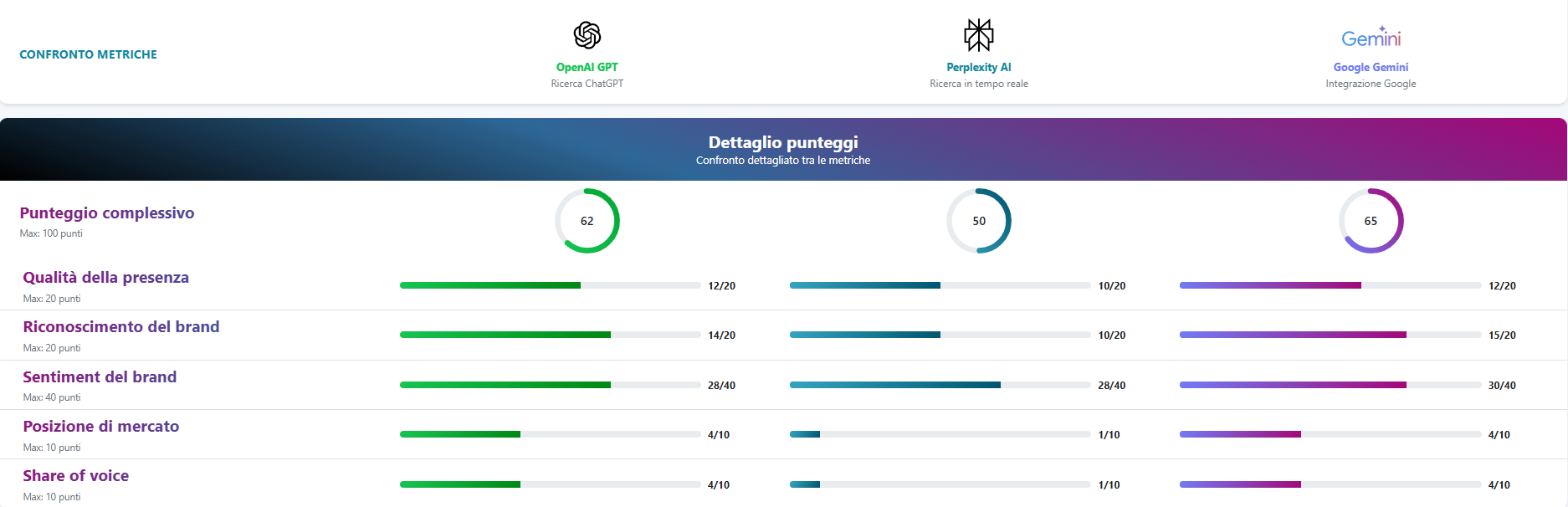
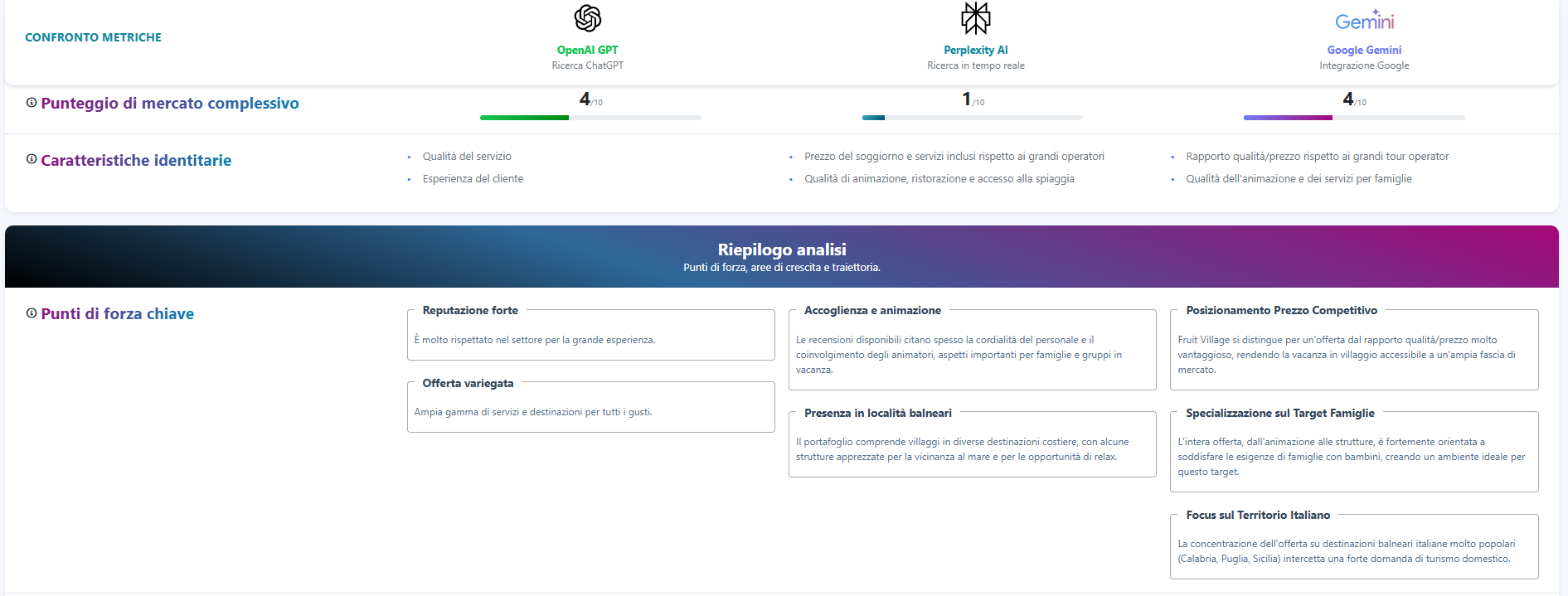
Fruit Village runs seaside resort villages in Italy and abroad. On October 13, 2026, the AEO Audit, launched with the “Travel” industry and the “Beach villages” product, gave an average of 59. A score that low suggests a reputation problem, but the individual items say otherwise. Sentiment holds up across every engine, while points are missing on quality of presence and recognition, and above all on market position and share of voice, where Perplexity gives it 1 point out of 10. To the engines, Fruit Village isn’t a badly judged brand. It’s a brand they barely know.
| Item | ChatGPT | Perplexity | Gemini |
|---|---|---|---|
| Score | 62 | 50 | 65 |
| Quality of presence (out of 20) | 12 | 10 | 12 |
| Recognition (out of 20) | 14 | 10 | 15 |
| Sentiment (out of 40) | 28 | 28 | 30 |
| Market position and share of voice (out of 10 each) | 4 e 4 | 1 e 1 | 4 e 4 |
| Recognition value (out of 100) | 65 | 34 | 55 |
| Market position | Challenger | Niche player | Challenger |
The engines measure Fruit Village against the big operators: among the identity traits are stay pricing and included services “compared to the big operators” and the value for money “compared to the big tour operators.” Perplexity, the engine that recognizes it least, also states what its judgment rests on: roughly 125 reviews on Trustpilot and the individual Tripadvisor pages for each property, ratings that, it writes, are “based on a limited number of reviews and on different properties.”
Among the strengths you’ll find lines that carry different weight. ChatGPT writes “Strong reputation” and “It’s highly respected in the industry for its extensive experience,” lines that could apply to any brand and that the same engine doesn’t back up with anything else, given that it places the brand among the challengers with a recognition score of 65. Gemini writes that the brand “is going through a phase of expansion, acquiring and renovating new properties.” If you know Fruit Village, you know whether that’s true; the tool just reports what the engine wrote, and checking it is on you.
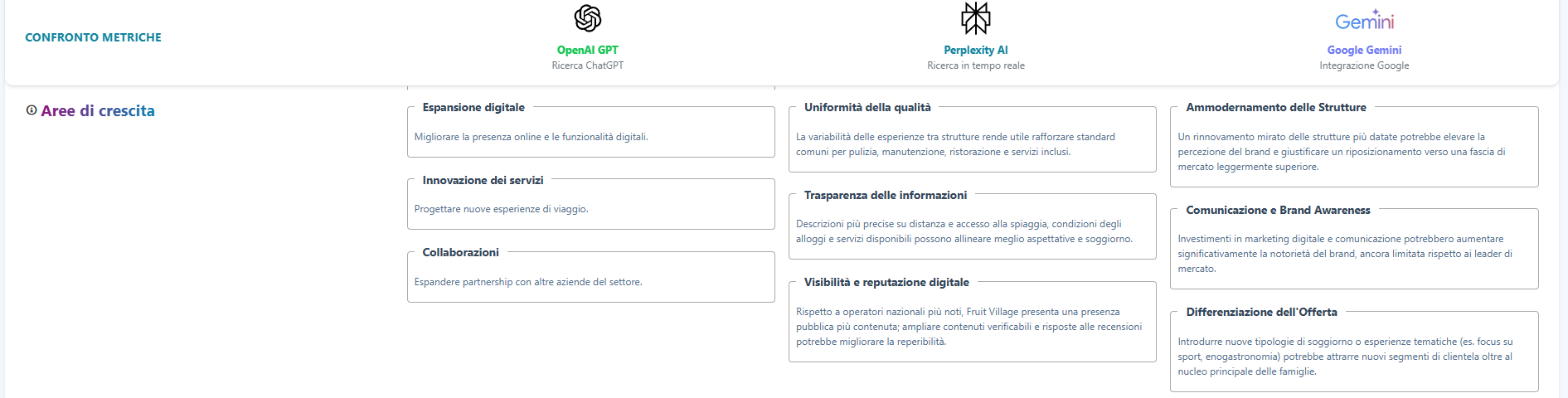
Among the growth areas, ChatGPT’s (“Improve online presence and digital features,” design new travel experiences, expand partnerships) are generic advice. Perplexity asks for common standards across properties and “more precise descriptions of distance and beach access, condition of accommodations, and available services,” along with “verifiable content and responses to reviews”; Gemini asks for modernizing the older properties and diversifying the offering. These last ones are the indications worth keeping, because they come from what the engines actually found about the brand.
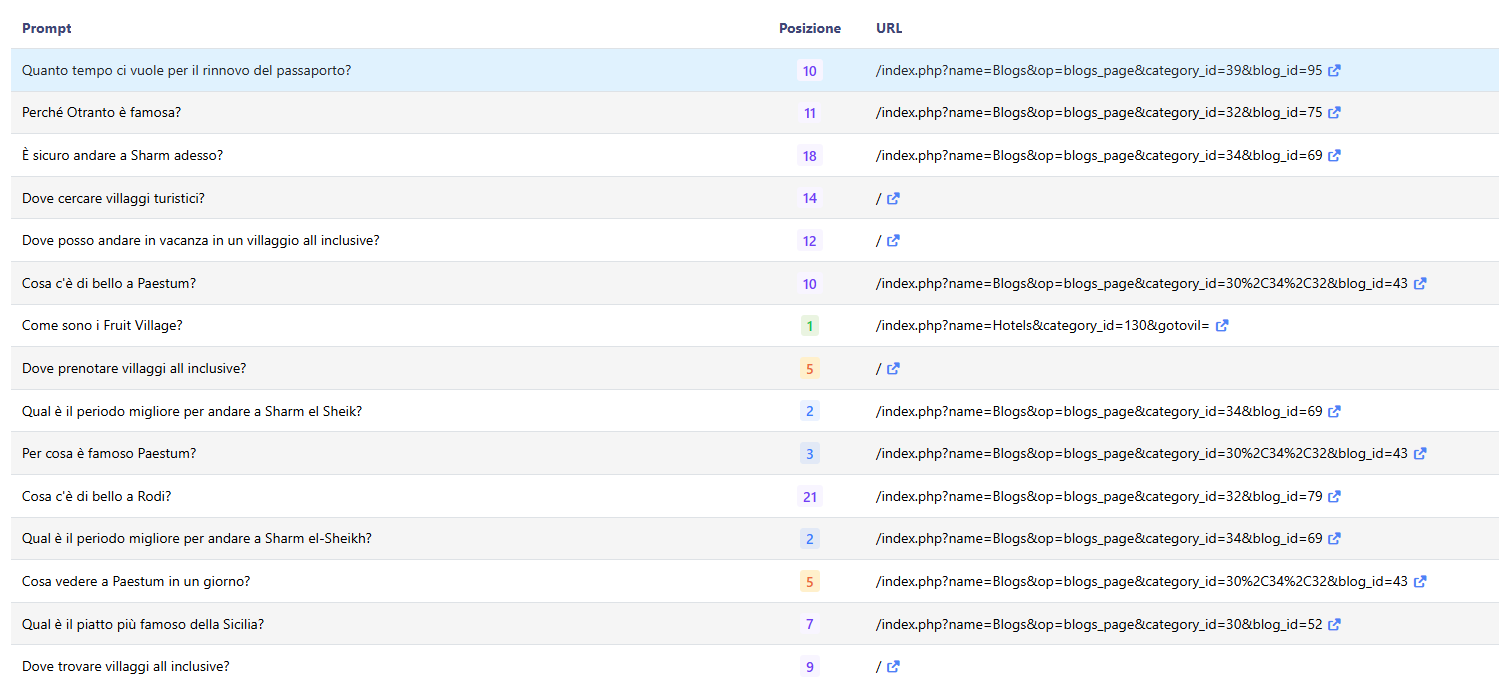
AI Visibility, on October 9, 2026, gave an index of 38, in the medium range, with the site present in 40 prompts and 10 pages. In AI Mode, the answers that cite it are mostly travel questions answered by blog articles: how long it takes to renew a passport, why Otranto is famous, whether it’s safe to go to Sharm, plus Paestum, Rhodes, a Sicilian dish. On questions from its own market, like where to look for resort villages or where to book an all-inclusive village, the homepage shows up among the sources in positions 5 to 14, and only reaches first place when the question names the brand: “What are Fruit Village villages like?”

For Fruit Village, the priority is presence: pages that answer questions about villages and family vacations with the information Perplexity can’t find, property by property, citations on travel portals and outlets, responses to reviews. These are the materials engines need to recognize the brand and compare it to the big operators, before they even judge it.
Before you file away an analysis
When you’re looking at your brand’s analysis, where you start depends on what the top-line scores say. If they’re good, look for the thread running through all of them: a negative keyword inside an OK sentiment score, an identity trait that keeps coming up, a purchase-intent question where the page you know doesn’t show up among the sources. If they’re low, separate what the engines don’t know from what they judge poorly, verify what they claim about the brand, and discard any advice generic enough to apply to any brand. If you’re comparing analyses over time, keep the parameters identical and don’t read much into gaps of a few points.
In any case, by the end pick a customer question where the brand is losing, and add it to the Tracker: that’s where you’ll see, scan after scan, whether the page you built makes it into the answer.


 Verified reviews on Trustpilot