AI Assigned You a Role. Here’s How to Take It Back in Five Moves
You show up in AI answers, but in what role? A 5-step checklist to find out how models describe you and shift that perception
Do you show up in AI? Do you appear in the answers to prompts in your industry? The hard part of the work starts now. Everyone’s afraid of disappearing from generative answers, but if you only measure presence you risk celebrating the wrong number.
You need to go deeper: do you come up as the reference point? As an alternative? As a generic mention? As a tangential source? As an outdated solution compared to where you’re positioned today? Presence tells you that you’re in. Role tells you whether that inclusion is helping you or weakening you, because even a positive mention can still cut you out of the user’s actual decision.
That placement comes from signals you can list, measure, and fix, and for the first time optimization has coordinates instead of hypotheses you can only check after the fact. There are five projects to open, and the order you tackle them in decides how much work it takes to move the answer.
Your role gets stitched together from whatever the web has already written about you
Some of the material the AI uses to describe you comes from your own hands. The rest was written by others, and it’s a live wire. The listing someone filled out on a directory back in 2019, the comparison site that slotted you into a price bracket, the reviews on the marketplace reselling your products, the thread where three strangers answered someone asking for advice in your industry: these are third-party documents that ChatGPT opens and uses with the same weight as your homepage, with the added advantage of looking disinterested to it.
When these versions diverge, the machine has to pick one, and it picks based on availability. The version that wins is the one that’s most widespread, most repeated, easiest to summarize, which is rarely the most recent one and almost never the one you’d have chosen. A company that repositioned itself two years ago and only updated its own site keeps getting described with the language of its old catalog, which survives in two hundred documents outside its control.
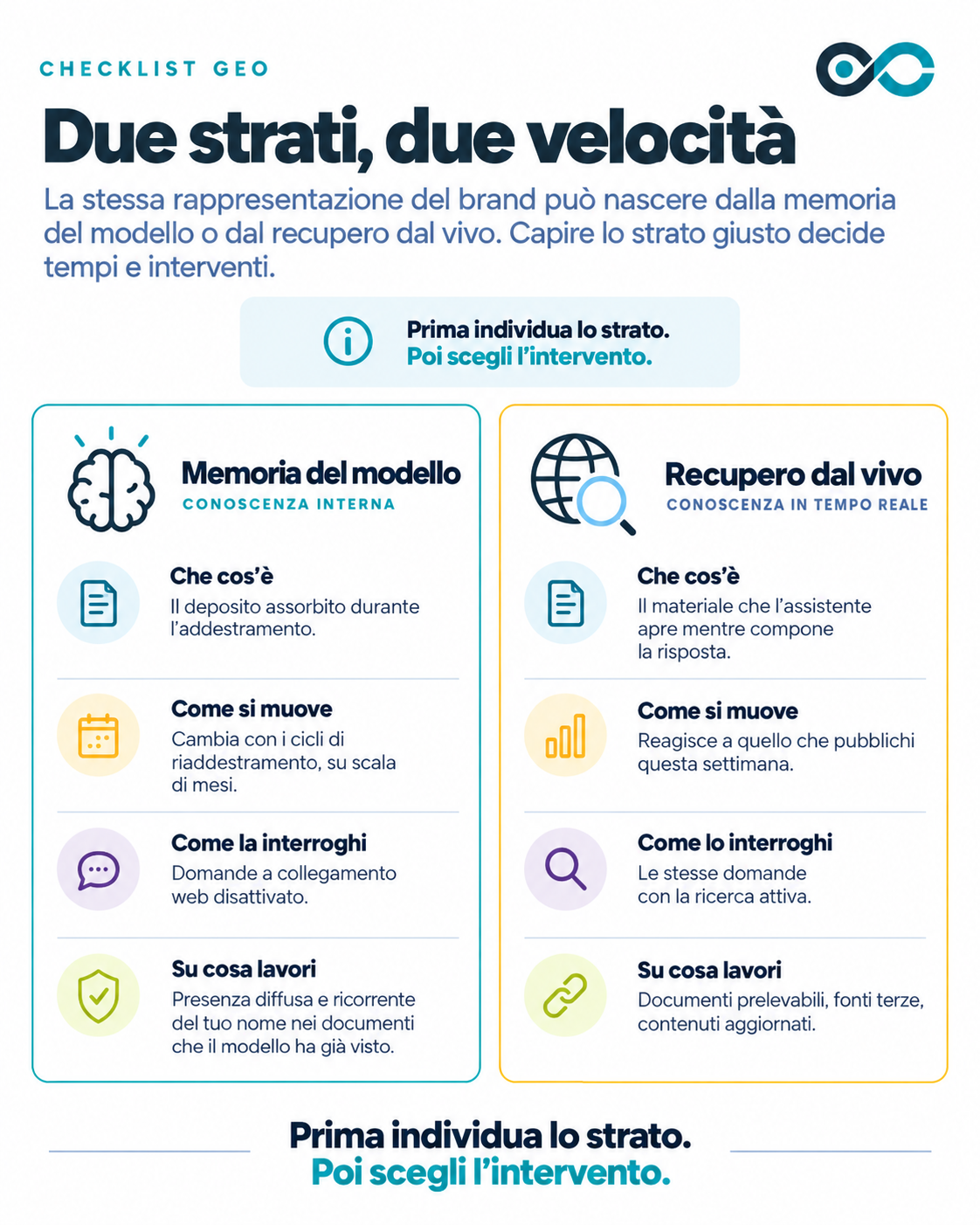
The material doesn’t all move at the same speed though, and ignoring that costs more than any other mistake. The stock of knowledge the model carries from training only changes with later training cycles, so on a scale of months. The material the assistant gathers live, as it opens documents to put together its answer, reacts instead to what you publish this week. Applying the same fix to the wrong layer produces nothing, and you find out once the season’s over, with your editorial budget already spent.
Abroad, people call GEO, in its broad sense, the whole game of how generative systems represent you, and whatever name you give it, the order of operations doesn’t change: first you figure out what role you’ve already been cast in, then you open the project that matches the most dangerous distortion, then you check whether the summary has moved. Starting by rewriting pages is everyone’s instinct, and it’s also the move that burns the most hours.
From guesswork SEO to actual coordinates
Until recently, optimizing for search engines was reverse-engineered work. You change a title, fix the headings, add a couple of internal links, wait three weeks, and look at the SERP to figure out which of the six things you touched made the difference. Then a core update comes out and shuffles the deck. Anyone who’s worked in this field for years recognizes the scene, and anyone starting today should know that was the method, not some aberration: watching the effect and guessing at the cause, with a margin of superstition nobody could ever fully eliminate.
When text becomes a vector, that margin shrinks. The document you publish gets split into chunks, and each chunk gets translated into a set of numerical coordinates that fix its position relative to everything the model already knows. Your paragraph about post-sale support stops being a section of a page and becomes a point, placed next to other points: a problem, a category, a competitor, a use case.
A brand‘s position in that space doesn’t depend on a machine’s judgment of your worth. It depends on signals you can open and read: the terms that keep appearing next to your name in the documents where you show up, the category the sources the assistant actually opens use to describe you, the problems you come up as relevant for often enough to form a pattern, the competitors cited in the same paragraphs where you appear.
You’re no longer chasing an algorithm that won’t explain its moves, and every action starts from a list instead of a guess. The work stays hard and slow, but it stops being blind: you know what you’re moving and which layer it acts on.
The diagnosis: what role has AI already put you in
The practical work starts with detection. Before you rewrite a page or reach out to a publication, you need to know which role the systems have already put you in and which layer that placement came from, because everything else on the checklist depends on it.
Query the same assistants twice with the same words, first with web access off, then with it on. What you get is a report: how the models describe you, which brands they place you alongside, where they pull the material from. The value is in the gap between the two runs, and that gap tells you where to intervene.
Do this before touching anything else, and not out of methodological caution. Without that report you pick your starting point by gut feeling, which tends to lead to rewriting pages, the most expensive line item and rarely the most urgent one. Five minutes here tells you whether you’re about to work on the right layer.
Four questions, no browsing allowed
Turn off web access on ChatGPT or Gemini and ask the questions exactly as written, swapping in the brand name. The description you get back is the residue of years of publications, yours and mostly other people’s, and it tells you what the AI knows about your brand rather than what’s on your site right now. This is what we call GEO. Save every answer in full, not a summary, because the exact wording matters for the comparison.
- “Describe the brand [nome]: archetype, core business, target audience, and perceived reputation.” Vague wording about you reveals past communication that left no trace, and it pushes the problem upstream of your content.
- “List five companies with semantic traits close to [nome], and explain why.” A neighborhood populated by brands you’ve outgrown, or by free tools when you sell a professional platform, tells you the market is dragging you into the wrong district.
- “Is there an established perception of trustworthiness around [nome]? What does it rest on?” Trust built on a single pillar is a fragile base, exposed to the first hostile piece of content that enters the index.
- “What information is missing about [nome], or arrives too fragmented for you to recommend it with confidence?” The answer is already the list of what you should be seeding, written by the system you’re working to influence.
Repeat the whole thing on ChatGPT, Gemini, and Perplexity, since they’ve absorbed different training material, and measure the gap between their descriptions. Date every check, because the generated text shifts from one session to the next and a single screenshot proves nothing. What matters is recurrence: an attribute that shows up across all the runs is something the machine treats as settled fact about you, and that’s the first thing you either confirm or dismantle.
One decision no analysis makes for you: which position you want to occupy. Without a stated goal every diagnosis stays mute, because the data tells you where you stand and says nothing about whether that spot works for you.
The same questions, with web access turned on
Turn web access back on and run the same query without changing a word, then put the two reports side by side. If it describes you poorly in both runs, the problem is in memory, and you’re stuck with the timelines that layer imposes. If it describes you well with access off but then builds its summary around a comparison site and two rivals the moment it goes online, the problem lives in the present, and you fix it with what you publish, which is AEO territory. Skip this comparison and you’ll spend entire seasons reworking content while the assistant keeps filing you under the wrong category.
Showing up is just the first clue: what matters is the role the brand plays inside the summary, because the same mention can put you next to the right competitors or park you on the sidelines, and no counter captures the difference.
- Look at which URLs get opened. The machine often enters through a minor article or a forgotten page instead of the guide you invested in, and if that pattern repeats, the preference is systematic.
- List the third-party domains feeding the text. They’re telling your market’s story for you, and they become the target of your off-site work.
- Write down which brands get mentioned alongside yours. The comparison you’re placed in sets the bar you’re judged against more than anything you’ve published yourself.
- Separate appearing from being recommended. Showing up in a list and getting recommended are two different outcomes, and the reasoning behind a recommendation reveals which attribute you were actually measured on.
- Weigh the tone. A hostile judgment almost always comes from documented material outside your domain, so go chase it there, not on your own pages.
- Rerun the same questions days later. A gap that keeps showing up is a problem; an isolated one is noise, and chasing it burns budget without moving anything.
How SEOZoom helps
This manual work holds up as long as the questions are few: you can manage four prompts, but forty across three assistants turn into an archive nobody reads again, and checks without a date can’t be compared. Inside SEOZoom, the closed-memory query is handled by GEO Audit, which returns industry, mission, values, sentiment, associated topics, buyer personas, and geographic relevance, comparing what the AI has memorized against the real data pulled on the spot. With search turned on, AEO Audit takes over, repeating the check on ChatGPT, Gemini, and Perplexity and delivering the quality of your appearance, brand recognition, tone, the role you’re assigned, and the topics that get you surfaced.
Above the audits sits AI Visibility, which doesn’t diagnose but measures, and it keeps two units separate that you can’t add together: on Google’s AI Overviews you count keywords, with volume, position, and cited URL; on conversational assistants the unit becomes the prompt, and instead of a keyword you get the full query along with the sources it drew on.

Five work areas, and which one to open first
Getting from the report to actual work requires a translation no tool can do for you. The same wrong description can come from your pages, from architecture that makes them hard to pull from, from the company your name ends up keeping, or from material circulating elsewhere, and the fix is completely different in each case. There are five areas of work, each dealing with a different kind of material, and figuring out which one applies to you determines how well everything else pays off.
- Your site. Make explicit what your domain currently leaves implied, so the machine doesn’t have to finish the story somewhere else.
- Crawlability. Remove the technical friction keeping the right documents out of AI summaries.
- Your semantic neighborhood. Change the company your name keeps by seeding content that says what you want attributed to you.
- External validation. Get claims you make on your own site confirmed off it.
- Monitoring. Check whether the role has actually shifted, using a historical series that tells movement apart from noise.
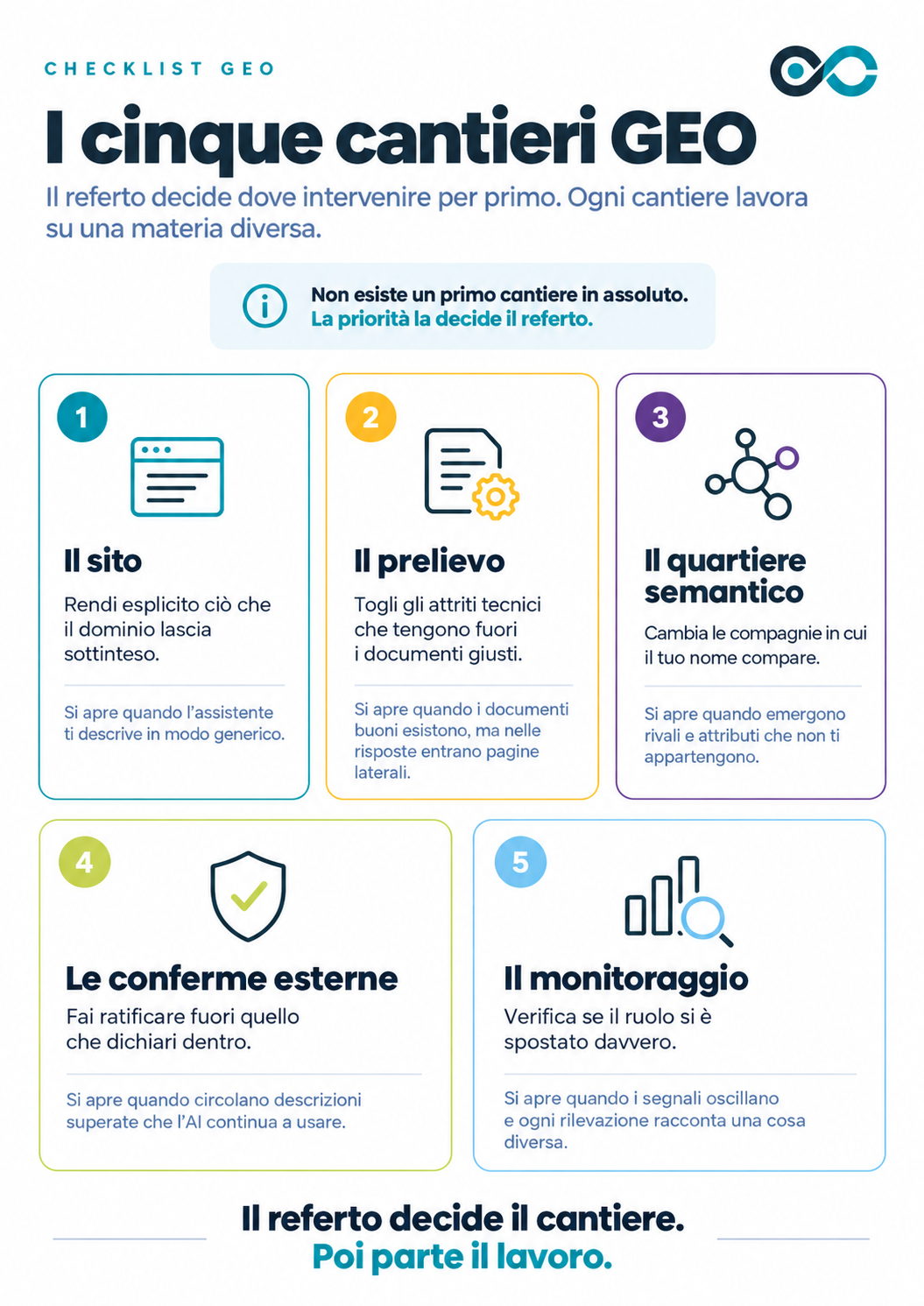
They happen in this order, but the deformation costing you the most dictates priority, and the report already shows you which one that is. If the assistant describes you generically, with no distinguishing attributes, the problem is identity and you open up work on the site. If the right documents exist but never show up in summaries, which instead fill up with minor pages and tangential articles, the problem is discoverability and the fix is technical. If rivals and attributes that aren’t yours show up instead, you work on the semantic neighborhood. If outdated descriptions keep circulating outside your domain and the AI keeps using them, you work on external validation. If the signals swing with no clear direction and every check tells a different story, start with monitoring, because without a historical record every move is a gamble.
Work area 1: make your site explain you
Your domain is the only piece of this game you fully control, and it takes away the machine’s excuse to finish the story somewhere else. Many sites sell well and document poorly: commercial homepages, generic institutional pages, service pages stuffed with promises, few proof points, no comparisons, no answers to the doubts that come before a purchase. A human visitor finds their way regardless; a generative system finds little solid material to pull from.
Your core pages need to answer, in explicit words, the questions the model asks itself to assign you a function, the same questions a customer who’s never seen you would ask.
- What category you operate in, and in which market. If you don’t state it, the category gets assigned by whatever document about you is most widely circulated.
- Who you’re for, with what needs and in what use cases. This is the criterion the machine uses to decide whether to put you forward for a given question.
- Who you are, with what method and what history behind you. A brand with no stated method gets summarized in the words of its industry, not its own.
- Why you deserve credit, with what evidence and what results. Proof is the only part of your story a system can verify elsewhere.
- Under what conditions you’re the right choice, and when you stop being one. Stating a limit gets you into the answers that rule out anyone who doesn’t state any.
A brand that leaves these points implicit opens itself up to oversimplification, and someone else will be the one simplifying it. Stating a difference does little good until it takes shape in sections, examples, numbers, comparisons, and evidence. For the assistant, these are building blocks: it can retrieve them, isolate them, and carry them into the summary without having to reconstruct them, while anything that arrives as a claim evaporates in the first summary.
Checks to make the site say who you are
You work on the pages that describe identity, offer, and proof, not on the entire domain. Start with the main hubs and finish with the shape of individual blocks, because the machine pulls out portions, and a site that’s flawless in its overall structure can still be unusable at the detail level.
- Rebuild home, about, products, and services as one system. They need to state scope, audience, and conditions of use instead of repeating adjectives.
- Put category, audience, use cases, and service level in writing. Leaving them implied means letting someone else define them from the outside.
- Publish definitional content. What it is, who it’s for, when it makes sense, how it works: a document that answers one question gets pulled more readily than a guide trying to cover all of them.
- Build real comparisons. Differences between plans, segments, and alternatives are the raw material of any answer that has to explain why someone should pick you.
- Bring proof onto the site. Documented cases, numbers, methodology, supply chain, processes, and certifications back up what sales pages merely claim, and they’re the material EEAT rests on when a system has to decide whether to trust you.
- Add decision-driving questions. They need to resolve real objections and doubts, not fill space with questions made up for the sake of it.
- Pull expired claims. A discontinued service still online remains recoverable material, and the machine treats it as current.
- Turn promises into thresholds. Timeframes, quantities, limits, and conditions survive compression, while words like “complete” and “custom” vanish in the first summary.
- Write blocks that stand on their own. Every section has to hold up out of context, with an explicit subject and the figure attached to the claim it supports.
How SEOZoom helps
Doing this by hand is the most time-consuming part, since you have to question each page individually without knowing in advance which questions matter. Question Explorer surfaces the questions your audience asks about the topic, and that’s where definitional content and decision-stage sections come from. The Content Gap tab compares your domain against others covering the same topic and isolates the subjects you don’t have a page for, while its extension, Content Gap AI Overview, narrows the comparison down to the keywords that actually trigger a generative response. Opportunity Finder ranks what’s left by value, so the backlog doesn’t turn into an endless editorial plan.
On a single draft, the Editorial Assistant works as you write, comparing your text against content already ranking on the topic and flagging subjects you haven’t covered. AI Engine steps in a moment later, before the page goes live, and gives it a relevance score for generative engines, measured against content competing for the same need.
Work area 2: close the gap between what you publish and what the machine pulls
A perfect document that nobody can open is worth exactly as much as one you never wrote. That’s the paradox facing anyone who underestimates technical SEO: you can have the best case study in your industry and still see it left out of every summary because the URL is poorly indexed, the headings don’t say anything, the architecture keeps it isolated, or the content loads through scripts that agents don’t execute.
Selection happens well before reading, at the title and preview stage, and title and description move out of the finishing department and back into deciding whether you get opened at all. Apply the check to a narrow set rather than the entire domain: the URLs that cover identity, offer, method, evidence, and use cases are what matter when the assistant goes looking for material about your market, and the rest can wait.
Checks that reduce friction in content retrieval
A document gets left out of summaries for reasons that call for opposite fixes. Either the crawler can’t reach it, in which case the problem is access: inconsistent canonicals, forgotten directives, link depth. Or it reaches it but finds nothing worth pulling, in which case the problem is form: silent headings, content loaded via scripts, tables that only make sense within the page itself.
- Check indexing and preview eligibility. Inconsistent canonicals, exclusions forgotten in the configuration file, and documents that take three clicks to reach via internal links drop out before any evaluation even starts.
- Review the directives that limit previews. A nosnippet tag added years ago to keep pricing out of the SERP now blocks that page from the material generative features can draw on.
- Resolve duplication and overlap. When two documents serve the same purpose, the machine picks between them for you.
- Use headings as sorting labels. A heading that states what the block covers guides extraction better than a catchy phrase.
- Move what lives behind a click into the source code. Prices, specs, and details loaded via script exist for people and disappear for some crawlers.
- Make your internal links say something. They should explain the relationship between two documents, not just show up.
- Mark entities with structured data. Organization, Person, Product, sameAs, and knowsAbout narrow the room a model has to make things up, right where a wrong guess costs the most.
- Make tables and summaries self-sufficient. They need to work as standalone units, readable even away from the document that hosts them.
How SEOZoom helps
This is the area where manual checks hold up least, because the friction points are scattered across hundreds of URLs and nobody notices them until they go looking. SEO Spider crawls the site the way a search engine would and returns a precise list of issues: unintentional exclusions, forgotten directives, canonical chains, silent headings, documents reachable only after three clicks. SEO Audit tracks the same picture over time and flags when a fix gets undone. Run these checks again after every major editorial push, because a new document published within a messy architecture inherits that mess.
Phase 3: move the brand into the right neighborhood
The AI always reads you in company. It places you next to categories, brands, attributes, technologies, problems, and price ranges, and some of that proximity opens doors for you while other instances drag the comparison down. Semantic seeding is the work of spreading content across the web that says what you want attributed to you, and the image works because scattered bits of information only bloom into the summary when they agree with each other.
Before you start seeding, there’s a decision no platform can make for you. The rivals you have in mind don’t match the ones that come out of competitor analysis, and neither list matches the brands the assistant places next to you. Sorting out who actually competes with you, who the machine pairs you with, and who you’d want to be near to level up is the step that makes everything else make sense. Keep them mixed up and you’re being judged by someone else’s criteria.
Showing up often next to “cheap,” “basic,” “local” installs those words in your description. Getting found next to “method,” “scalability,” “proprietary data,” “specialization” shifts the neighborhood, slowly, through accumulation: the semantic distance between your name and a concept only shortens through consistent repetition.
Checks for semantic seeding
As long as your description changes wording from one channel to the next, no seeding takes hold. So put order in what you say first, and widen the scope to other topics and channels only afterward.
- Write your positioning once and use it identically everywhere. Category, segment, market, service tier, audience, and use cases can’t change wording across your site, social media, and press materials.
- Study the vocabulary of whoever already owns the space you want. Every brand that communicates leaves a footprint of recurring terms, technical language, and ways of describing the market, and reconstructing it means understanding which signals put it there.
- Cut back on the words that drag you down. Attributes that don’t serve you need to shrink on your own pages first, because as long as you keep repeating them, no one else will stop either.
- Give your data certainty. Key-value pairs, tables, price lists, and spec sheets make classifiable what prose leaves open to interpretation, and valid markup beats a vague description.
- Build self-contained blocks. A passage a reader can understand even out of context works the same way for a machine, while chopping everything into micro-paragraphs backfires.
- Cover the adjacent questions in your space. Owning a single head term puts you in competition on one branch, while pricing, limits, comparisons, timelines, and use cases get you listed across different sets.
- Keep your terminology fixed. With technical terms, an elegant synonym just creates ambiguity, so call the same thing by the same name every time.
- Repeat the same information across every channel. News that goes out on your site but never reaches social media, webinars, and press outlets leaves an outdated version out there, ready to be picked up again.
How SEOZoom helps
You can’t eyeball vertical presence, and topical authority doesn’t show up in a single ranking position. Topical Zoom Authority weighs the strength of a domain within a single sector rather than across the whole web, and you read it in the sector analysis alongside your ranking position and the keywords that put you there. It’s the number that tells you whether seeding is building mass where you need it.
AI Prompt Research looks at demand instead. It breaks a query down into the areas it triggers (informational, evaluation and comparison, trust, transactional, follow-up) and hands you a map of the topics you should cover but don’t, which is the seeding agenda. The signal you’re waiting for lies elsewhere, though, in the brands mentioned alongside yours, which at some point start to change.
Phase 4: get outside sources to confirm what you say about yourself
No system trusts your own self-presentation alone, for the same reason none of us stops at the first opinion we hear. It looks for corroboration in reviews, articles, comparison sites, lists, profiles, bylined pieces, discussions, videos, and podcasts, and uses that material with the same weight it gives your own domain. Outside opinion carries more weight than what you claim about yourself, and ignoring it leaves the narrative to people with different interests from yours.
Digital PR changes target, then. A ranking of sites sorted by authority scores describes generic reputation, while the domains that keep showing up in your category’s summaries reflect a choice that’s already been made, tied to a specific need and the context it arises in. You build that list by starting from the questions you want to be visible for and looking at which documents the assistant opens to answer them, and it almost never matches your commercial rivals: vertical publications, institutions, trade magazines, communities, video channels, professionals’ blogs.
Even the piece that hosts you needs to be built a specific way. The space around your name needs to be populated with the concepts you care about, because the model reads the text surrounding the mention and infers from it which family you belong to. Anchor text loses relative weight, co-occurrences gain it.
Checks for your reputation outside your own site
Which questions you start from to build the contact list matters more than any authority score, and it’s the choice everything else depends on. The listings you already control and the material nobody else can reproduce in your place, you fix without asking anyone’s permission, and they cost you far less.
- Build your outreach list starting from the questions. Identify the requests that affect revenue, see which documents feed those summaries, and start there.
- Push for mentions with context. A standalone citation transfers little, while a name surrounded by topic, category, and recognizable attributes shifts where you get placed.
- Update whoever describes you badly. If a page tells an outdated version of your story, fix it by contacting whoever published it; that’s pruning applied outside your own site.
- Go back and fix the listings you control. Directories, marketplaces, company profiles, and category portals hold descriptions nobody has reread in years, and the assistant keeps using them anyway.
- Produce material nobody else can repeat on your behalf. Figures you’ve collected yourself, named methods, research, and documented case studies carry the signature of whoever produced them, while an anonymous number travels perfectly well on its own.
- Cite the sources that matter, in turn. Naming recognized institutions, studies, and references puts you closer to them on the same map where the machine is placing you, and this part doesn’t require negotiating with anyone.
- Make video and podcast content retrievable. Spoken content gets transcribed and indexed, but as long as it stays a file inside a platform, with no structured text version, that content never becomes a citable document.
- Stay active where opinions take shape. Reddit, niche forums, and review sites generate the material the system pulls together when it has to recommend a name.
How SEOZoom helps
You can build the contact list by hand, opening one answer after another and noting the sources, assuming the assistant discloses them. AI Prompt Tracker tracks a portfolio of queries over time and records, for each one, the documents that built the answer. The sources that keep recurring in your sector tell you who’s writing the story of your market; the ones feeding the same summaries without you are already an outreach plan, ranked by priority.
Zoom Authority comes in afterward, once the list exists and you need to set a contact priority: between two domains feeding the same summaries, you reach out to the stronger one first.
Phase 5: check whether your role has actually shifted
The fifth workstream produces measurements rather than content, and the measurement that matters isn’t how many times you show up. A brand can be mentioned twice as often and still be the third option on every list. What matters is the quality of the position: whether you’re put forward as the reference or as a generic name tacked on at the end, next to whom, with what attributes, and drawing on which of your documents.
A single summary proves nothing, since it varies by assistant, phrasing, and moment. What matters is the pattern that keeps recurring, and spotting it requires a historical series.
Checks that show whether your role has shifted
Getting the unit of observation wrong, or mixing different baskets together, produces numbers that move without telling you anything, and a report that’s moving is more dangerous than one that’s still, because it convinces you that you’ve achieved something.
- Track intents, not strings. Wildly different phrasings lead to the same need, and the unit to watch is the problem that affects revenue.
- Keep your baskets separate. Mixing informational questions with purchase requests changes the denominator and skews every percentage.
- Separate citation, mention, and recommendation. Feeding a summary without appearing in the text and getting recommended outright are different outcomes, built on different work.
- Check whether new documents actually get opened. Content published to get into a response but never retrieved points to an accessibility problem, not a writing problem.
- Check whether the summary keeps your distinctive traits. Delete your name from the sentence that describes you and read it again: if it describes a competitor just as well, the differentiation hasn’t landed.
- Compare the company you keep over time. A change in neighborhood is the strongest proof that your positioning is shifting.
- Repeat the audits after you’ve made changes. A memory that keeps describing you poorly and a live presence that falters call for different fixes, and only by placing the two pieces of evidence side by side can you tell which one you actually worked on.
How SEOZoom helps
This is where manual work breaks down first, because keeping forty questions across four assistants in a spreadsheet, with the documents opened and the brands lined up side by side, turns into a second job. Inside AI Prompt Tracker you can see separately how often the domain gets used as a source, how often the brand appears in the text, and how often it gets recommended. Next to that you’ll find the tone, the competitive role you’re assigned, and fan-out coverage, which shows how much of the informational territory opened up by each question you already cover.
The AI Overview function now works alongside Google’s SERP, adding measures that classic rankings never had. AI Rank scores where in the box a mention falls, with a value of one marking the first source listed. The AI Overview Gap tab lists the keywords where competitors get recognized in generative answers while you’re left out, and that’s where the work starts over.

The mistakes that burn the most time
A whole set of shortcuts has grown up around this work, sounding like rules even though they don’t come from how these systems actually operate. They all cost the same thing: time spent on the wrong level while the real problem stays exactly where it was.
Opening the editorial calendar as your first move is the most common reaction, and the most expensive one. If a brand doesn’t show up in a summary, the automatic response is to commission articles, the highest-cost option aimed at the least defined target. Before you write a single line, you need to know whether your page never made the source list, whether another page took its place, or whether your page was there and the key sentence got lost in compression. The fix changes case by case, and writing only covers one of them.
Managing memory with today’s tools is the variant that eats up the most calendar time. Skip the logged-out test and you’ll blame your site for a problem that lives elsewhere, publishing for twelve months while the model keeps filing you under the wrong category. Five minutes of checking saves you a quarter spent moving in the wrong direction.
Chopping up content to please the machine comes from a rushed reading of how block-based retrieval works. Since the system pulls out chunks, people got in the habit of reducing everything to two-line paragraphs and strings of questions, which backfires: the model loses the cues it needs to reconstruct the meaning of what it’s pulling. The self-sufficiency you need is about meaning, not length, and you get it by spelling out implied subjects and keeping the figure close to the claim it supports.
Buying technical shortcuts feeds a market built on promises: markup reserved for AI, files meant for machines, formats that supposedly guarantee a fast lane. Google’s generative features rely on the search index and its usual conditions, so that time gets taken away from content depth, which is what actually produces measurable effects.
Closing the books by counting mentions brings back the exact mistake this work started from. A brand can double its appearances and still be the third option on every list, and a report that only measures presence logs that as a win.
The work, in order
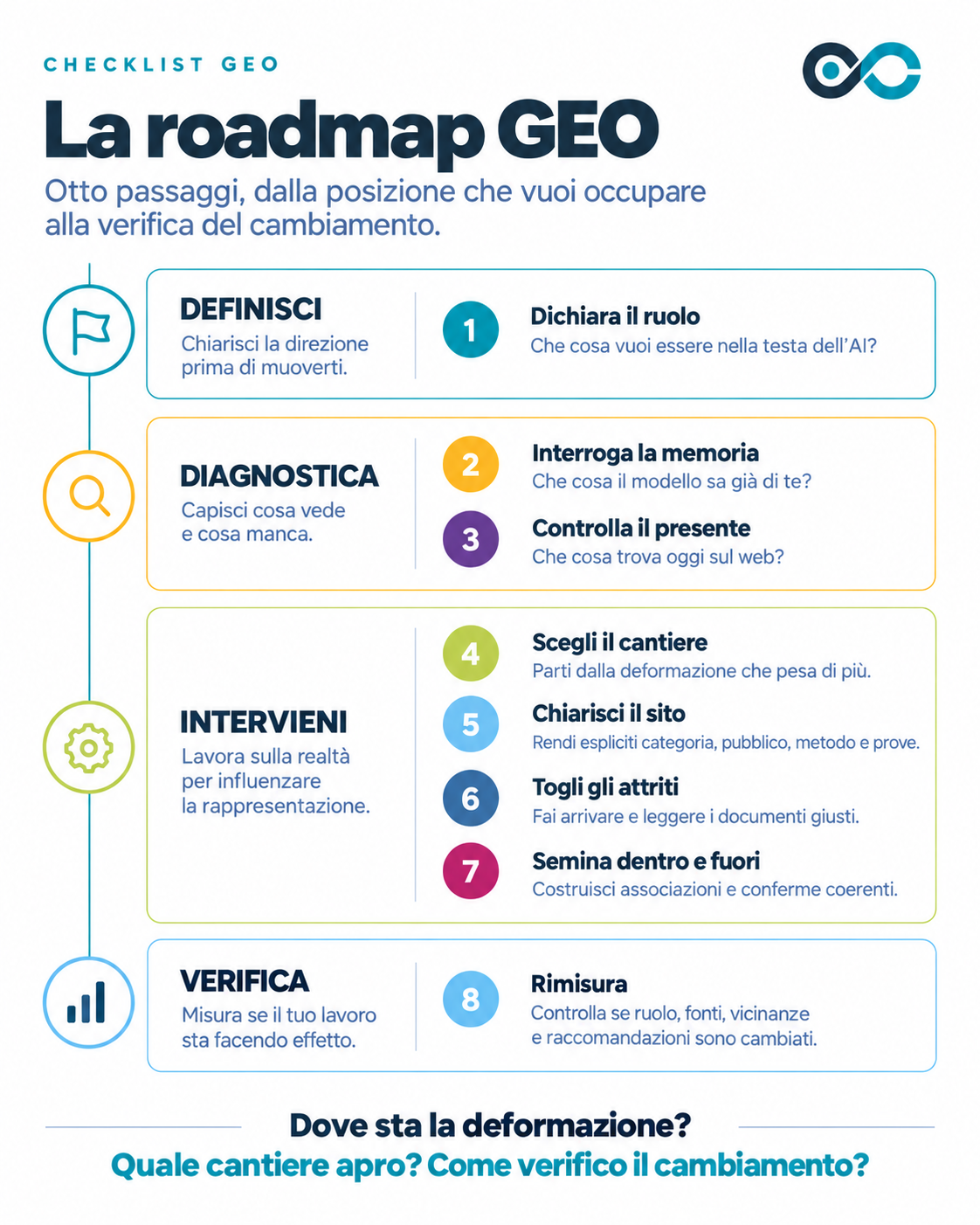
Diagnosis and fixes run in this order, and each step ends with a decision made, not a file saved. Until that decision happens, the next step doesn’t start.
- Declare the role you want to occupy. Category reference, vertical specialist, premium alternative, affordable solution: without an explicit goal, every diagnosis stays a snapshot with no verdict.
- Interrogate the memory. Closed-ended questions, repeated across multiple assistants and dated, tell you what the model carries about you.
- Check the present. The same questions with active search enabled show whether the problem lives in memory or in the material you’re publishing today.
- Pick the project to tackle. The distortion that weighs the most decides where you start, and rewriting is never the first move.
- Make your site the clearest source about you. Category, audience, method, proof, terms of use made explicit, with differentiators turned into measurable thresholds.
- Remove technical friction on the small set of URLs that tell your brand’s story, before touching the whole domain.
- Seed it outside and inside. Stable terminology, chosen associations, contextualized mentions in the sources the AI actually opens.
- Remeasure once the picture has changed. Run the same audits again after some time and you can tell a real shift from a temporary blip.
Nothing in this sequence requires a platform. You can query one assistant after another, archive the texts, chase down the cited sources by hand, build a spreadsheet of the brands showing up next to yours, and end up with a snapshot that changes shape every session. The cost grows worse than proportionally: four questions across three assistants, you can manage on your own; ten times that, with documents, URLs, and competitors to track, becomes a full-time job, and the editorial calendar stalls right there.
Inside SEOZoom these same steps live in one project and the cycle closes on its own, with a history that tells a real shift from a blip. The web feeding these summaries changes while you’re working, so nothing stays fixed forever, but with the cycle running you catch it as it happens instead of after the fact, once your market has already told its story without you in it.


 Verified reviews on Trustpilot