Read the new map of AI visibility
Visibility is now also measured inside AI responses: how to read presence, citations and competitors of your brand with AI Visibility.
For years, visibility was read with a relatively stable grammar: keyword, ranking, URL, traffic, competitors. The new search landscape has made the picture more fluid, because the domain now spreads across environments that follow different logics and produce different forms of presence. A page can appear in Google’s AI Overview for certain keywords, find space in a conversational engine for certain prompts, remain visible in one environment and lose weight in another. Around it, within the same response space, editors, vertical sites, forums, videos and social platforms move, capturing attention on the same questions.
This is precisely where the difficulty lies. An isolated citation says little about the site’s real weight, and what’s needed instead is to reconstruct the structure that makes it possible: where the site appears, with which URLs, in which engines, for which queries or prompts and within which competitive field. Before even getting to the data, you need a framework that makes this fragmentation legible.
AI Visibility was built to organise this complexity: it gathers your domain’s presence across AI responses into a single dashboard, helping you truly understand your site’s real weight within the generative space.
Presence in AI is not a single data point
Google remains a decisive part of Search, but its AI presence takes shape within an environment still rooted in the SERP. Alongside this layer, conversational engines open up a different space, built on complete questions phrased in natural language and treated as requests to be developed and resolved.
Your visibility therefore moves across two adjacent but non-overlapping planes: in one you work with keywords and AI summaries; in the other you enter generated responses shaped around prompts, sources and pages drawn on by the engine.
This also changes how you should observe performance. A keyword triggers one kind of analysis. A prompt triggers another. In the first case, what matters is volume, mentions, position and continuity within an environment still close to classic search. In the second, what matters is the complete question, the page that makes it into the response, the position it occupies and the system of sources that accompanies the engine in building the output. Two different environments thus produce two different types of presence. Reading them with the same criteria weakens the diagnosis and flattens the distinctions that matter most today.
The competitive context also changes shape. You share the response space with sites from your own sector, but also with editors, official documentation, forums, videos and social platforms that cover the same questions in different ways: YouTube can capture attention for tutorials, Reddit for discussions, Quora for structured answers, LinkedIn for more professional topics. The comparison also extends to attention competitors, not just those closest to you by market or business model, and this makes reading presence more complex, because you’re being compared against sources that capture trust and usefulness in different forms.
The fragmentation of tracking between hybrid queries and conversational prompts
The real weight of your brand emerges when environments, keywords, prompts, pages, sources and competitors all enter the same reading framework. Presence in AI thus resembles a distributed structure, not a single figure to be read at the surface.
The most useful distinction to focus on concerns the starting point of the response. Within Google, you stay close to a keyword-based logic: a query triggers the SERP, the SERP can trigger an AI summary, and from there you can read mentions, position, visibility and continuity of presence. In conversational engines, the question instead takes a broader form. The language is natural, the need is already fully developed, and the answer is built by combining multiple sources.

This is why the domain shouldn’t be observed through a single lens. A keyword tells one kind of story about presence. A prompt tells another. In the first case, what matters is volume, mentions, position and staying power within an environment still tied to classic search. In the second, what matters is the complete question, the page that makes it into the response, the place it occupies and the sources that accompany the engine in building the output.
When the two planes end up read as one, the diagnosis flattens out. When they’re kept distinct, the picture changes immediately: you understand where the site gains space, in what form it manages to do so, and which URLs genuinely sustain its visibility across the different AI environments.
AI Visibility measures where your domain appears in AI responses
Analysing online presence therefore requires surgical mapping of brand mentions on both fronts, tracking occurrences across both hybrid search queries and extended text prompts.
AI Visibility was built to hold these levels together without blurring them. It gathers the domain’s presence across AI responses and AI Overviews and organises it into a dashboard that links prompts, keywords, engines, cited pages, sources, competitors and performance over time.
The advantage isn’t simply counting occurrences. An isolated mention says little, especially when the domain moves across environments that follow different logics and produce different forms of presence. What you need is a reading that brings the signals back together and makes them speak to one another.
This is exactly what the report does. It shows you where the site appears, which URLs are gaining ground, which engines it performs best in, and how its presence is distributed across the competitive field. The domain stops looking like a flat, abstract number. It starts taking shape through pages, questions and sources that make it genuinely visible.
The value of the tool lies entirely in this reassembly. It doesn’t just add up screenshots, doesn’t pair up disconnected data, and doesn’t leave you alone in front of a series of scattered mentions. It restores order to a fragmented presence and gives you a more precise reading of the domain’s real weight within the generative space.
A single dashboard to organise the fragmentation
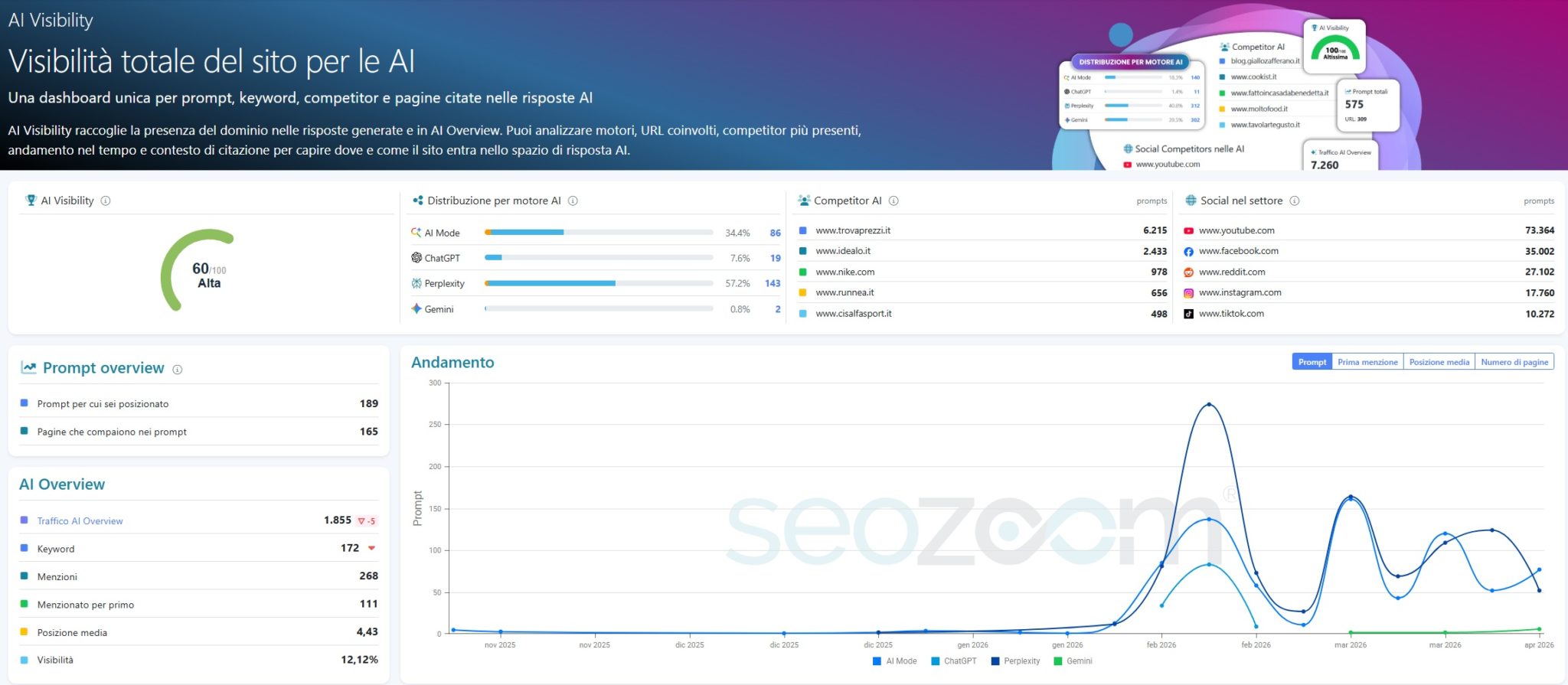
The initial screen of AI Visibility immediately gives you a synthetic but very dense view. At the top you’ll find the index of AI Visibility, the total number of unique prompts in which the domain appears, the breakdown by AI engine, the competitors most present in the same response space, and the social platforms that recur most often in the prompts for the analysed sector.
The chart brings together AI Mode, ChatGPT, Perplexity and Gemini and lets you follow how the domain’s presence is distributed across the various engines. Read it well, and it will show you whether the site maintains consistency, concentrates its weight in just a few environments, or changes profile depending on the platform.
The Total Prompts figure indicates how many unique questions activate the site across the analysed engines: read it carefully, because it excludes duplicate prompts detected across multiple environments. The total, therefore, doesn’t match the simple sum of prompts distributed among the individual engines. It’s a useful figure precisely because it brings the domain back to a cleaner, less redundant base.
Alongside this reading comes the block dedicated to AI Overview, with specific metrics on keywords, mentions, average position and visibility, together with the trend chart that helps you follow how presence evolves over time. The AI Competitors box adds further context: here you’ll find the domains that recur most often in the sector prompts of the analysed site and that occupy the same competitive space in AI responses. Alongside it, you widen the field further with the focus on social platforms: YouTube, Reddit, TikTok, Quora, LinkedIn and other environments can emerge consistently within the same universe of questions. The result is a reading much closer to the reality of the generative response, where competition doesn’t stop at the sites in your market alone.
The strength of the tool lies in how it brings these levels together without blurring them. The domain is observed as a presence distributed across different environments, each with its own logic. On one side there’s the overall dashboard level, which helps you understand the site’s general weight within AI. On the other, there are the detailed analyses, which let you drill down into individual engines and individual queries with much more operational granularity.
Knowing how to read the distribution of presence
The crucial point to grasp is the difference between AI Overview and the other analysis environments. Google’s AI Overview is read through a predominantly keyword-based logic: in the dedicated view you work with keywords, volumes, mentions, first mention, position and URLs associated with the domain’s presence in Google’s AI summaries.
AI Mode, ChatGPT, Perplexity and Gemini instead follow a different logic, fully prompt-based. In these sections the starting point isn’t the keyword, but the question phrased in natural language. The output changes accordingly: at the centre you’ll find prompts, position and the URLs involved, while in the side panel you can read a preview of the AI response and the list of sources used to build it. It’s a substantial difference, because it also shifts the kind of work you do with the data.
In the AI Overview view you observe the domain’s presence in an environment that still engages with keywords, volumes and classic search signals. In the prompt-based views, however, you enter the heart of the generative response: you read how a question is handled by the AI engines, which page of your site appears, in what position, and alongside which sources. AI Visibility holds these two levels together, but keeps them distinct. The strength of the dashboard lies in this distinction. It lets you read the domain’s presence without flattening data that comes from different environments.
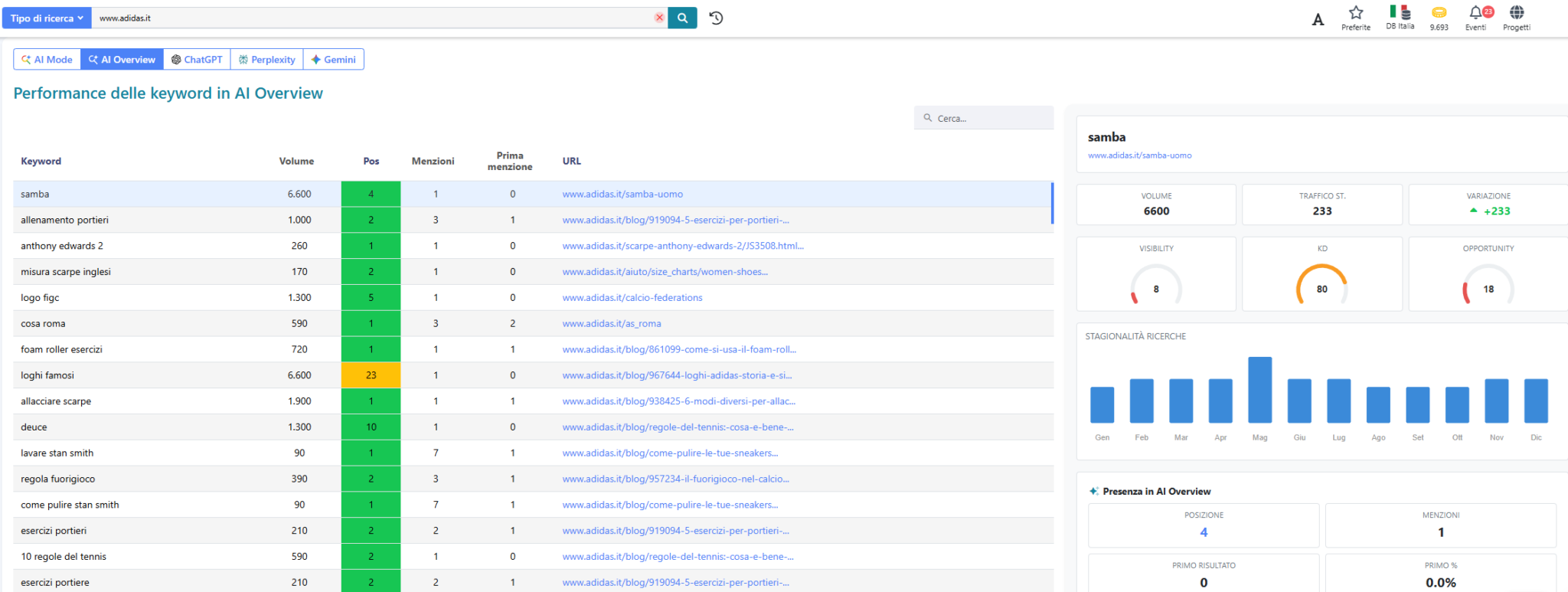
A broad presence concentrated in a single environment tells a different story from a presence distributed across several engines. A domain that maintains a solid standing in AI Overview but gains less space in prompt-based contexts shows a different profile from a site that frequently appears in generative responses but has little grip on Google’s AI summary.
Detailed analysis of AI engines: prompt, URL, response and sources
When you enter the sections dedicated to AI Mode, ChatGPT, Perplexity and Gemini, the view gains depth. At the centre you’ll find the prompts in which the domain appears, the position associated with the site, and the URL featured in the response. This alone is enough to understand which pages hold up best, which areas of the site get activated most often, and which questions the domain genuinely finds space in.
For each prompt selected, on the right you’ll see a preview of the AI response and the list of sources. Perplexity makes the visual component more prominent, while AI Mode, ChatGPT and Gemini keep a more text-based structure. The difference matters because it brings you back into the real context of the citation: you’re no longer just looking at a number, but at the concrete form in which a page is referenced and placed alongside other sources.
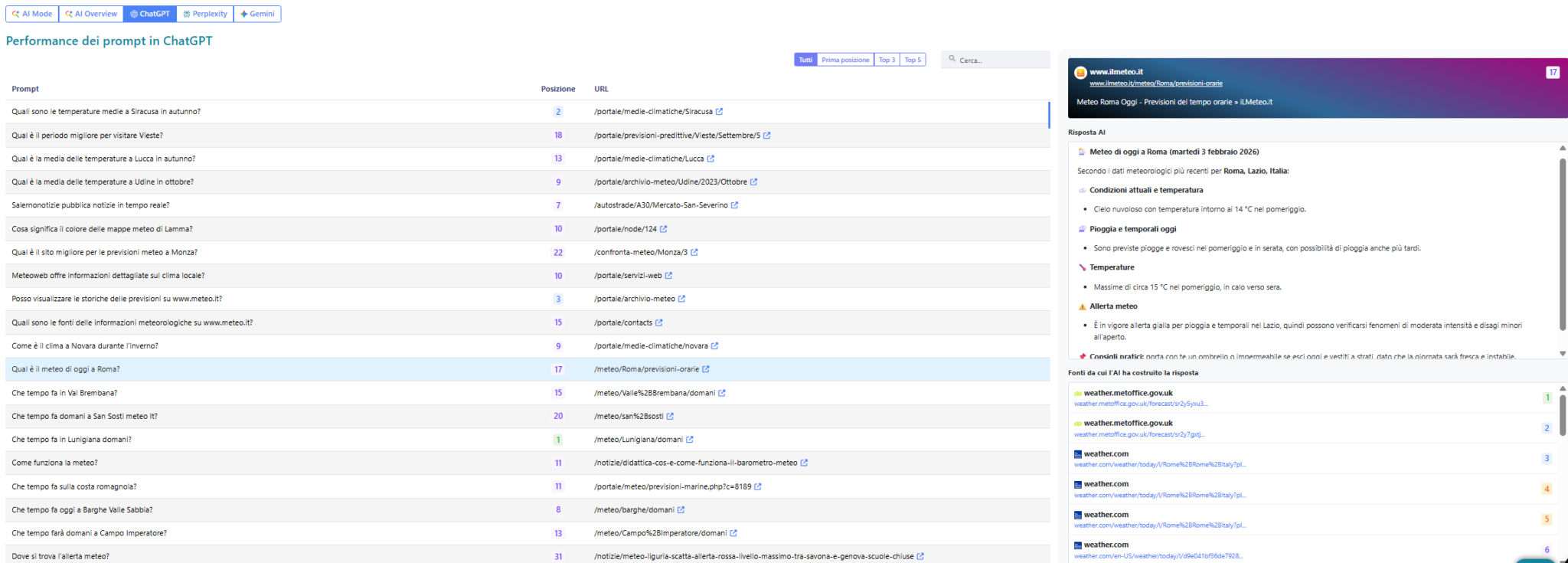
This is a much richer step than simply listing prompts. The combination of the central table and the side panel lets you connect three elements that usually remain separate: the question, the page that appears and the answer the engine generates. This makes working with the data more actionable. You can see which of the site’s contents get triggered most often, in which positions they appear, which sources they’re linked with, and what form the final answer takes.
Each engine keeps its own character, but the reading logic stays consistent. AI Visibility doesn’t flatten ChatGPT, Perplexity, Gemini and AI Mode into a single column of numbers. It keeps them distinct and lets you observe how the domain moves within each of these environments. It’s precisely this level of detail that makes the report useful for anyone who needs to truly read the site’s presence in AI engines rather than just note it down.
Competitors and social platforms: the real context of competition
In traditional search, competitive comparison is often built around keywords, SERPs and sites covering the same topic, but in the AI answer space the picture broadens because multiple entities come into play, appearing for the same questions despite starting from very different editorial logics.
The AI Competitors box captures exactly this level. It doesn’t list abstract or self-declared competitors, but rather the domains that appear most frequently in the analysed site’s industry prompts and that share the same answer space. The difference matters immediately when reading the data. The comparison stops being limited to sites in the same market and shifts towards all the sources the engine considers credible for the same network of questions.
The benefit of this reading is very concrete. It lets you understand which domains show up most consistently within your site’s own perimeter, where the competitive field gets denser, and which presences dominate the engine’s attention. The dashboard thus returns an actual competitive picture, built at the very point where the answer takes shape.
Social platforms widen the boundaries of competition
Alongside editorial competitors, AI Visibility also highlights the social platforms that appear most in industry prompts. This step carries a lot of strategic weight, because it reveals competition that classic SEO only partly captures. YouTube can enter the same space for practical explanations or tutorials, Reddit for testimonials and discussions, TikTok for quick, experience-driven content, Quora for questions and answers, LinkedIn for professional topics.
The domain, then, doesn’t just share the field with other sites in its own market. It also shares the engine’s attention with platforms that hold different forms of trust, usefulness or immediacy. AI Visibility makes this expansion of the competitive perimeter very concretely readable, because it shows which environments recur most frequently in industry prompts and genuinely shift the centre of gravity of the answer.
Your domain’s weight only takes shape within its field of forces
The site’s presence only gains meaning when you look at it within the network of domains and platforms occupying the same space. A domain can appear in many prompts and still be less impactful if it shares that perimeter with sources the engine treats as more natural or stronger. In the same way, a more selective presence can turn out to be much more significant if it sits within a more precise and less crowded competitive context.
The report, then, doesn’t just tell you where the site appears. It also clarifies who it shares attention with and what competitive field surrounds it. This is what makes the data less superficial and much more useful to interpret.
Three different cases, three different ways of reading AI Visibility
To really grasp how useful AI Visibility can be, it helps to see it at work on three very different and unrelated domains. Adidas helps you read how an ecommerce brand spreads its presence across product pages, editorial content and choice-related queries; ilMeteo takes you inside an information service that lives on constant demand, fragmented by location, time and updates; Vegolosi, an Italian magazine dedicated to vegan cooking and plant-based eating, brings out an even more interesting aspect – how much the competitive field widens when you move from editorial niche to the AI answer space.
- Adidas: instantly understand which areas of the site genuinely support presence in AI
If you open Adidas within AI Visibility, you won’t find a domain that appears the same way every time. In some answers, product pages rise to the top; in others, guides, editorial content, support sections or URLs that help users find their way come into play. The brand’s presence is therefore spread across areas of the site that, seen from outside, would look far more uniform.
For you, the value lies precisely in this breakdown. You don’t just read that the brand is there. You read where it takes up space, with which pages and in which environments it holds up best. If you work on an ecommerce site, this kind of reading matters a great deal, because it helps you understand which sections are genuinely supporting the domain’s visibility and which ones remain in the background.
On the competitive front, something else interesting happens. Adidas doesn’t share attention only with other ecommerce sites or brands in the same market. In AI answers, it can find itself alongside magazines, comparison sites, buying guides, sports sites and editorial content that address the same need from a different angle. The brand’s presence, then, takes shape in a space wider than what you’d see through a purely commercial lens.
- ilMeteo: when the value lies in the continuity of presence
With ilMeteo the perspective changes completely. Here you have an information service working on a constant demand, broken down by location, time window, alerts, specific conditions and practical needs. A presence like this doesn’t live on a single appearance. It lives on continuity.
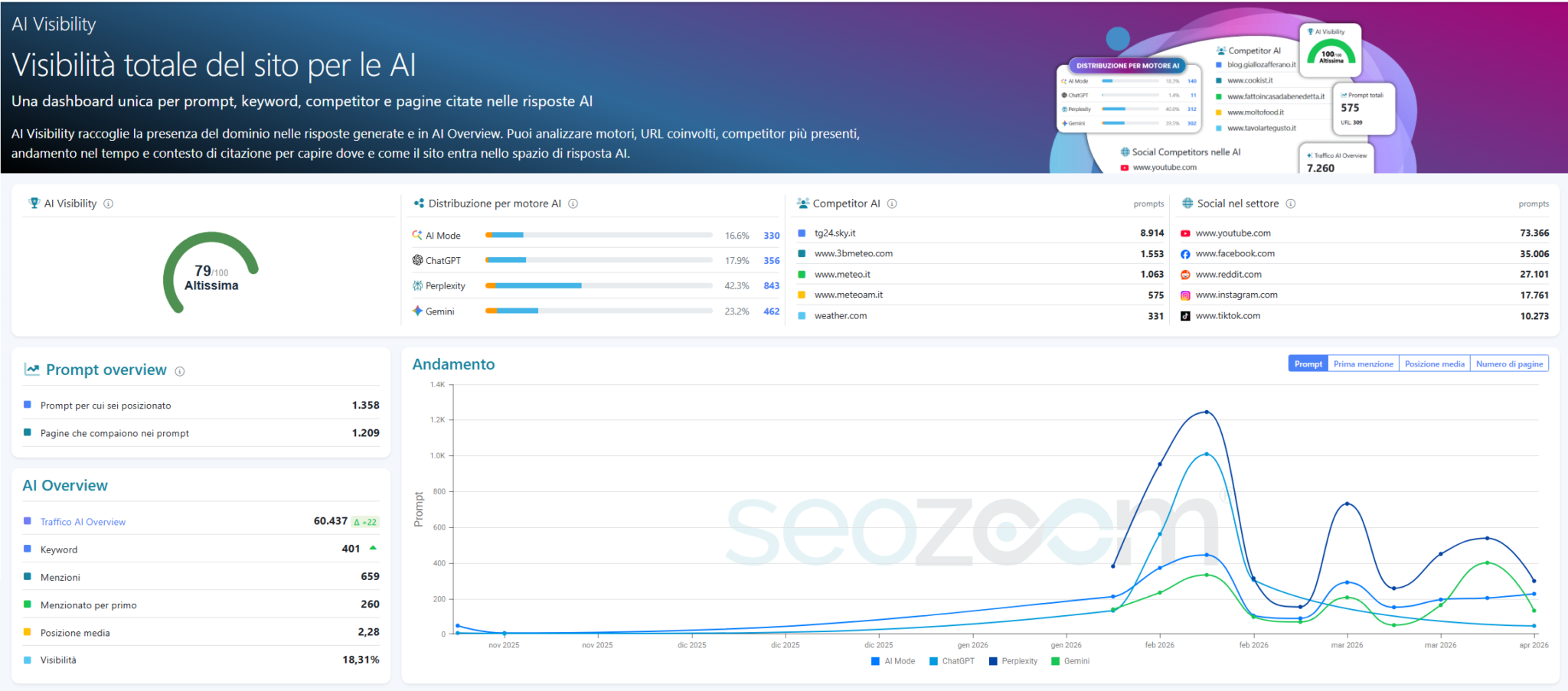
Looking at it through AI Visibility, you can immediately tell whether the domain holds up over time or concentrates its strength in narrower slices. Prompts, distribution by engine, trends and AI Overview together give a much more useful reading than simply counting appearances. For an information site, the point isn’t to appear one more time. The point is to stay relevant while the demand keeps multiplying and constantly changing shape.
Going deeper into the individual engines, the picture becomes even more concrete. You see which URLs hold up best, which questions keep triggering them, which sources share the same space. This part is valuable to you for one main reason: it lets you read the real weight of your presence, not just its surface. On domains like ilMeteo, the strength comes precisely from the ability to stay consistently useful.
- Vegolosi: in AI your competitive context widens beyond the niche
The case of Vegolosi is perhaps the one that best illustrates the more strategic side of the tool. If you looked at the domain through a more traditional SEO lens, you’d immediately think of comparing it with other vertical portals about vegan cooking, plant-based eating, or niche recipes.
Within AI, however, the scene changes: here the domain finds itself sharing space with broader food publishers, general recipe sites, video platforms, social networks and sources that capture attention on the same questions in different registers. The niche is still there, but it’s no longer enough to explain the competitive field.
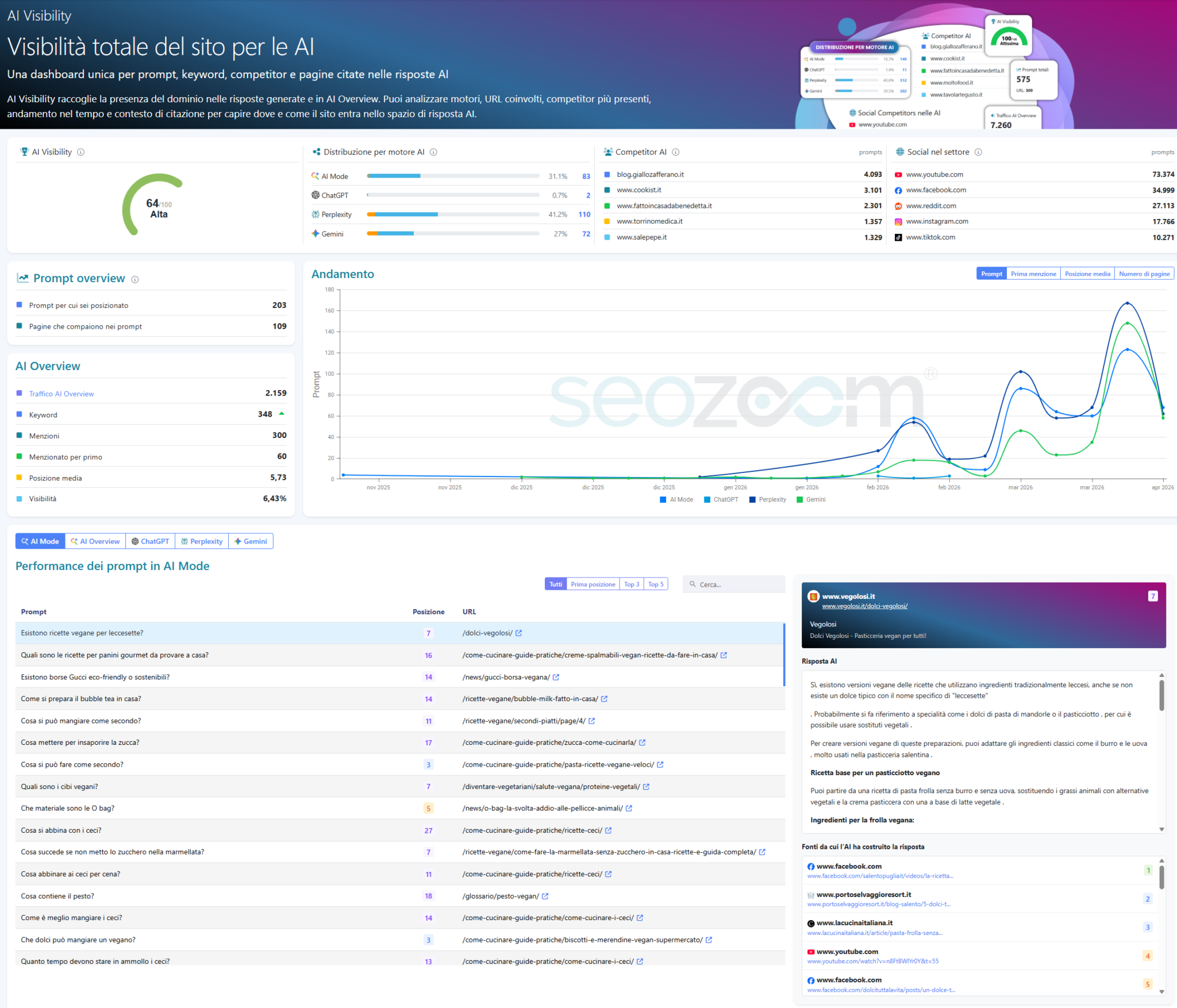
The useful shift here is this: you’re no longer just looking at how many times the domain appears. You’re reading who it’s actually sharing attention with. And there, the picture widens considerably. Alongside editorial competitors come social platforms, video content and cross-cutting sources that you’d read as far more separate in the SERP.
Vegolosi helps you see this gap clearly. The brand keeps a recognisable presence, but its strength is measured within a space that’s more crowded, more mixed, and more fluid than a classic reading of the niche would suggest.
When to use AI Visibility
The most useful moment to open AI Visibility comes when the domain’s presence has already spread across different environments and you need to bring order back to it. Start with an overall view, read how the site’s weight is distributed between AI Overview and conversational engines, identify the pages that really support that presence and the competitive field the domain moves within.
An initial read helps you understand whether the site maintains a distributed presence or concentrates its weight in just a few areas. You see which URLs appear in the answers, with which questions, in which position, and alongside which sources. The domain stops looking like a single compact figure and shows itself for what it really is: a set of pages that each support visibility in AI engines differently.
The most recurring AI competitors and social platforms make clear who you’re really sharing attention with in the same answer space. Knowing whether the domain appears is only the first level. What you need is to understand where it gains ground, how well it holds onto it, and which other presences sit alongside it or crowd it out.
That’s why AI Visibility works well at the start of an analysis, but it also holds up beyond that initial snapshot. Follow the trend of the presence over time and piece together a picture that, read in fragments, would otherwise remain unclear.
Domain presence should be read as a structure
AI Visibility organises the domain’s presence within the AI answer space. Prompts, keywords, engines, cited pages, competitors, sources and trends are signals that, read on their own, remain fragments – the dashboard connects them.
The distinction between AI Overview and prompt-based environments underpins the whole reading. On one side, there’s a reading tied to keywords and the structure of Google’s SERP. On the other, there’s the fully conversational dimension of AI engines, where what matters is the complete question, the generated answer, the URL’s position and the sources used by the system. AI Visibility holds these two worlds together without blending them.
The domain no longer appears as an isolated figure, but as a presence that takes shape across different environments, pages and competitive contexts. It’s from this structure that its weight in AI becomes readable.
How to read the dashboard’s main boxes
The initial screen of AI Visibility offers a quick diagnosis, but each box tells a different layer of the domain’s presence. The AI Visibility index sums up the domain’s level of presence in AI answers, giving you a concise snapshot of the site’s weight in the generative space. The Total prompts box adds a different piece of information: it counts the unique prompts in which the domain appears, excluding duplicates across multiple engines. That’s why the total may come out lower than the sum of prompts distributed across each individual environment.
The Distribution by AI engine helps you understand how this presence is split between AI Mode, ChatGPT, Perplexity and Gemini. This isn’t a minor detail, since a domain can have broad coverage in one engine and a much more selective presence in another. The AI Competitors box then places the domain within its actual answer space, gathering the sites that recur most often in the same sector-specific prompts. Alongside this, the section dedicated to social platforms makes it clear when YouTube, Reddit, TikTok, Quora or LinkedIn enter the same competitive perimeter.
The Trend chart completes the reading, as it shifts attention from the instant snapshot to the continuity of the presence over time. Alongside this structure sits the AI Overview box, which introduces the tool’s predominantly keyword-based side and highlights mentions, first mentions, average position and the domain’s visibility in Google’s AI summaries. Read together, these blocks immediately show whether the site distributes its presence well, whether it concentrates it in just a few areas, and which other presences it’s really sharing the answer space with.
How to integrate AI Visibility with other SEO for AI tools
AI Visibility gives you the overall view: it shows you where the domain appears, which pages carry weight, in which engines it holds up best, and within which competitive field it operates.
When you want to dig into the reasons behind that presence, the work continues with SEOZoom’s other SEO for AI tools.
GEO Audit helps you understand how AI interprets the brand and whether its informational identity is clear; AEO Audit instead measures the quality of the brand’s presence within Answer Engines and gives you a reading geared more towards reputation and competitive strength; AI Prompt Research breaks down prompts to show you needs, sub-topics and informational steps to cover; AI Prompt Tracker takes you into monitoring individual prompts and the relationship between questions, sources and cited pages; AI Engine, finally, lets you check whether a piece of content truly has the structure and coverage needed to hold up in generative engines.
Taken together, these tools form a very clear flow: with AI Visibility you read the overall picture, with the audits you understand the quality of your presence, with the prompts you get into the user’s real need, with AI Engine you work on the content that must support that visibility.
A more mature reading of AI visibility
AI Visibility doesn’t just tell you whether your domain appears in AI. It helps you understand how it appears, where it holds up best and who it’s actually sharing the answer space with. This is a difference that matters, because it shifts the reading from the surface of the data to the structure that underpins it.
Within the dashboard, the domain stops being a generic presence. It takes shape through keywords, prompts, URLs, sources, engines and competitors that change from one environment to another. This reading gives you a very concrete advantage: you can distinguish occasional presence from solid presence, genuine command of the space from mere appearance, the closest competitor from the one stealing attention even if it comes from a completely different field.
AI Visibility recomposes signals that would otherwise remain scattered and hard to read on their own. That’s why the report matters: it gives you a more precise, more mature and more useful reading of your space within AI.


 Verified reviews on Trustpilot