Black Friday for Ecommerce: where you win and lose the sale
The pages Google rewards, the price your customer checks, the site that has to survive the traffic spike: that's where your Black Friday gets decided.
Pay less today. Black Friday was built entirely around this simple message, one that won over customers’ attention and their wallets.
One Friday used to be enough. Then came online shopping, Cyber Monday, Black Weeks, and deals that start earlier every year. Prime Day, Singles’ Day, marketplace campaigns, promotions built around nearly every occasion available.
So why, even though it’s lost its exclusivity, does your revenue still hinge on Black Friday? And how do you avoid wasting the opportunity?
What Black Friday Means for an Ecommerce Site Today
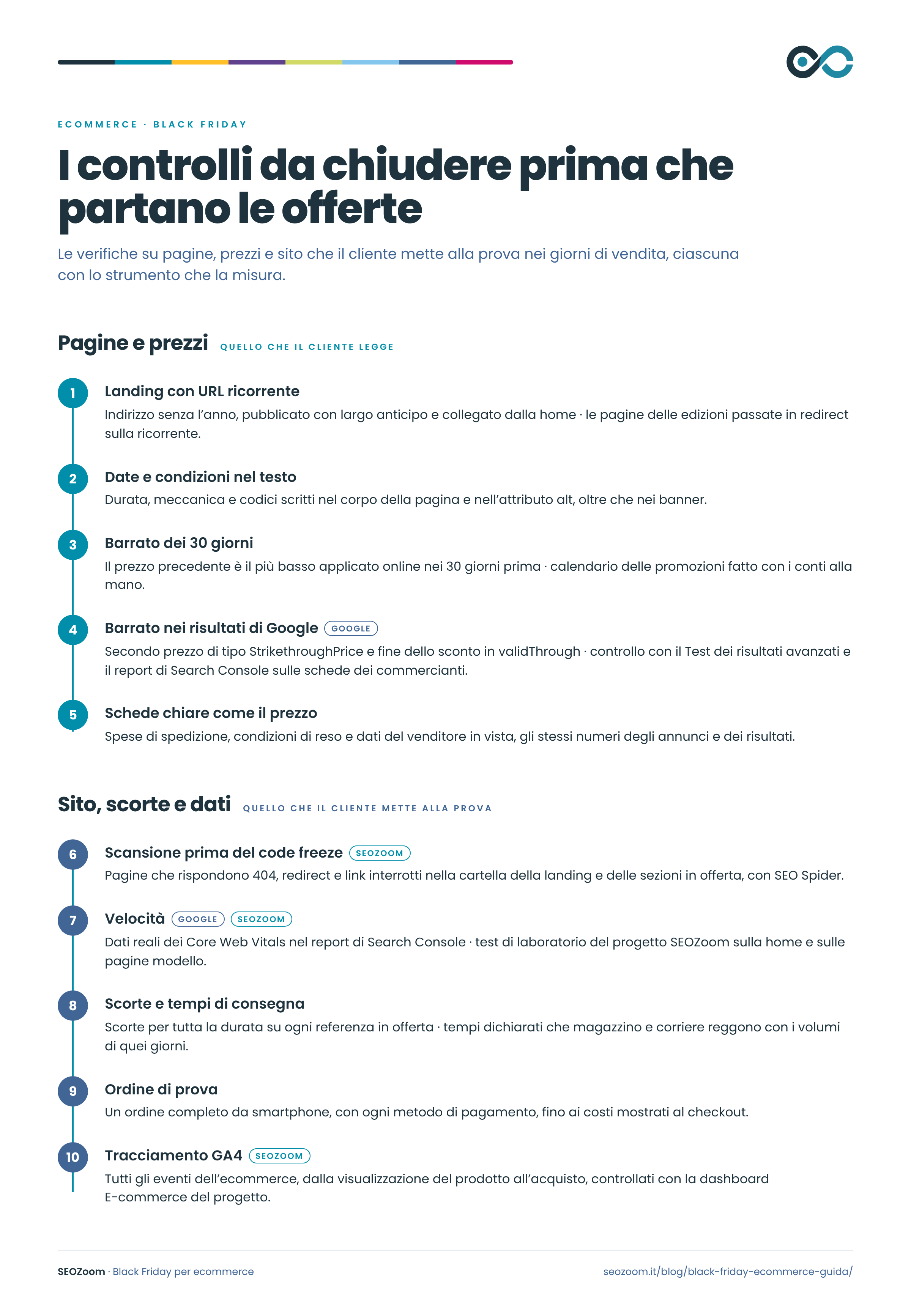
Black Friday is the promotion your customers wait for to shop. They see discounts all year, from Prime Day to seasonal sales, but this is the occasion not to miss, as advertising has taught them. They may not know the exact date, which changes every year and falls on November 27 in 2026, but they know late November means sales. The American tradition, the Thanksgiving connection, the history of the name: none of that matters anymore. What matters is buying and spending less.
The name is often just a label at this point, and it doesn’t even mean a single day anymore: after Friday comes Cyber Monday, but more and more brands stretch the discounts across weeks or an entire month, calling sales “black” even in other parts of the year. Amazon has gotten us used to a Black Friday Week, which lasted twelve days in 2025; MediaWorld opened on November 1 with the first “episode” of its Black Friday, and Notino, in early October 2026, was already telling shoppers not to wait until November 27 to get “super prices.” Lenovo even has its own “Black Friday in July,” and Trony runs a “Black Friday Summer Edition.”

And people have adjusted too, even in the Italian market. Last year, online sales grew 3% on Friday, 5% over the week, and 14% across all of November, compared to 2024. Ecommerce benefited more than physical stores: in consumer electronics, online sales rose 13.2% versus 5.6% for brick-and-mortar stores, and accounted for 37.7% of the €544 million earned that week.
For your business, you can decide how long the discounts last, but keep in mind the customer doesn’t wait for your calendar: if you start on Friday, you have to assume they’ve already had a week or more to see and compare your competitors’ discounts, and they’ve likely already decided what to buy and at what price, if they haven’t bought it from them already.
Searches for the Event, on Google and in AI Assistants
Before even choosing the product, your customer wants to know when the deals start and which stores are running them. They ask Google as early as October, when SEOZoom data shows a rise in searches about the date, like quando inizia il black friday (“when does black friday start”), and by November they move on to deals and store names, with queries like offerte black friday (“black friday deals”) or amazon black friday. The same questions reach AI assistants, which in turn search the web to answer them.
Google answers mostly with the pages stores dedicate to the event, Black Friday landing pages, even when the query is just about the date: in October 2026, the top result for quando inizia il black friday was MediaWorld’s page, while landing pages took the first four spots for offerte black friday, with articles from news outlets further down.
The pages that win these searches stay at the top from one edition to the next, and they share one thing: a URL without the year. SEOZoom’s SERP History, which keeps track of results pages recorded over time, shows this for black friday deals: the top three on October 12, 2026 were the same as on November 1, 2025, and by November 2024 they already appeared among the results with today’s addresses, /it/campaign/black-friday for MediaWorld, /black-friday/ for Zalando and /sconti/black-friday-offerte for Idealo. Google has known those pages for years, and the links they’ve earned at every edition still point there.
| Landing Page | November 10, 2024 | November 1, 2025 | October 12, 2026 |
|---|---|---|---|
| MediaWorld · /it/campaign/black-friday | 1 | 1 | 1 |
| Zalando · /black-friday/ | 7 | 2 | 3 |
| Idealo · /sconti/black-friday-offerte | 14 | 3 | 2 |
| Amazon · /blackfriday | 2 | – | 4 |
| Unieuro · /online/Black-friday | 3 | 5 | – |
| Euronics · /black-friday/ | 6 | 8 | – |
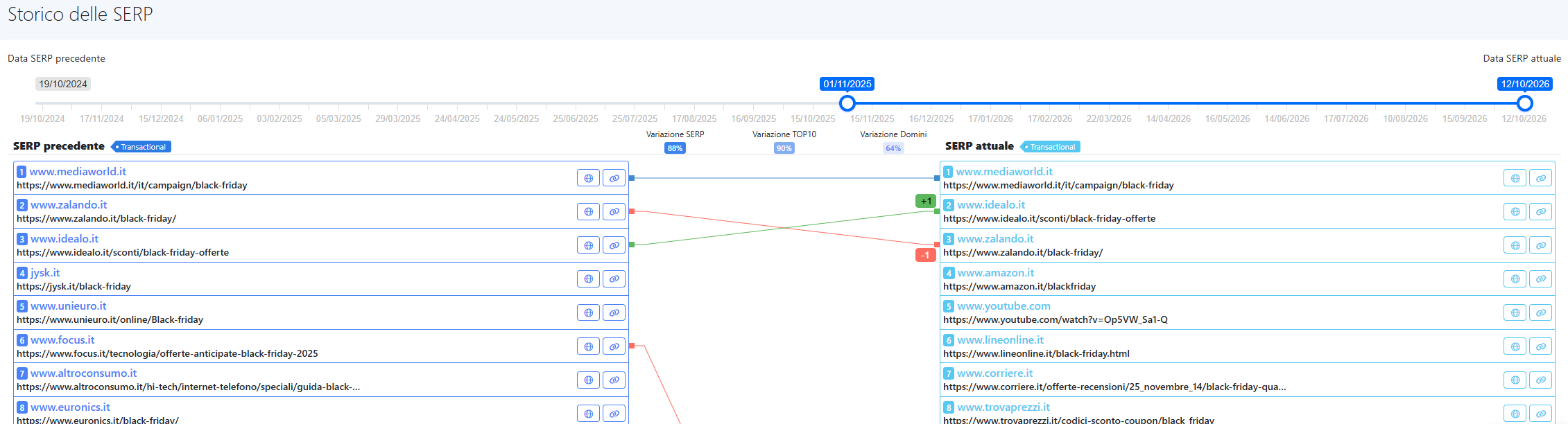
With a new landing page launched in November, you’re competing against pages with years of head start. How much it costs you to catch up depends on your industry, and SERP History tells you that too, for the searches that matter to you: where the same addresses hold steady, you’ll need more than one edition to break through; where they change year to year, there’s room for you as well. Rankings aren’t set in stone, either: Unieuro’s and Euronics’ landing pages, among the top ten results in 2024 and 2025, hadn’t shown up yet as of mid-October 2026.
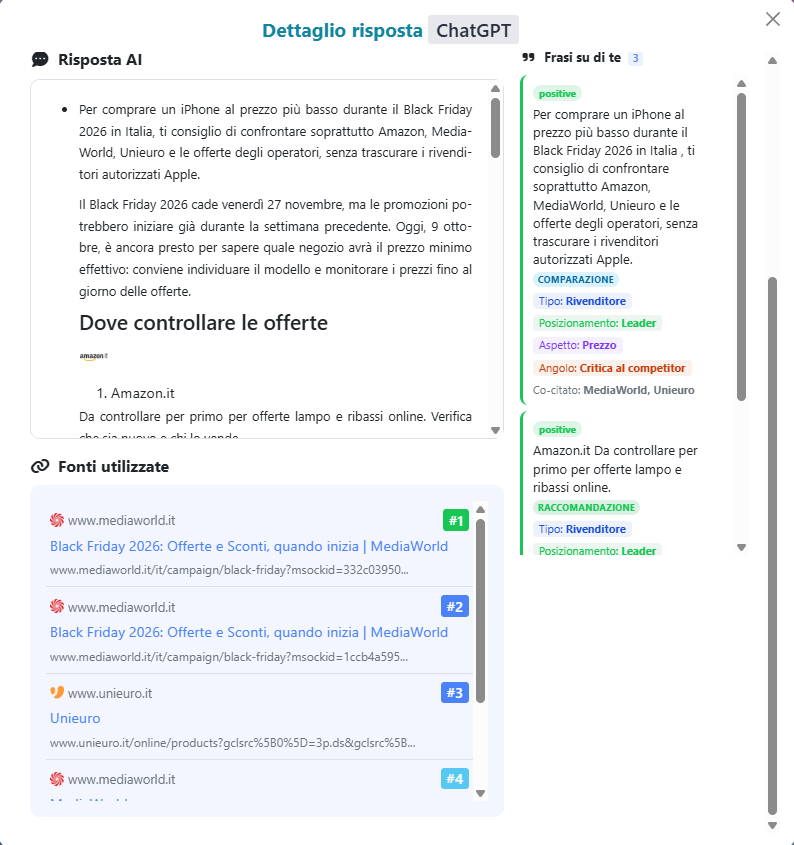
Even in AI assistants, the path runs through Google. ChatGPT, Gemini and AI Mode, when they search live, query search engines, Google first among them, and read pages that are already indexed and ranked: in answers about where to buy and when deals start, which we collected with AI Prompt Tracker, store landing pages keep showing up among the sources, and the most cited is MediaWorld’s, which also leads Google’s results. You earn your spot in these answers on Google, and a single page works for both.
The URL You Keep from One Edition to the Next
You choose your landing page’s address once, for good, without the year, so it can accumulate over the years what MediaWorld’s and Zalando’s pages have built up. Google recommends exactly this in its guidelines for event pages: a recurring URL, /sale/black-friday rather than /sale/2020/black-friday, published well ahead of time so Googlebot has time to find and index it, and linked from the homepage. A landing page launched right before the deals start risks hitting the peak before it’s even in the index.
The copy, though, you refresh every edition, and that’s where even longtime winners slip up: on October 5, 2026, MediaWorld’s landing page still read, “Black Friday 2025 has ended!” Dates, duration and terms are what visitors come to the page looking for, and you can publish them as soon as you’ve decided on them, even with the discounts still under wraps, since Google expects a first version with general information and a new crawl once you update it. Put them in the page’s body text and in the image alt attributes, not just in the banners: a percentage or a discount code that exists only inside an image risks never reaching search results or AI assistant answers, where someone else’s terms end up instead.
Pages opened in past years for each edition, with the year in the URL, split across multiple addresses the history a single page would have built up, and with a redirect from the old versions to the recurring one, with equivalent content, you put it back together. A landing page you’ve never had is still worth launching, even just weeks before the deals: you won’t reach the top for this edition, but Googlebot has time to get to know it, and by the next one you’ll start with a year of history behind you. And when the discounts end, don’t take it down: with a note about the next edition, it will be the one answering whoever searches for the date.
Ads for the Visibility You’re Missing
As long as your landing page has no history, getting to the top of deal searches means paying for it. Google Ads gives you the position for as long as you pay for it, while the landing page keeps working even afterward, and you need both, because the ad only holds up if the page the click lands on delivers what it promised.
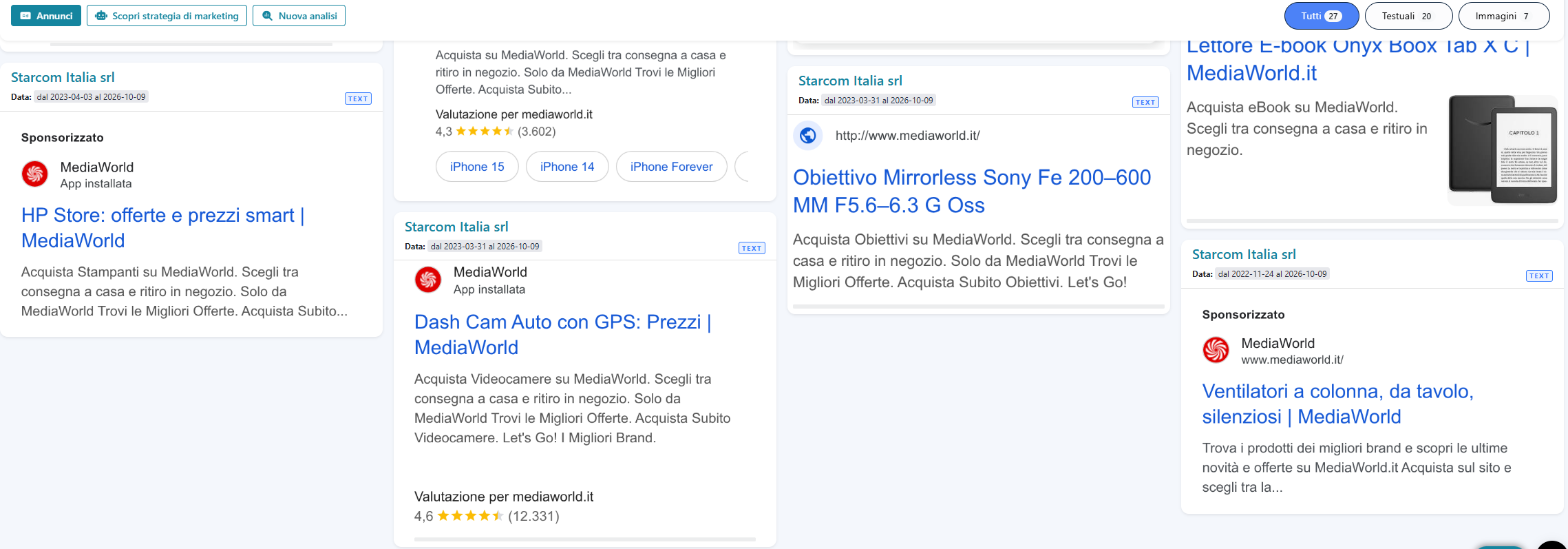
Before you buy those searches, you can see who’s already buying them, with what copy and since when. SEOZoom’s ADS Insights shows you a domain’s active ads with advertiser, format and time frame: for MediaWorld, in the October 9, 2026 check, there were 27, some running since 2022, and more than half attributed to the media agency. Ended ads don’t show up, so you read your competitors’ Black Friday campaigns while they’re live, and worth checking back on more than once during those days.
Inconsistency between the ad and the landing page costs you twice: in the Google Ads auction, which decides which ads to show and in what order by weighing ad relevance and landing page experience, and again after the click, when the customer looks on the page for the dates, the mechanics and the figure they just read.
A promotion running just a few days can rely on two Google Ads tools. A promotion asset puts the offer, the discount, any code or spending threshold, and the dates right under the search ad and on YouTube, at no extra cost beyond the clicks. And with seasonality adjustments you warn Smart Bidding, the automated bidding strategies, that during those days the conversion rate will rise more than recent data suggests. Google built these for events lasting up to seven days and warns that beyond fourteen they may not work: with a month of discounts, they’re not for you.
Where the Choice of Model Begins
You can have your landing page among the top results and still lose the sale, because your customer picks the product elsewhere. They compare, read reviews and guides, ask AI assistants for help: more than 13% of Italians who shop online already use AI in their purchases, and two times out of three to compare prices and products.
When asked which product to buy, from a 500 euro washing machine to a gift for an eight-year-old, the assistants cited publications and buying guides like Altroconsumo, QualeScegliere, and HDblog, comparison sites like Idealo and Trovaprezzi, manufacturer sites like Bosch, and only rarely a retailer. At this stage, the pages that explain and compare are what counts.
When the search is a product name, Google leaves event landing pages out even during the sale days. The SERP History for robot vacuum, between September and December 2025, shows a marketplace category page in first place in every check, with manufacturer lineups and electronics chain departments right below; between November and December, roundups and deal collections from a few publications enter the top ten, and once, a discount retailer’s product page, but never a retailer’s landing page. Someone searching for a product by name is still deciding, and Google shows them pages where they find many models together.
Product searches also last longer than searches about the event. Queries with black friday, in SEOZoom data, drop off in December, while robot vacuum or air fryer rise in November and stay high until Christmas, following their category’s seasonality. So when the customer is choosing the model, you win Black Friday with the categories and product pages you already have, and for the entire year-end shopping season.
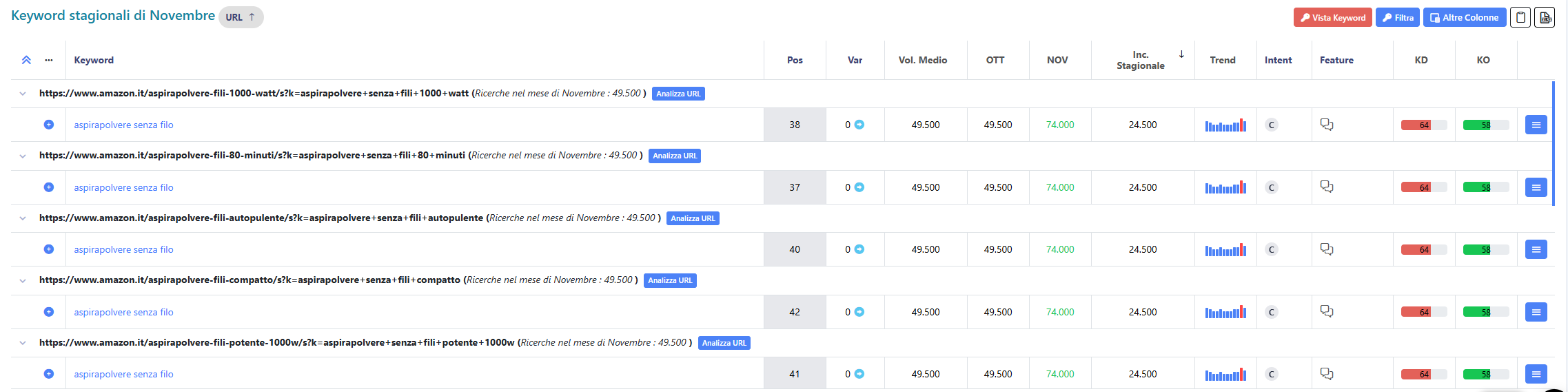
You find out which of your pages enter this season in the Seasonal Keywords report in the SEOZoom project, which lists the searches growing in the month you choose and for which your site already ranks, each one with the page that captures it. You need to filter it, because it picks up everything that’s growing: for amazon.it, in November, the top of the list included news searches, typos like black pfriday, and past editions like black friday 2023. Narrowed down to the words of one category and grouped by page, it instead shows problems you wouldn’t notice from the catalog: cordless vacuum showed up under five different URLs, all internal search pages, ranking between 37th and 42nd. Multiple pages competing for a single search cannibalize each other, and before working on a category you should decide which page should own it. The volumes in the report are estimates, useful for prioritizing which pages to work on, not for predicting traffic: you read the actual clicks in Search Console.
The Categories That Answer Buying Questions
The guides your customer uses to decide compare models and explain what matters. If your category page only shows a list of products, they’ll go elsewhere to find comparisons and explanations, and come back to you only after they’ve already decided, if they come back at all.
You can figure out what to put in a category page using the SEOZoom Editorial Assistant, which pulls out the topics covered by the pages Google ranks for a given search: for robot vacuum these are model comparisons, 2-in-1 devices that also mop floors, and navigation and room mapping, the topics your category page can use to guide someone who hasn’t decided yet.
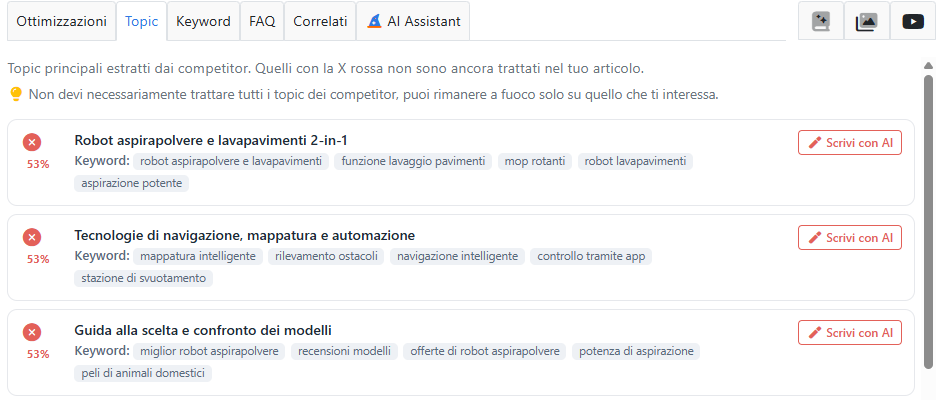
The tool also collects the real questions people ask about the product: how much power you need, what detergent to use in a mop-and-vacuum model, which vacuum to buy instead of a Dyson. These are the questions your customer would ask an assistant, and if they find the answers on your category page, that’s one more reason to buy from you. The topics also include store financing options and brand-specific stores, and the tool notes you don’t need to cover all of them: that choice is yours.
When Black Friday Deserves Its Own Section
Some searches combine the event and the product, like black friday iphone or black friday smartphone, and whoever searches these has already picked the model: they’re looking for who’s discounting it. Google answers these searches with sale category pages, sections with their own URL that collect discounted products of one type, and these last too: for black friday iphone, MediaWorld’s iPhone-dedicated section and Euronics’s landing page filtered for Apple products ranked first and second in October 2026, and SERP History already shows them in the November 2024 results, with the same URLs as today.
A section like this is worth building if that search exists in your market and you have enough products to fill it. You find the signal in the search results: if your competitors show up there with dedicated category pages, that’s the format Google associates with that query. Without that signal, opening a sale section for every department just leaves you with duplicates of your regular categories, with little stock and no search demand to capture.
When you build one, start from the event landing page, give it a URL that will last for years, and link it to the product pages. With a small catalog, Euronics’s approach can work too: an event page filtered by brand.
The Price They Compare You Against
Your customer arrives at the sales with a figure already in mind, based on the prices they’ve seen from you and your competitors, and the assistants help them set it. When asked whether to buy on Amazon or from brand websites, ChatGPT suggested writing down the current price of each product; in another answer, for a 55-inch TV selling for around 839 euros, it suggested a target of 750.
When the discount shows up, buyers check whether it’s real. Asked about whether a discount was a good deal, ChatGPT explained the 30-day rule every time, AI Mode did so four times out of five, and Gemini always pointed to price history and comparison sites, warning against the “psychological urgency tricks” that much of Black Friday psychology relies on.
The rule comes from Article 17-bis of the Italian Consumer Code: when you announce a discount, the previous price you display has to be the lowest price you applied to the general public in the 30 days before, channel by channel, even in general ads like “20% off everything today.” So your prices from the month before set the strikethrough price for your Black Friday: if you start on November 20, the reference is the lowest price you charged online between October 21 and November 19. Raising your list prices during those days won’t change that, because the lowest price counts, even if it only lasted one day.
In November 2025 the Italian Competition Authority fined the online wine retailer Tannico 150,000 euros for presenting as promotional prices that were equal to or higher than the 30-day minimum. But before the Authority steps in, customers spot an inflated strikethrough price themselves, using a price history tool or asking an AI assistant.
The Promotions That Move the Crossed-Out Price
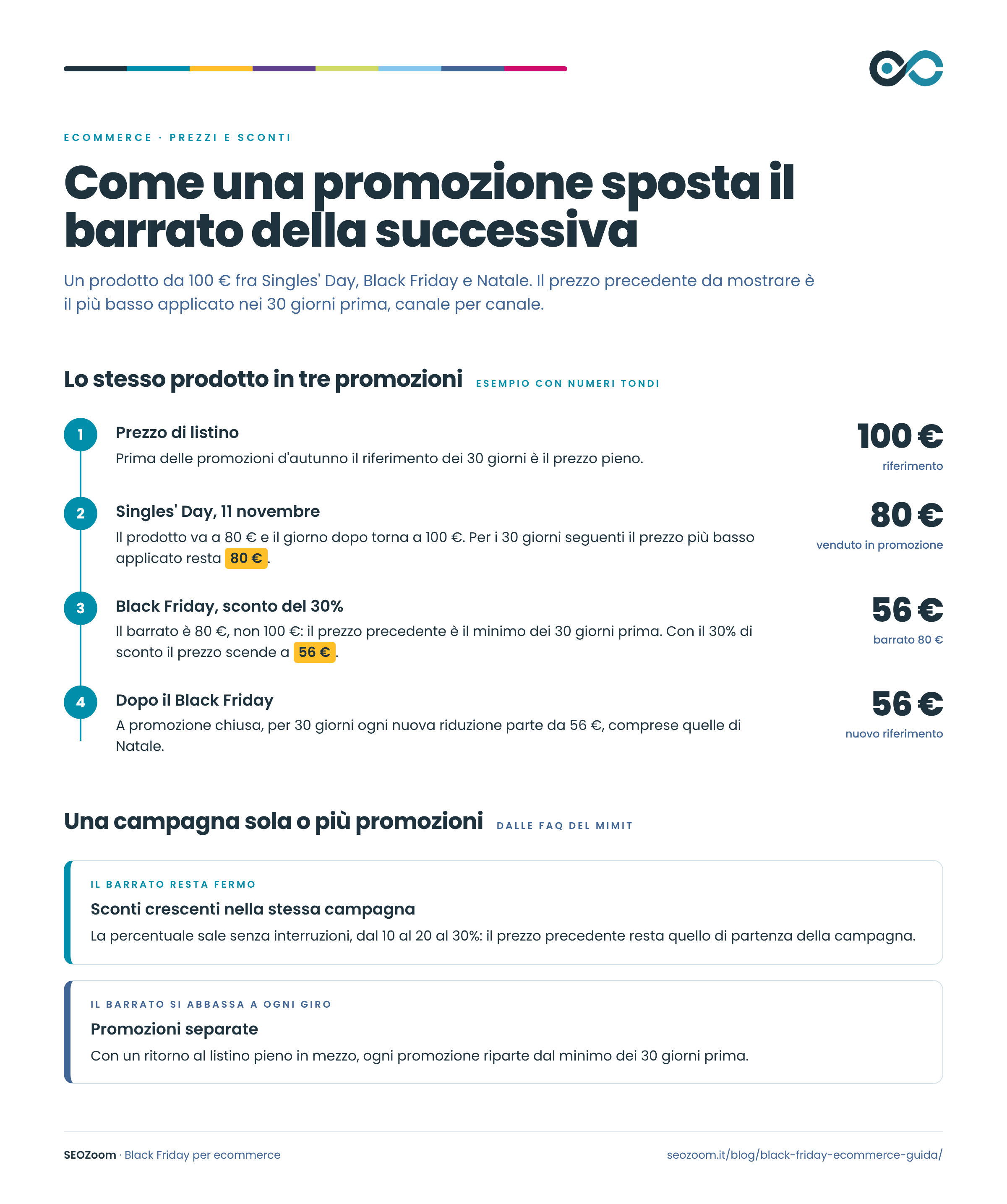
Fall brings a string of promotions, from Singles’ Day to Christmas, and each one shifts the reference price for the next. You need to plan your calendar with the numbers in hand. Take a product priced at 100 euros that you sell for 80 during Singles’ Day on November 11, then bring back to 100: that 80 euros becomes the previous price for the entire Black Friday period. Discounted by 30%, it drops to 56 euros, and once the promotion ends, that 56 euros stays the reference price for any new markdown over the next 30 days, including Christmas sales.
The FAQs from the Italian Ministry of Enterprises and Made in Italy draw a distinction that changes the outcome significantly. If within the same campaign you increase the discount percentage without interruption, say from 10% to 20% to 30%, the previous price stays the one you started with: a week of escalating discounts keeps the strikethrough price fixed. But if you run separate promotions with a return to full price in between, each one resets to the 30-day minimum, and the strikethrough price drops every time.
Early access for registered customers is trickier, like the weekend LEGO reserves for members before November 27. The FAQs exclude discounts reserved for members and loyalty cardholders from the rule, and tie the previous price to what you charged the general public. Read together, they suggest that a discount for members only doesn’t lower the reference price for the promotion open to everyone. The Ministry doesn’t spell this out explicitly, though, so it’s worth getting confirmation from whoever handles the legal side of your store before building offers around it.
The Products Where a Discount Isn’t Enough
When you sell a product your competitors also carry, customers search for it by code across multiple stores, the way ChatGPT suggested: “I’d compare the same product code on Amazon, Unieuro, and MediaWorld.” AI Mode and Gemini warned about this too: for major sales events, manufacturers create “slightly different model codes” for individual retail chains specifically to block that kind of comparison. Comparison sites and AI assistants rank offers by final price, and how far down you can go to match the lowest price depends on your margin. The product’s own history matters too: if you’ve already discounted it recently, its reference price is lower, and the discount you can legally advertise ends up smaller than what the customer expects.
Where you can’t win on percentage, you can shift the comparison to what only you offer: your own products, exclusive variants, bundles. ChatGPT wrote about LEGO.com that “it’s not necessarily the place with the highest percentage discount, but it can offer better overall value,” between exclusive sets, freebies, and member perks.
What you put on sale is also a decision you make with the comparison in mind. A selection discounted for the whole period lets you choose which products to feature, but every item you pick needs stock to last the entire campaign. If it sells out halfway through, your ads and landing pages keep pushing a product page that’s no longer selling anything.
Then there are deal structures that make a purchase more appealing without touching the percentage, like spending thresholds, free gifts, or buy-two-get-one offers. Many of these fall outside the 30-day rule, though they’re still subject to rules on unfair commercial practices, and the Mimit FAQs give these as examples.
| Type of Promotion | Examples from the Mimit FAQ |
|---|---|
| Discounts Tied to a Condition Other Than a Simple Purchase | prize promotions, loyalty programs, vouchers for future purchases, discounts above a spending threshold or up to a cap, minimum quantity requirements, 50% off the cheaper item when you buy two products |
| Quantity Discounts and Free Gifts | buy two get one free, free earbuds with a smartphone purchase, gifts tied to spending amount |
| Personalized Offers | reserved for a single customer, for example on their birthday or when they join a loyalty program, or for members and loyalty cardholders |
| Discounts on an Unspecified Product | 20% off the most expensive item in the cart |
| Discount Vouchers and Cashback | conditional vouchers or vouchers reserved for a specific customer category, refund of part of the purchase |
| Bundled Sales | multiple products at a price lower than the sum of the individual items |
| Launch Prices | products not sold in the previous 30 days |
Also outside the rule: comparative advertising against competitors’ list prices, generic value claims like “always low prices,” and below-cost sales, which have their own separate regulations. A product with a new EAN, the barcode number, or a new version of a model doesn’t inherit the reference price of the previous version.
The Discount Your Customer Checks
Customers do their final check on your product page: they look for the strikethrough price and the figure to compare against their target, and they expect to find the same numbers they saw in your ads and in search results. The strikethrough price you show is the 30-day minimum even if your most recent selling price was higher, and you calculate the percentage from that number. Stating this clearly helps buyers: ChatGPT flagged as useful the label “lowest price in the last 30 days” that Zalando displays on its product pages, since it hands shoppers the information they’d otherwise have to dig up themselves. You can add other reference prices too, as long as they’re clear and don’t distract from the legally required one.
AI assistants teach shoppers to look beyond the price tag: “Shipping, paid returns, or other conditions can change the effective price quite a bit,” ChatGPT noted, and Gemini suggested checking whether the seller is an authorized retailer, whether it offers an Italian or European warranty, what its reviews look like, and whether returns are free. Shipping costs, return policies, and seller information need to be just as clear as the price on your product page, because those are exactly the factors customers, and the AI assistants helping them, use to compare you against everyone else.
For the strikethrough to show up in Google results, declare it in the structured data of the product listing as a second price, type StrikethroughPrice, alongside the active one, with the discount’s end date in validThrough. Use the Rich Results Test and the Search Console merchant listings report to check that Google reads it. The markup, though, doesn’t guarantee it will display it.
The rule loosens only partly for collective advertising and promotions covering many products: the Italian Ministry of Enterprise’s FAQ let you state just the final figure or just the percentage, as long as the earlier price appears “in the price sections of online store interfaces,” and they ban presenting as discounted a figure already applied by most retail outlets. The FAQ’s examples are flyers and posters, and they don’t mention web advertising at all.
The Promises of Sale Days
By the time deals go live, customers arriving on your site have already chosen the retailer, the model, and the price, and they’re there to check that you deliver what they read elsewhere. Beyond price, they’ve factored in delivery times and return policies, and AI assistants weigh these too: AI Mode counted slower logistics during that period and less flexible return policies among the drawbacks of brand sites. Every promise you break, from an out-of-stock product to a late delivery, costs you a sale that was already yours.
The most fragile promises are the ones about timing. At year’s end, orders, shipments, and support requests pile up during online retail’s peak season, and the delivery times you state on the product page and at checkout need to reflect what your warehouse and carrier can actually handle at that volume, not what they manage in a normal month.
When a product sells out in the middle of a promotion, pull the ads pushing it and take it off the landing page, but keep the product listing live with updated availability. Demand for that product keeps coming through Christmas: a removed page would return a 404 error, while anyone who finds a restock date or an alternative model stays on your site. Reserve the 404, or the 410 for a resource removed permanently, for products dropped from the catalog with no equivalent model to redirect to. Redirecting all closed listings to a category page or the homepage sends visitors away from what they were actually looking for.
Your Site Before the Code Freeze
A customer who’s made up their mind takes the shortest path, from landing page to product listing to cart, and any glitch stops them right when they were about to order. During sales, then, freeze code releases and let only urgent fixes through: a code freeze keeps you from introducing new errors on peak days. But errors the site already has stay exactly where they are, and either you find them before the freeze or your customers find them.
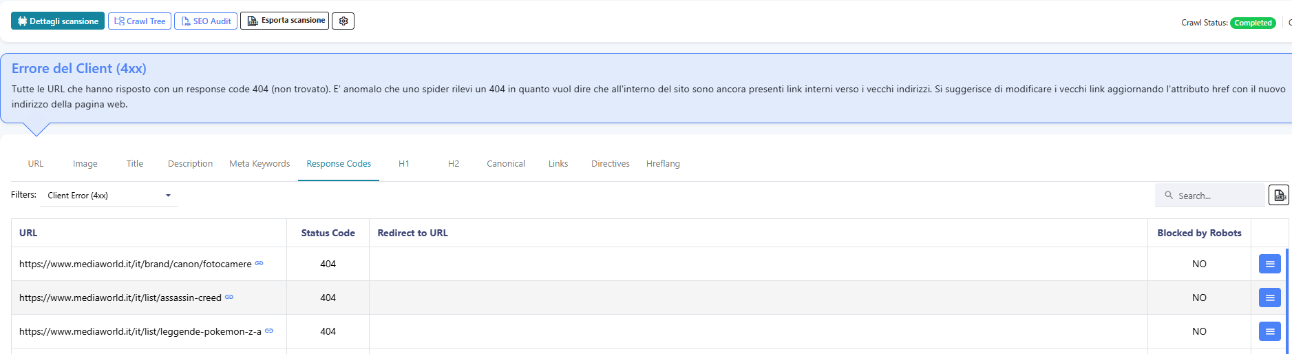
A crawl that follows links the way Googlebot does will catch them and flag pages that don’t respond, redirects, blocked pages, and other technical issues that break the shopping experience. SEOZoom’s SEO Spider, run on MediaWorld’s site in late September 2026, found three 404 URLs, one brand section, and two removed product listings out of 749 pages. A crawler finds these because the site still links to those addresses, and anyone who followed them would have hit a dead end. You can limit the crawl to the folder containing the landing page and the sale sections; response times and cache performance under load, though, you check with whoever manages the infrastructure.
You deal with speed ahead of time because it has a measurable impact on sales: in a 2020 Deloitte study for Google on mobile sites, a tenth of a second gained across four speed metrics, at every step of the purchase journey, drove 9.2% more retail spending. You’ll find real Core Web Vitals data, collected by Google from Chrome users, in the Search Console report, while SEOZoom’s lab tests let you track the homepage and template pages over time and see whether a redesigned site is slower than the one that handled last year’s peak.
The final check is to act as a customer yourself: complete an order from a smartphone, with every payment method, retracing the full path and seeing the costs you’ll show at checkout.
A Drop You Need to Read Quickly
If orders drop while sales are live, you need to figure out where the problem is coming from right away, and the data doesn’t all arrive at once: GA4’s real-time report updates within minutes, intraday data arrives in 2 to 6 hours, daily data in about 12, and Search Console’s most recent data can still be provisional.
Real-time data is enough to tell a traffic problem from a sales problem. A sudden drop in visits points to paused campaigns, a tag that’s stopped firing, or a site outage; if traffic holds steady and orders fall, look for the problem in checkout, payments, or stock availability.
This distinction only works if tracking was complete before the peak. SEOZoom’s Ecommerce dashboard flags it when GA4 isn’t receiving one of the ecommerce events, from product views to purchases: check this before the deals go live, not once sales are underway.
The Final Tally Once Returns Are In
Revenue from discount days tells only part of the story of what the promotion left you. The rest comes from orders, revenue, margins, and customers, read once returns have settled. Rankings and traffic estimates don’t prove what actually happened, and a good ranking doesn’t equal visits: you’ll find real clicks in Search Console, which, through its generative AI report, now also shows impressions earned in AI Overview and AI Mode, by page and by date, with no clicks attached.
With a double-digit discount, your margin shrinks more than revenue suggests. A product you sell for 100 euros net of VAT that costs you 60 leaves you 40 euros; discounted 25%, it leaves you 15, and to earn as much as a full-price sale you need almost three discounted sales. Alongside margin, track average order value, the share of new buyers, and what it cost you to acquire them.
| Discount | Sale Price | Margin | Discounted Sales Needed to Match One Full-Price Sale |
|---|---|---|---|
| None | 100 € | 40 € | 1 |
| 10% | 90 € | 30 € | 1,3 |
| 20% | 80 € | 20 € | 2 |
| 25% | 75 € | 15 € | 2,7 |
| 30% | 70 € | 10 € | 4 |
You close the books late, too. The 14-day right of withdrawal runs from delivery, so returns from late-November orders keep coming in until mid-December and beyond, and if you didn’t provide the withdrawal notice, the deadline extends by twelve months.
The hardest question is how much you would have sold anyway. November is already a shopping month, and some of those orders would have come in without a discount, but no report separates that out for you. You need a baseline left out of the promotion, for example the products you didn’t discount: if they sell at the same level as last year, the growth in discounted products is down to the price cut; if they grow too, some of it belongs to the season. The rest of the accounting shows up in the following months, through the return of shoppers who discovered you during the sale and through how well full-price sales hold up.
The Comparison with Last Year
Comparing one edition against another only makes sense with matching days and duration: if the sale ran twice as long as the year before, you’re measuring the calendar, not the promotion. A landing page with a recurring URL has one continuous history, so you can compare it against itself: in the SEOZoom project’s Period Comparison, connected to Search Console, line up the sale weeks against the same weeks last year and see clicks, impressions, CTR, average position, and which keywords gained or lost clicks.
Revenue per Keyword estimates which searches drove orders, splitting a page’s organic revenue proportionally across the keywords that bring in clicks, and it flags the attribution as approximate. With GA4 connected, the E-commerce dashboard lets you compare revenue, orders, average order value, and conversion rate against the previous edition, by channel and by product, down to abandoned carts.
Orders Created Before the Deals
How much of your Black Friday was decided before the sale even started is something you can measure with the Funnel view in the SEOZoom project, connected to GA4. It tells you how many days pass between first contact and purchase, which channel opened the path and which one closed it, and how many conversions involved a touchpoint with an AI assistant: there you can see whether part of November’s orders started with October visits.
And it tells you where to focus next year. When orders originate well before the sale starts, landing pages, categories, and price lists prepared in the fall matter more than last-day campaigns. The Funnel only sees visits to your site, though, and the comparison shopping customers do on Google and through AI assistants without ever landing on your site leaves no trace: it measures the part of the wait that went through your store, not all of it.


 Verified reviews on Trustpilot