Google’s first page is worth fewer clicks: a study of 13,000 italian sites
Ivano Di Biasi analyzed what happened to the 63 million clicks that vanished in a year from Italian sites.
You ask yourself this every day, every time you check Search Console and find fewer clicks than last year: where did your organic traffic go?
Online experts point to various culprits: Google holds onto traffic with its AI answers and redirects it to social platforms, people now search on ChatGPT, Instagram, TikTok or other search engines, and results pages already give people what they need before they ever click through.
Ivano Di Biasi, our CEO and co-founder, didn’t settle for hypotheses. He tested them one by one against real Search Console and Google Analytics data. Here are some of his main findings; you’ll find all the rest in the study «Where Did the Organic Traffic Go?».
Ranking yield
It’s true: sites still show up in Google results, but people click on them less. We measured this on a sample of 13,098 Italian sites from the SEOZoom database, those with Search Console data available for the entire period, comparing June, July, and August 2026 with the same months in 2025 and counting only traffic from Italy.

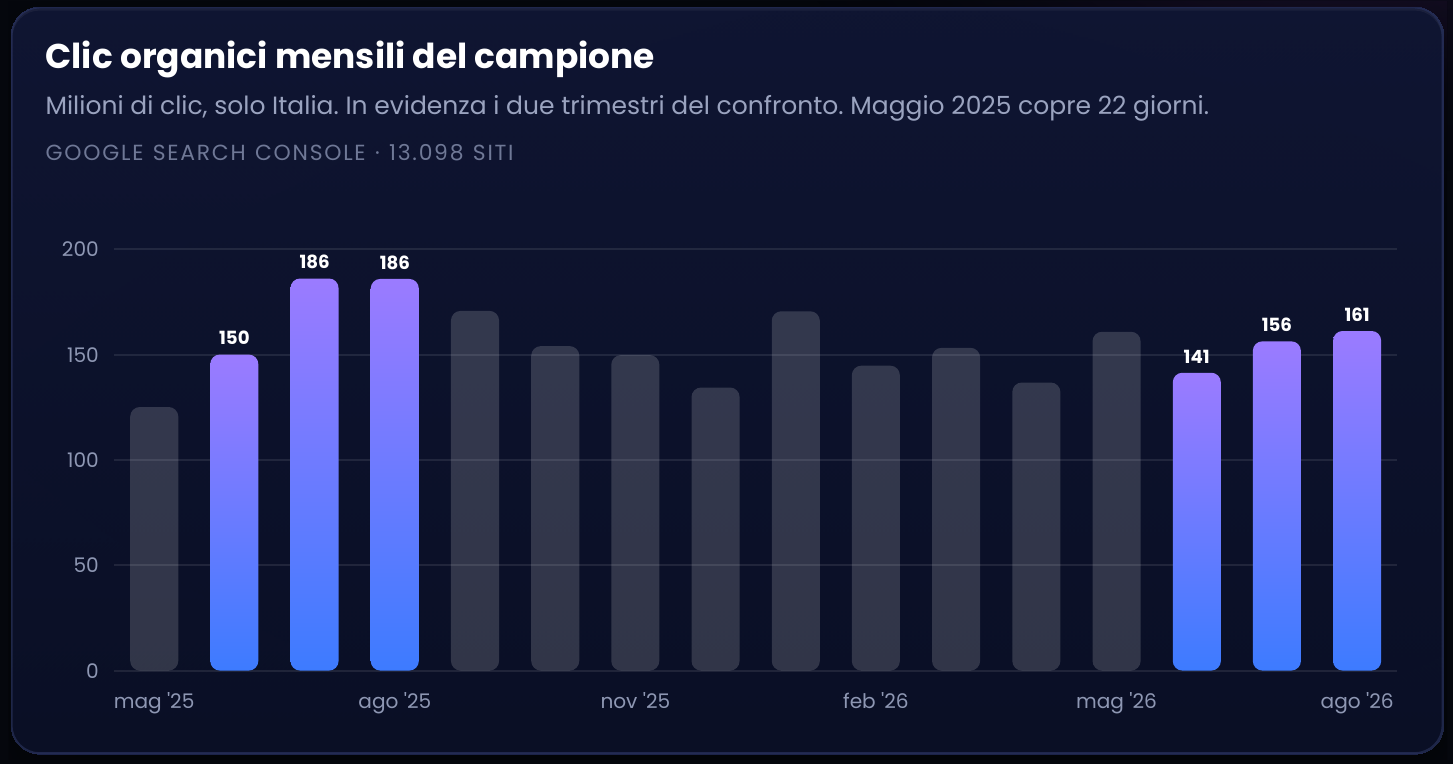
Between one summer and the next, the monthly average of organic clicks drops from 174 to 153 million, and from June to August 2026, 63 million clicks are missing, 12.1% less than a year earlier. The median site loses 11.3%, and after summer 2025 the click curve never returned to its starting levels. Waiting for things to go back to normal means building your 2027 plan on traffic that no longer exists.
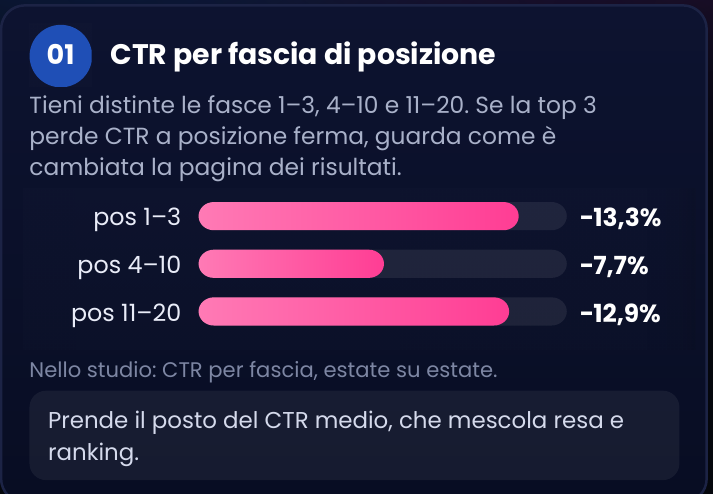
Over the same period, impressions for searches where those sites rank in the top 10 drop just 2.9%. What’s declining is the yield of each appearance, the CTR, the share of impressions that turns into a click, lower than a year ago across every position range and every type of site, and in positions 1 to 3 it drops 13.3%. This is a conservative estimate, because since September 2025 Search Console counts fewer impressions, and a lower count alone pushes CTR upward.
Of the 12 clicks out of every 100 that are missing, about a quarter is lost because sites show up less often in the top 10, while the rest goes to platforms that have taken their place. Almost certainly, the largest share is captured by AI Overviews and the panels Google displays above the first result. The answer now arrives before the click, people find it right on the results page and stop there, and searches that end with no click now reach even the top positions.
The missing traffic doesn’t resurface on other channels
Searches that move to ChatGPT, TikTok, or another search engine and end with a visit still show up in Google Analytics, either in the channel they came from or under Direct, and a migration of people would keep the total number of visits steady. In the second sample we tracked, 11,713 sites from the SEOZoom database with Analytics data, the total drops too, and the median site closes out summer 2026 with 10.8% fewer visits across all channels combined. Referral and paid search decline more than organic, which loses 14.9% in Analytics, more than the 12.1% seen in Search Console, because Analytics counts visits and does so across a different set of sites.
| Channel | June-August 2025 | June-August 2026 | Change |
|---|---|---|---|
| Organic search | 394.8M | 335.9M | -14,9% |
| Direct | 341.6M | 365.8M | +7,1% |
| Organic social | 67.0M | 60.5M | -9,8% |
| Paid search | 55.3M | 41.6M | -24,7% |
| Referral | 34.5M | 21.8M | -36,7% |
| Paid shopping and paid social | 45.1M | 46.3M | +2,7% |
The only major channel that’s growing is Direct, up 24 million visits against the 59 million lost by organic. It captures visits with no recorded source, from typed URLs to AI assistant apps, and Analytics doesn’t break out how many come from the latter. Even crediting the apps with all of that growth, the recovery still falls short of half.
Social platforms send fewer visits almost everywhere, a quarter less from Facebook, half as much from Instagram and TikTok. Traffic to sites is shrinking across web search as a whole, with fewer visits coming even from Bing and DuckDuckGo, and Google still accounts for 97.2% of organic search.
Visits that AI engines send to sites are growing fast, more than doubling over the past year, but they remain small compared to the traffic that’s missing. Among the 3,297 declining sites connected to Analytics, about 2.5 visits from AI arrive for every 100 lost organic clicks. On average, a visit from AI generates 1.41 times the key events of an organic visit to the same site, meaning purchases, contacts, and sign-ups. AI traffic is already its own channel and should be kept separate from organic in your analyses.
Platforms have become competitors inside Google
Google keeps giving more room to large platforms. In our Observatory we’ve tracked the results page for a fixed list of 20,000 keywords since September 2024, and YouTube, Facebook, Wikipedia, Reddit, and the other web giants held 17.8% of the top 10 in fall 2024, a share that’s grown to 20.5% by summer 2026. Every position they take is one less position for everyone else.
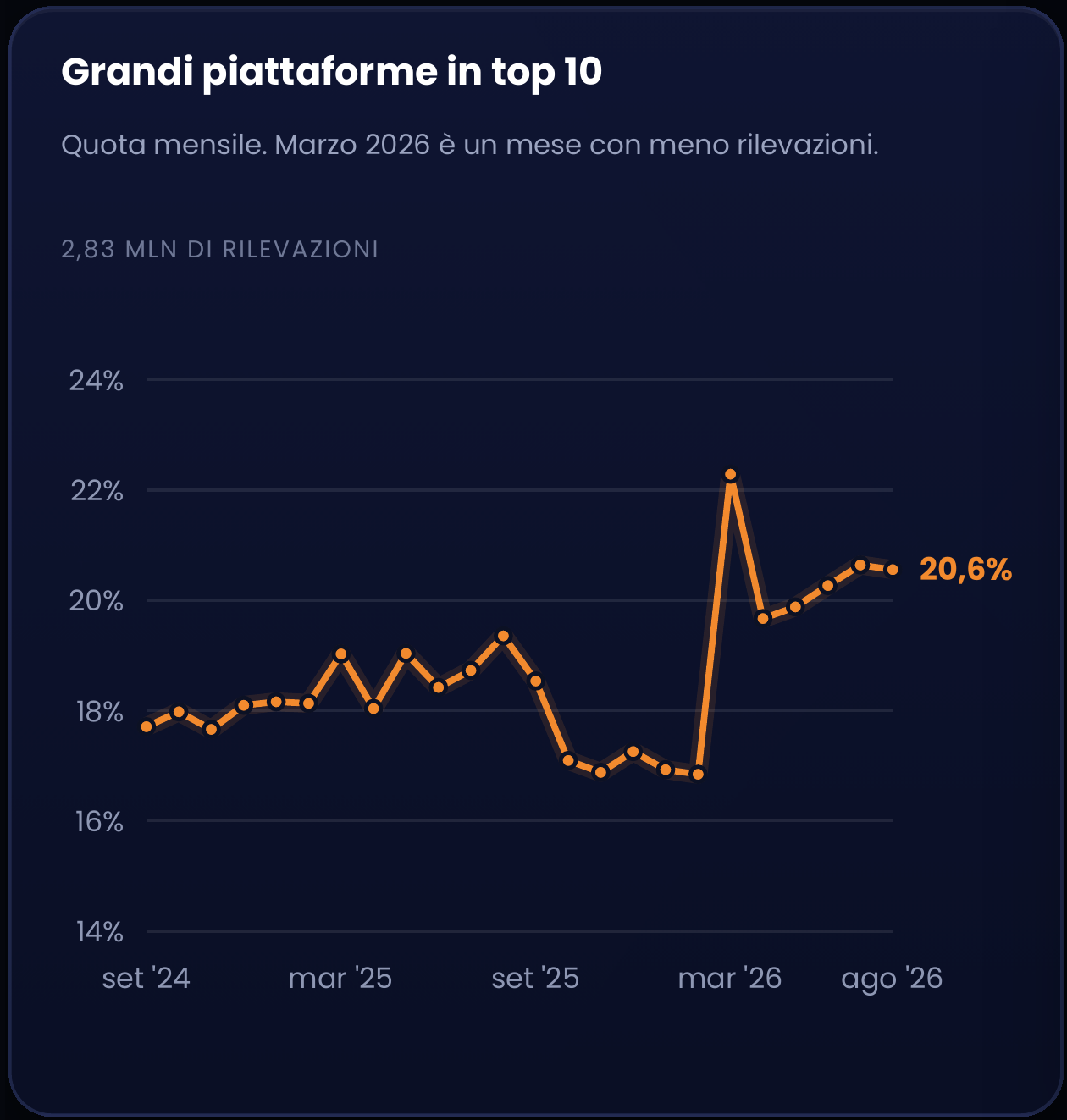
Social media, community sites, and Wikipedia are gaining ground, with Reddit up 3.5 times its starting share and Instagram nearly doubling. Amazon, eBay, Subito, and Tripadvisor are losing ground. Google seems to be rewarding firsthand experience from people and communities.
The social platforms climbing into the top 10 are the same ones sending less traffic to sites, Pinterest aside, and their strength lies in competing for first-page spots. For some keywords, the top 10 competitors are YouTube videos, Reddit threads, and social pages alongside the usual industry sites. Showing up there becomes a ranking choice on Google, not just a social presence one.
The click survives where Google’s answer isn’t enough
The median blog loses 20.1 percent of its clicks and, in positions 1 through 3, 28.4 percent of its CTR, the steepest drop among site types. For e-commerce sites, CTR in the top three positions falls by 12.5 percent; for service sites, by 7.4 percent.
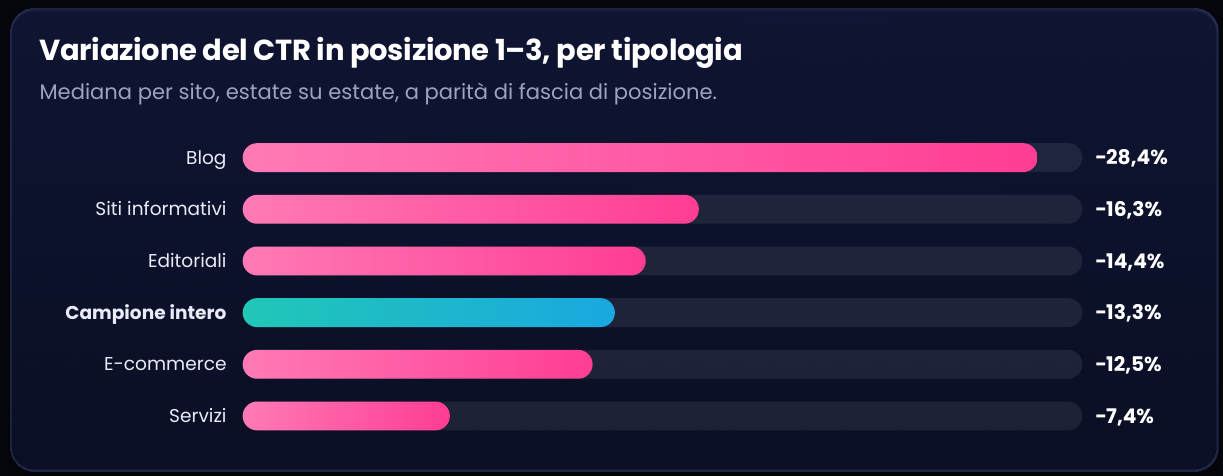
In our view, what determines how well a position performs is search intent, how fully the results page already answers the query, and how well the person already knows the brand. Services and e-commerce are sites where the visit exists to buy, book, or make contact, and there Google’s answer isn’t enough.
Pages that drive action need protecting first. A lost click on a product page or a contact page costs more than one on a guide, because there the visit is the step toward a purchase or a request. The CTR of those pages should be read alongside conversions.
Articles answering generic questions bring in fewer clicks, and multiplying them isn’t worth it, because AI tends to summarize them without mentioning you. They remain, though, the material Google and AI systems draw their sources from, and answer content matters less for traffic and more for the trust a site earns as a source. Proprietary data, real case studies, and attributed, firsthand experience give AI systems something specific to cite.
Brand protects
Searches that include a brand name lose 11.1% of clicks, while generic searches lose 19.5%. Brand holds up better because someone searching “brand + need” already knows where they want to go, so a generated answer matters less to them.
In total traffic, brand searches mask the erosion happening in generic ones, so SEO judged on overall numbers can look fine even where it’s actually losing ground. Brand becomes a channel worth investing in, with digital PR, community building, newsletters, and video driving growth in the searches that hold up best.
SEO stays at the center of the strategy
Across the 20,000 keywords in the Observatory, 98 percent of AI Overview citations go to domains already ranking in the organic top 10 for that same search. Google almost always picks the sources for its answers from domains it has already placed on page one. The top 10 still matters, but it pays off less. A first-page position brings in fewer clicks than a year ago, while also putting the site forward as a source for AI answers, and that needs to be leveraged through brand, citations, and action-driving pages.
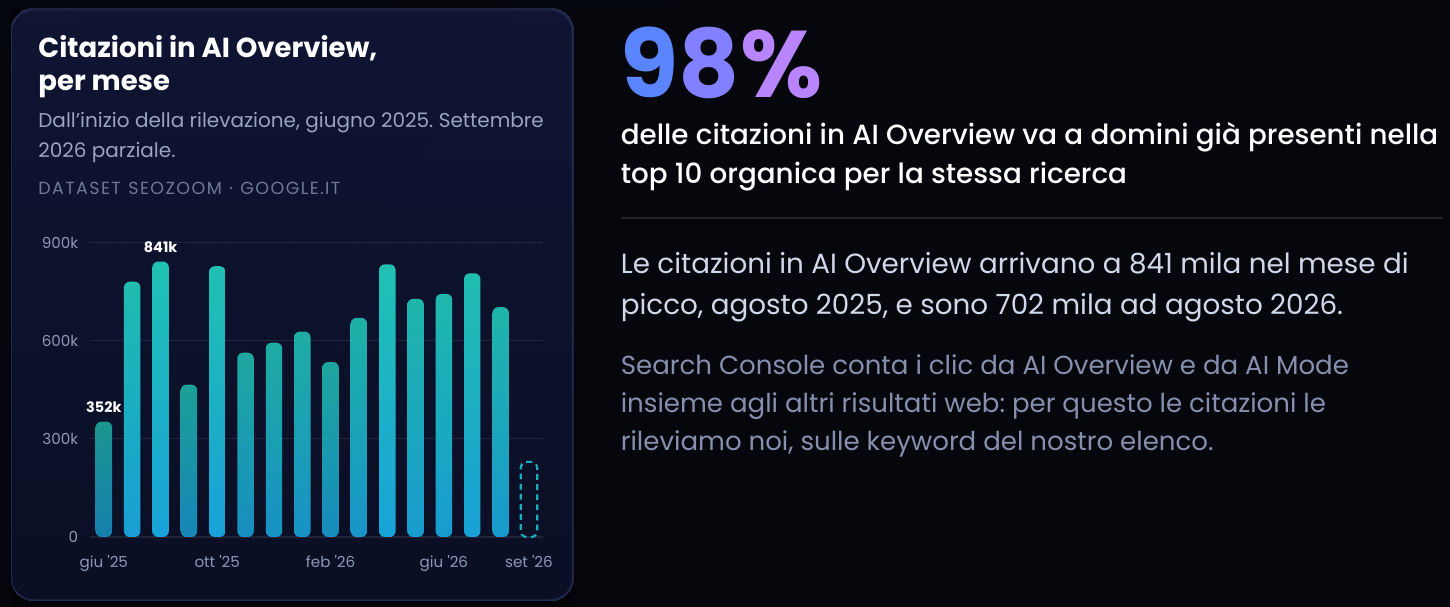
SEO is still central to the strategy. AI Overview and AI Mode are still SEO work, because they run on the same systems as Search, which require a page to be indexed and eligible to appear with a snippet before showing it among their links. Assistants looking for up-to-date information on the web rely on search engine indexes, Google chief among them, and without indexing and SEO visibility they won’t pick up your pages. SEO for AI extends that work to model memory and to assistants that don’t depend on Google, and dropping SEO to chase AI means giving up on their answers too.
Total traffic is no longer enough to decide where to act
What to do depends on where you’re losing ground. Stable impressions with falling CTR call for different work than a drop in rankings, and traffic built on generic searches has different priorities than traffic from a brand people already search for.
How you measure organic traffic needs to change before your strategy does. CTR by position range replaces average CTR, which blends performance with ranking, with the 1-3, 4-10, and 11-20 ranges read separately. Impressions alongside clicks show how often you show up and how well each appearance performs.
In the SEOZoom platform, you connect Search Console and Google Analytics from the Integrations page, and Period Comparison sets clicks, impressions, CTR, and average position against the same period the year before. It also lists the keywords and pages that lost the most clicks, with figures for both periods. Among the declining keywords, those that dropped in position have a ranking problem, those losing impressions at an unchanged position are affected by fewer searches or by the count Search Console changed in September 2025, and those holding position and impressions while getting fewer clicks have the falling CTR we measured across each range.
When rankings stay flat but CTR drops, check how the results page has changed. In Keyword Explorer, the “High Impressions, Low Clicks” category collects the searches with the weakest performance, the SERP Features column shows where AI Overview appears, and the Brand filter separates searches that include your name from generic ones. Social Opportunity starts from the competitors listed in your project and finds their keywords where YouTube, social platforms, and communities rank in the top 10, the searches where it pays to show up there too with published content.
AI reads a lot and gives back little
As of August 2026, answers from Google AI Mode, ChatGPT, Perplexity, and Gemini to the questions we monitor contain 7.9 million citations, and for now, visits flowing back to sites remain few. Citations should be measured separately from clicks, as a result in their own right, and we’re the ones tracking citations, since Search Console counts clicks from AI Overview and AI Mode together with other web results.
In the project, the AI Overview feature identifies the keywords where your site appears among Google’s source citations, tracking mentions and how often you’re cited first, while AI Visibility captures your domain’s presence in AI-generated answers, including which pages get cited and which competitors show up most. AI Prompt Tracker measures how often you’re cited and mentioned for the questions you choose, and your share relative to competitors. The project’s AI section counts, using Google Analytics data, the visits coming from AI engines, broken down by engine and by key events.
An answer can also name you and attribute incorrect information to you. GEO Audit shows what the models have learned about your domain, AEO Audit shows how ChatGPT, Perplexity, and Gemini talk about it today, and the AI Competitor Analysis lets you compare yourself against competitors.


 Verified reviews on Trustpilot