A good “about us” page stops being enough for AI
What survives from your stated identity in AI answers, and which sources get the credit: SEOZoom analysis of ten Italian brands
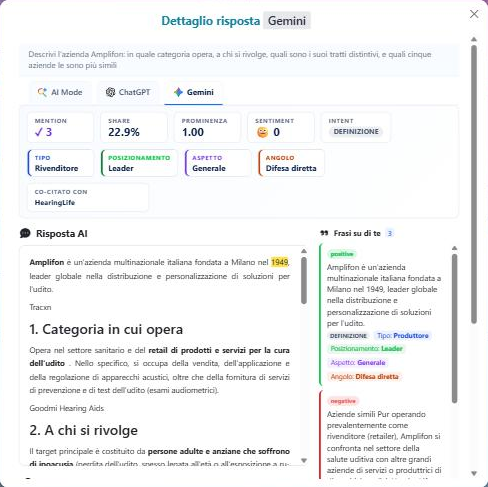
Gemini is convinced: Amplifon is a multinational Italian company founded in Milan in 1949. Too bad it was actually founded the year after.
This isn’t a simple hallucination: to answer the user’s prompt, the engine didn’t use Amplifon’s “about us” page, which is well written, up to date, and full of verifiable figures, but instead pulled information from a database of company profiles and reported what it found there, errors included.
To find out how often this happens, we analyzed ten Italian brands that have invested heavily in their own narrative, and in two out of five answers the official site was left out of the sources entirely. When a profile compiled by someone else is doing the talking about you, rewriting your own pages doesn’t change a single line of what the person searching for you reads.
The sources an assistant opens to describe a company
AI builds the answer on the fly: it searches, opens a few documents, and stitches the pieces together. The sources can be the official site, a profile on a business database, a reseller’s listing, and in the final text the different voices merge into one, written with the confidence of someone who’s known the company for years. The model has the name and the industry of the brand in memory; it fills in the rest with whatever it just opened.
On your own site you choose every word of how you want to be known, but in the answer that text counts for only as much as the sources sitting next to it, and it only matters if the assistant actually opens it.
The alternatives have a name and a revenue model. Tracxn, Owler, craft.co, CB Insights, RocketReach, apistemic, and GlobalData sell company information to investment funds, sales offices, and recruiting firms. On those platforms every brand has a page broken into fields: founding year, headquarters, estimated revenue, employees, main competitors, compiled from filed financial statements, press releases, and job postings, with an estimate wherever public data is missing. Updates follow the commercial value of the profile: a funding round goes in fast, a corporate reorganization can stay out for months.
Faced with a question that asks to size up a vendor, that format works better. The data is already broken out and already comparable with everyone else’s, while an institutional page has to be read in full and keeps the numbers wrapped inside a narrative.
The question we asked the three assistants, and the pages we started from
To measure how often an assistant describes a company without opening its site, we asked the same question to ChatGPT, Gemini, and Google AI Mode about nine Italian companies. Probios, the tenth brand, was included as a comparison term for Alce Nero and is left out of the counts.
Hanno tutte un marchio riconosciuto nel proprio settore, una pagina istituzionale curata e densa di dati controllabili, e nessun problema di notorietà. Amplifon per le soluzioni per l’udito, Technogym per le attrezzature per l’allenamento, Brunello Cucinelli per la moda di lusso, Datalogic per l’automazione industriale, Florim per le superfici ceramiche, Arper per l’arredo di design, Aboca per i prodotti naturali per la salute, Alce Nero e Probios per l’alimentare biologico, Satispay per i pagamenti digitali. Se il ritratto si deforma su di loro, si deforma su chiunque.
La domanda è sempre la stessa…
From the pages where each company introduces itself, we extracted every claim that an outside party could verify, word for word – a date, a market share, a certification, a record, a size figure, a stated value – and arrived at 107 sentences. We ran the prompt through AI Prompt Tracker, the tool SEOZoom uses to query ChatGPT, Gemini, and Google AI Mode, which stores the full text of each response along with the list of open sources and the brands cited next to it. We then searched for every sentence inside the three responses about its own brand: it reappears identical, gets reworded, or disappears. The counts cover nine companies, because Probios was included as a comparison term for Alce Nero.
The pages were read on September 10 and 11, the responses on the 17th. ChatGPT opened the company’s site in all nine responses, Google AI Mode in four, Gemini in three: in 11 out of 27 responses the official domain doesn’t appear among the sources, replaced by profiles compiled by third parties.
When the site gets left out, the data comes from a database profile
On its corporate site Amplifon states 75 years of history since its founding in Milan in 1950, alongside the figures of a global hearing-care multinational: 20,600 people in 25 countries, 8,800 hearing care professionals, 13% of the world market, 2.4 billion in revenue. ChatGPT opens those pages, goes through the Annual Reports, and returns almost every number.
Gemini never touches the site. It reads Tracxn, and Tracxn’s Amplifon profile opens like this: “Amplifon is a public company based in Milan (Italy), founded in 1949 by Juan Gasso and Jose Maria Espoy.” That year and those two names belong to GAES, the Spanish hearing-aid company that Gassó and Espoy founded in Barcelona in 1949 and which joined the Amplifon group seventy years later. The profile attributes them to the parent company, Gemini copies them, and none of the stated figures survive in the response.
With Technogym the pattern shifts to a different pair of elements: the claim and the measure meant to prove it. On the page where it introduces itself, the company calls itself the “world leading brand in the fitness, wellness, sport, and health sector,” and right below gives the scale behind that claim: 75 million people training with its products, 100,000 wellness centers, 500,000 private homes. Gemini and Google AI Mode read craft.co, Owler, CB Insights, Tracxn, and Mordor Intelligence, and from there pull “global leader” without a single figure attached. ChatGPT, which opens “About us,” cites the 500,000 homes but never says the word leader. The claim travels on its own, while the evidence behind it stays on the site.
With Datalogic the profile isn’t wrong, it’s blurry. The company claims roughly 1,200 patents; Google AI Mode reads apistemic and GlobalData and writes “hundreds of patents.” And there’s a fact none of the responses records: Datalogic left the stock exchange on September 9, delisted from Euronext Milan after a tender offer, and eight days later all three assistants still describe it as a publicly traded company.
When the site is among the sources, but the description still comes from elsewhere
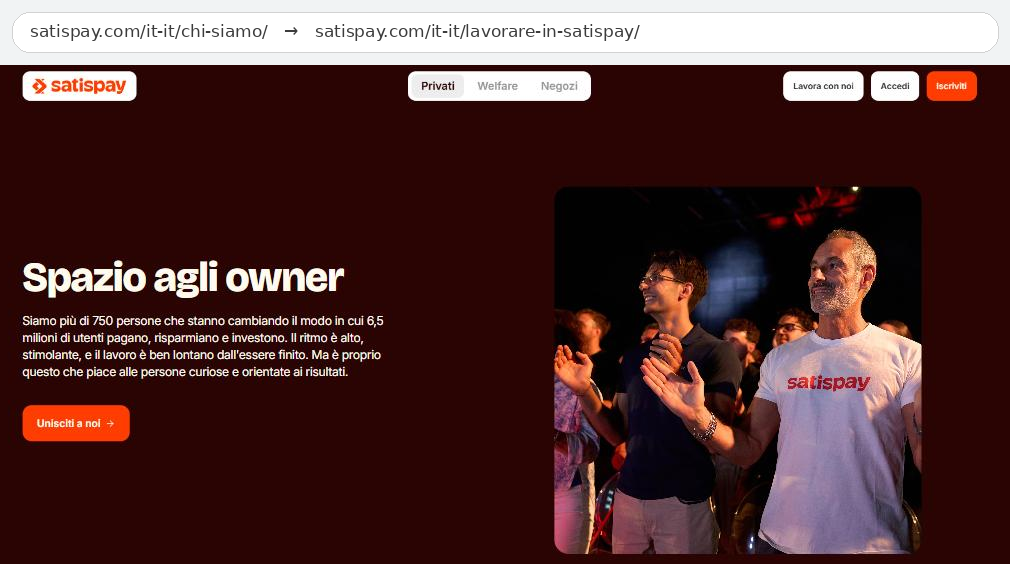
Satispay’s domain appears among the sources of all three responses, and a citation metric would log that as full presence. Its figures – 6.5 million users, over 450,000 merchants, more than 750 people across Milan, Luxembourg, Barcelona, and Naples – are reported only by ChatGPT. The address satispay.com/it-it/chi-siamo/ redirects to a “Work with us” page: the numbers are there, inside a job listing for candidates. An assistant can open the right site and still never reach the point where the company tells its own story.
Arper was founded in 1989 in Monastier di Treviso and designs furniture for offices, hotels, and homes. Google AI Mode opens arper.com and in the same response places the company in “Monfalcone (Treviso),” a town that isn’t its headquarters and doesn’t even belong to that province.
With Alce Nero all three assistants open the site. The company presents itself as a network of farmers: more than 1,000 in Italy, over 10,000 small farming businesses in Central and South America, about 400 products. ChatGPT copies all three figures. Gemini stops at 1978 and organic Fairtrade certification, counting “about 300 product lines.” Google AI Mode says nothing about the farmers. The same site, read by three assistants, returns three companies of different sizes.
Brunello Cucinelli tells the company’s origin story in the first person: its clothes should be “expensive, yes, but not pricey,” the segment is “absolute luxury,” and in May 1996 he writes “We need a new Humanism.” That page doesn’t appear among anyone’s sources. The investor relations site does, and with it comes a phrase that isn’t on brunellocucinelli.com: “Humanistic Capitalism.” In the Tracker, those citations don’t count toward the project’s Citation Rate, which tracks only the main domain and leaves out subdomains: the brand reads a low score while the assistants are actually citing its own material.
What gets through is what someone else can confirm
Aboca makes two claims on equal footing: that it’s a Benefit Corporation, and that it holds patents, the first from 1986 for the total concentrate of the phytocomplex, the second from 1999 for the first excipient-free tablet. The corporate status shows up in all three answers; the patents show up in none. Florim repeats the pattern: B Corp certification appears everywhere, while its 1967 white monocottura tile and its 1981 porcelain stoneware, the company’s actual industry firsts, stay on the page.
Benefit Corporation and B Corp status show up in public registries anyone can check. A patent from 1986 and an industry first from 1981 exist only where the company itself claims them.
That’s the same reason Arper’s five values – Responsibility, Care, Openness, Imagination, Courage – don’t get cited anywhere, while Cucinelli’s Humanistic Capitalism shows up everywhere: one lives in a document that someone outside the company keeps updated, the others don’t.
The categories in the table group together things that differ by nature: qualifications and industry firsts are the formulas a company uses to position itself, corporate status covers legal form and certifications, founding history holds the year, founders, and milestones, size figures are headcount, countries, products, points of sale, and revenue, and values are the words a brand uses to declare how it operates.
| Type of phrase | ChatGPT | Gemini | Google AI Mode |
|---|---|---|---|
| Credentials and records (30) | 15 | 16 | 15 |
| Legal status and certifications (16) | 9 | 6 | 8 |
| Founding and history (22) | 6 | 7 | 7 |
| Size figures (25) | 14 | 2 | 2 |
| Values (14) | 3 | 2 | 2 |
51 out of 107 statements don’t show up in any answer, on any assistant. The 26 that show up across all three are mostly qualifications, and not one of them is a figure that measures the company. With the site among the sources, one in three statements resurfaces; without the site, it’s one in eight.
The five names that close out every answer
The end of every answer lists five similar companies, and that’s the part a potential customer reads to figure out who you compete with, and it’s also where brand recognition stops being enough. 10 lists out of 27 come from a third-party profile, eight from databases of company profiles, and two from an aggregator that compares domains rather than companies.
For Datalogic, ChatGPT pulls from Zebra Technologies’ annual report, where Zebra lists its own competitors: Datalogic, Honeywell, Cognex, Keyence, SICK. In the list that shows up in the answer, Zebra takes Datalogic’s place and the other four names stay intact. A competitor ends up describing the brand’s own market.
Probios takes the mechanism to its logical end. When the question is about Probios, the similar companies listed include Baule Volante, Finestra sul Cielo, and Fior di Loto, brands Probios acquired in 2024 along with BiotoBio. When the question is about Alce Nero, ChatGPT calls it “the most direct comparison” and credits it with “a strong specialization in organic, health-focused, and free-from food”: the line Probios uses to describe itself ends up delivered inside the answer about a different company.
How to read your brand’s portrait
Measuring a brand’s visibility inside AI answers starts here, and the text of an answer alone doesn’t tell you where to intervene: the same wrong statement can come from your own page or from an external profile. The description prompt has been added to the ones tracked in the Tracker, and every answer comes with open sources and co-cited brands.
- Copy your stated claims. The exact wording from your institutional pages.
- Separate figures from credentials. Mark what an outsider can verify and what remains just your word.
- Run the prompt on ChatGPT, Gemini, and Google AI Mode.
- Compare line by line: identical, reworded, or gone.
- Check the sources: which of your pages got opened, and which outside profiles spoke for you instead.
- Compare the identity. Among the SEO for AI tools, GEO Audit shows which attributes assistants associate with your domain and where ambiguity remains, while AEO Audit checks whether that identity holds up inside answers built on the fly.
- Check the neighborhood. Competitor AI Analysis compares your brand against competitors inside AI engines, on visibility, trust, and semantic relevance: the same readings we used to separate Ferrari’s and Havaianas’ name recognition from their citability.
- Re-trigger the crawl. Run a “re-scan” after every fix, on your pages or on outside profiles, and track the comparison over time with the GEO checklist.
Fixes, on your own pages and on outside profiles
Where a statement gets lost tells you which side to work on, and the patterns repeat with surprising regularity: across the nine companies in the study, eight show the same pattern. A qualification that comes through while the numbers lag behind points to an external-source problem; a figure that comes out different from how you wrote it points to a profile that needs fixing; a formula you never used points to a subdomain speaking in place of the main page.
The signal is almost always in the list of sources, and it changes what you fix, not how urgently you need to fix it.
| Signal | Where to find it | Fix | In the study |
|---|---|---|---|
| The credential gets through, the numbers don’t | Sources used | Put the figures into the outside profiles the assistant opens instead of your site, too | Technogym |
| A figure comes out different from yours | Sources used | Fix your profile in the source that carries it | Amplifon |
| The site gets opened, but not the right page | Sources used | Keep the presentation on a stable page whose purpose doesn’t change | Satispay |
| A phrase your page doesn’t use shows up anyway | Sources used, Citation Rate | Align corporate and investor subdomains with your institutional page | Brunello Cucinelli |
| Nobody cites the values | Comparison between stated claims and the text | Pair each value with the fact that proves it | Arper, Aboca |
| A corporate change gets left out | Sources used | Update institutional pages and outside profiles as soon as it happens | Datalogic |
| The named peers change with every assistant | List sources, co-cited brands | State on one of your pages the market you compete in and who you compete with | Amplifon |
| You show up in answers about competitors | Competitor prompts in Tracker | Check how they present you when the question is about someone else | Probios |
Working on external profiles looks nothing like editorial work. Every portal has its own process: some let you claim the company profile with a business email and correct it directly, others take a report and act on it whenever they get to it, and others still never respond and keep serving the old data to anyone who asks, assistants included. On that last group, the only lever is making the correct version more prominent than the wrong one, right where the databases source their data: press releases, industry profiles, trade association pages, financial portal listings.
Getting corrected data back into circulation takes weeks, and in the meantime the answer stays the same. That’s why it pays to check the sources before rewriting the pages, not after.


 Verified reviews on Trustpilot