2027 Budget: why SEOZoom belongs on your spending plan
SEOZoom takes up one line in your budget. Cut it, and the savings show up right away. But where does the analysis, monitoring, and work that line covered actually go?
1,200 euros. That’s the price an Italian agency lists for a GEO Audit, an analysis of how AI models interpret a brand: what they know about you, where they get it wrong, and what’s worth fixing. Within a few business days the report lands in your inbox, you sit down for a call where they walk you through it, and you walk away with a list of things to fix.
A number like that has everything a budget line needs: a vendor, a date, a defined scope. It has nothing to do with the eleven months that follow.
What you still have to pay for once you cut us
If you’re putting together your 2027 budget, SEOZoom is one of the line items you can cut without anything grinding to a halt tomorrow morning. No site goes offline, no campaign shuts down, no client notices. The savings are immediate and visible, and that’s exactly what makes it easy to cut.

In a budget, a specific line item is easier to defend than a cross-functional capability. “I’m putting 16% into SEO,” “I’m increasing marketplace advertising,” “I’m cutting email marketing”: these choices fit into a precise box. SEOZoom is harder to squeeze into a label. You use it to choose content, track competitors, read real and estimated data, follow AI answers, check technical issues. The subscription takes up a single line. What you do with it touches many more.
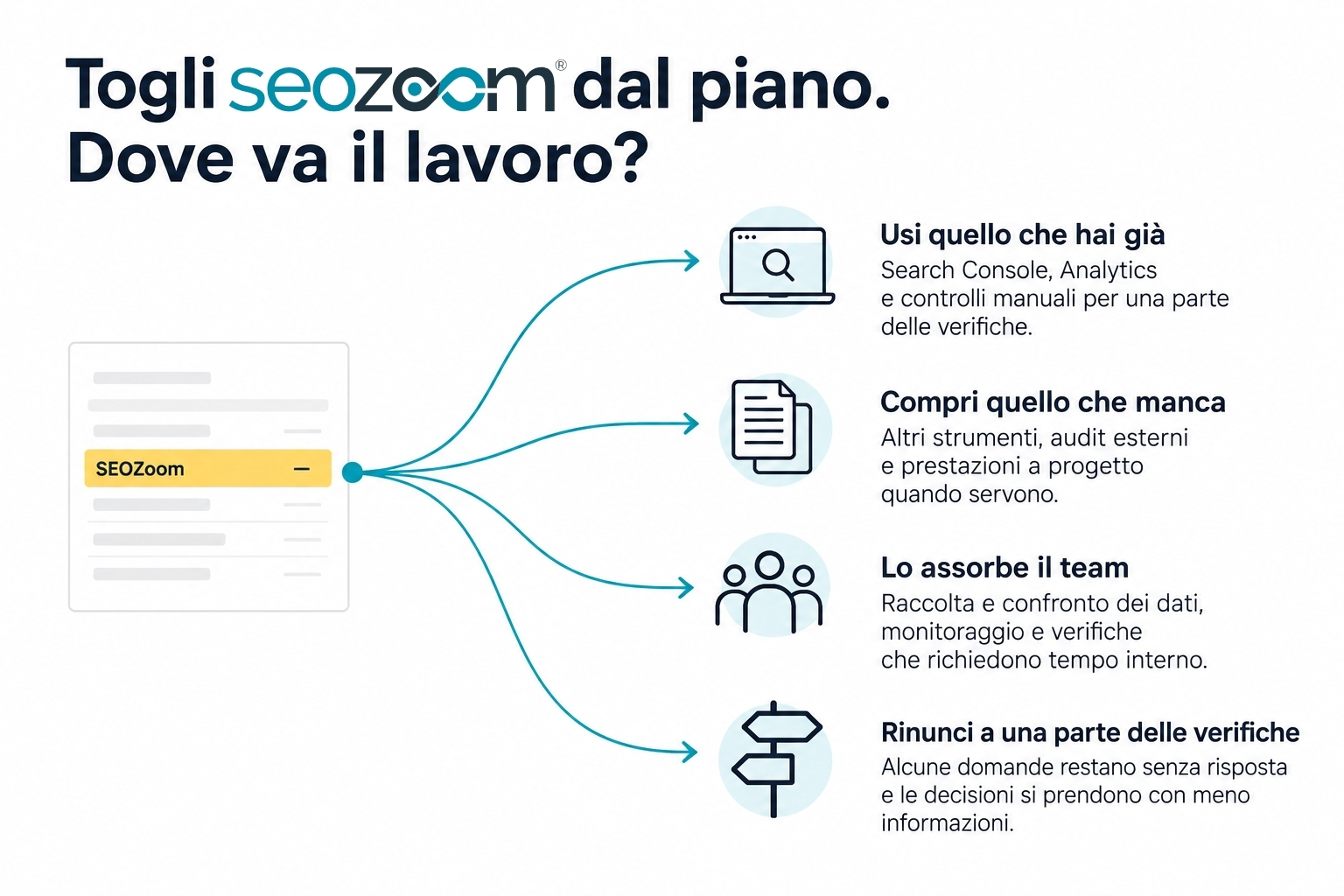
For your own site, Search Console gives you queries, clicks, and pages for free, and for a lot of questions that’s enough. To see how competitors are moving, or which searches you’re still not showing up for, you need another tool. You can buy an AI audit as a one-off service, like the 1,200-euro one. You track prompts on assistants by hand. Or you can skip something altogether. Either way, the cost just takes a different shape: another subscription, a one-off service, your team’s time, or a decision made without that check.
If you want to compare AI assistant responses six months from now with today’s, today’s baseline has to exist. Prompt tracking series start the moment you begin recording them; stop monitoring, and that stretch stays blank. Search Console and Analytics, on the other hand, keep holding on to whatever data is available in your accounts.
The work you have to do either way
One of your pages that used to bring in customers drops in rankings. To figure out why, you check which keywords it lost and since when, and you look at whether a new competitor showed up or whether you undercut yourself and another page on your own site jumped ahead on the same search. Lost keywords and pages swapping places you can find in Search Console, by filtering the Performance report by page and by query; a new competitor you only spot by looking outside your own site. Even knowing exactly where to dig, you know how much time it takes to go from one check to the next.
Deciding which content to work on now instead of in November means cross-referencing search seasonality with the pages you’ve already published. For the technical side, you run the site through a crawler and read the results, because Search Console flags only some of the URLs returning errors or declaring a wrong canonical, and you find the rest only by going looking for them.
If you need to know why a page is losing ground and where it’s worth putting in work, that work doesn’t go away. You just choose who does it and how long it takes.
In your SEOZoom Project, the area where you connect your site and start your analyses, the overview opens with a set of findings ranked by priority. Among them are declining pages, with estimated visits before and after, and an “Analyze Page” button that opens the page’s detail view: keywords with position and change, a chart where you pick a time range to see what shifted, other pages on your own site covering that topic, and competitor pages on it. Other findings flag pages on topics expected to see rising interest over the next three months, or technical errors from the latest SEO Spider crawl, which you can rerun whenever you need to. The time you’d spend checking doesn’t disappear. You spend it deciding instead of gathering data.
Findings are hypotheses, not verdicts. The visits SEOZoom attributes to a page are estimates; the real numbers live in Analytics, and whether merging two pages is actually worth it is something you see for yourself by opening them up. You start from a list of things to check instead of a hunch and a pile of sources to cross-reference.
The answers no console gives you
For organic search, Search Console remains the fixed point, with data coming straight from Google. On AI-generated answers, the engines only started giving you anything this year. Since February, Bing Webmaster Tools, in public preview, counts citations of your pages in Copilot and the queries that surfaced them. As of August 31, the Search Console report on generative AI is available to all properties and shows impressions in AI Overviews and AI Mode, though sites with very few may not see it at all. Both reports log when one of your pages showed up or got cited, not what the answer actually said, and Microsoft spells this out plainly: the citation count doesn’t indicate the page’s role within that specific answer. How many times ChatGPT pointed to a competitor instead of you is something no console will tell you; to find out, you have to go get it yourself.
You can check everything by hand: open the assistants, write the prompts a client would actually use, read the answers, note which sources get cited and which brands show up next to yours. Doing this once doesn’t require any tools and gives you useful material.
A check you run today only stays useful three months from now if you can compare it to the next one. Showing up among the cited sources, being named inside the answer, and being recommended are three different outcomes, so you need to apply the same criteria over time, even when someone else is the one reading the results. Without a date, or with a prompt that changes wording, the results start speaking different languages.
AI Prompt Tracker repeats these checks with consistent criteria and dates across multiple assistants. After the initial setup, it periodically runs the prompts you choose through ChatGPT, Gemini, and Google AI Mode, qualifies each answer using the same criteria – citation, mention, recommendation – and archives it with its date. Competitors who show up in those answers get counted alongside you, and you also find the domains feeding those answers even when you never appear.
You can build a comparable series by hand too. A handful of prompts checked now and then is something you can manage on your own; dozens of prompts across three assistants every week becomes a fixed job for someone on your team.
When you buy the analysis elsewhere
In an outside engagement, the part that matters most is the interpretation: someone who knows your market reads the data and tells you which problem to tackle first, and why. Software doesn’t give you that part, and whoever does it well is worth what they cost.
Once the work is delivered, you get a report with its date and recommendations, and a good provider leaves you the method too: the prompts used, the criteria for classifying answers, the raw data. If you bought a one-time job, the next check is a new agreement; with an ongoing relationship, it may already be included. Switching providers or methods can reduce how comparable the numbers are, and that’s true whether you’re switching between two consultants or two pieces of software.
A continuous series saves you from rebuilding your starting point every time. The answers to the prompts you track, the GEO Audits and AEO Audits you run, the keywords you monitor all stay in a dated sequence within the same environment. The interpretation stays professional work, whether done in-house or outsourced.
What it costs you not to budget for it
There’s no single total for this, because it depends on how you work. In your budget spreadsheet, SEOZoom takes up one line, while the cost of alternatives spreads out. Part of it shows up on invoices: analyses you buy externally when you need them, subscriptions for tools that each cover one function at a time. The rest has no line of its own: the hours your team spends collecting and standardizing data before anyone can read it, and the checks you put off because each one needs a separate purchase decision.

Budget shares can shift quite a bit from one year to the next. In the Ecommerce Italia 2026 report from Casaleggio Associati, SEM drops from 30% to 22%, email marketing from 11.5% to 7%, while marketplace advertising rises from 3.2% to 7%. SEO stays at 16%. The 2027 plan is built on shifts like these too: some line items lose ground, others gain it. SEOZoom has to earn its place too.

If you’re paying separately for an AI monitoring service and your subscription already includes one, compare what each one tracks: where they overlap you’re paying twice, elsewhere you’re buying something you were missing.
A check is worth the money when its outcome can change something you have planned; otherwise, skipping it is real savings.
Leaving it out of the plan is the right call when what you’d use during the year is minimal or occasional, the decisions riding on it carry little weight, or you’re already covering it well with what you have. For a one-off need, a targeted engagement can serve you better than a subscription, even at a higher price, because it comes with a person’s actual work.
If the line item stays, size the plan to the real workload. The pricing page compares limits and features based on the sites, monitoring, and analyses you’ll actually use.
Cutting the line item from the plan saves you a number you already know. What keeping it is worth gets measured against the work SEOZoom supports throughout all of 2027, and what it would cost you to do that work another way.


 Verified reviews on Trustpilot