


Money Prompt: AI questions that drive revenue
“Which mattress should someone who sleeps on their side and suffers from back pain choose?” Anyone asking a question like this isn’t studying sleep. They’re trying to avoid making the wrong purchase, and have delegated the initial screening to artificial intelligence. In just a few seconds, the response narrows the field to two or three brands among the credible options, leaves others out, and assigns each brand a role in the decision-making process.
It’s a more common practice than you might think: 37% of consumers surveyed by ChannelEngine began their purchasing journey with an AI assistant. The transaction is then completed elsewhere—on a website, a marketplace, or in a store—because only 17% trust the AI enough to finalize the purchase within the conversation. But the initial selection still originates from a generated response that precedes the click, the visit, and the search for the brand.
You don’t write the prompt that triggers this mechanism—your customer does, the moment they stop exploring and ask the machine to choose for them. And it’s no longer enough for you to know whether you appear in that response, because it’s more important to understand which role you’re assigned in the shortlist that forms: recommended choice, budget alternative, niche specialist, marginal player, or a source used to construct the response without your brand ever being mentioned.
What Is a Money Prompt
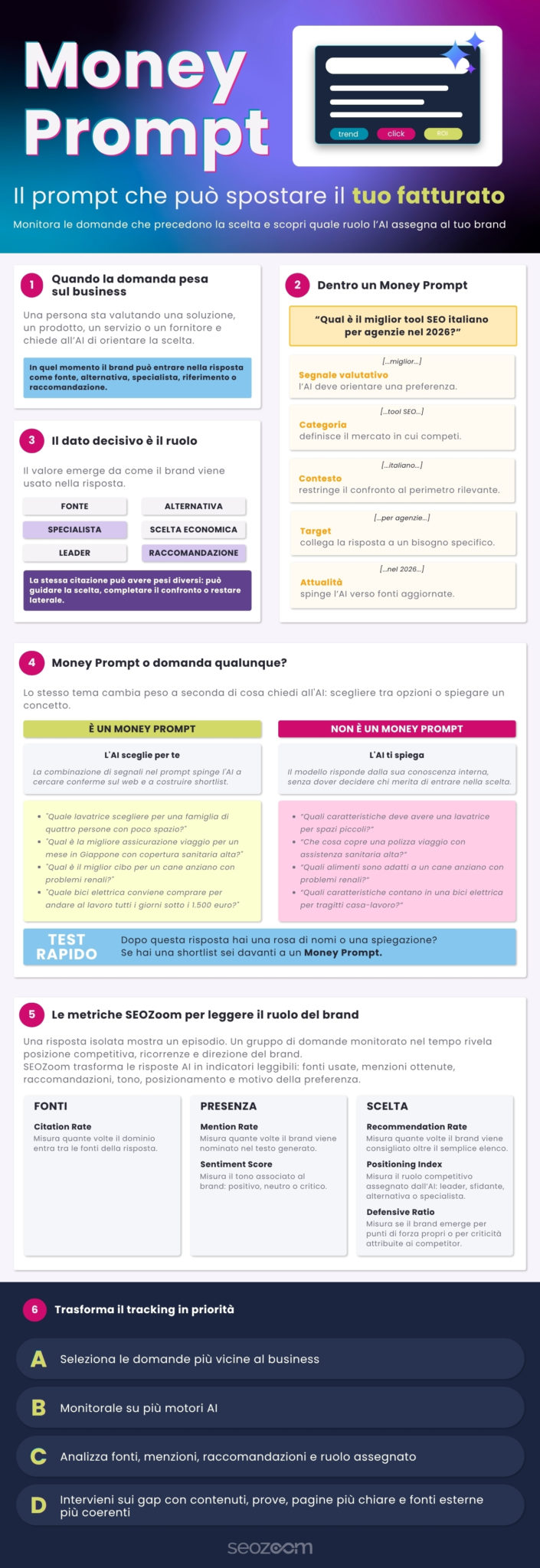
A Money Prompt is an unbranded query with high commercial intent directed at a generative AI model. The person formulating it already knows the category of interest, has a specific need, and is looking for a criterion to decide between products, suppliers, or solutions. “Best management software for a medical practice,” “lightweight stroller for frequent flyers,” “heat pump for a single-family home in a cold climate” all work the same way: they engage the AI in an evaluation and narrow the field down to a set of credible options.
They’re called Money Prompts because of their proximity to the moment of purchase and their potential economic impact. The name follows that of money keywords, which targeted a commercial SERP but left the user to sort through the results entirely on their own. Today, the same query can reach the customer as a pre-filtered comparison, complete with a reasoned recommendation, and the work that used to involve opening six tabs and comparing them side by side is now delivered ready-made within the text.
Even before it’s a category of questions, it’s a unit of observation: the precise point at which you examine what happens near the point of sale. It isolates the moment when a customer stops exploring and asks the system to choose, and it shows what happens within that single decision—which names come up, in what role, and with what argument. It’s the lens through which you read the market, one question at a time.
Anatomy of a Commercial Prompt
“What’s the best electric bike for commuting to work every day without spending too much?” condenses into a single line everything that makes a prompt commercially rich. “Best” calls for a judgment rather than a list; “electric bike” defines the category in which you compete; “for commuting to work every day” ties the output to a specific use case and customer profile; “without spending too much” introduces the budget constraint that filters the alternatives.
Taken one at a time, these elements remain partial; put together, they shift the AI’s focus from the general category to the specific use case, ultimately asking it which products are suitable for that daily use, that profile, and that price range.
The same mechanism can be seen in “What is the best heat pump for a single-family home in Northern Italy in 2026?” “Best” opens the evaluation, “heat pump” defines the market, “detached home” narrows the use case, “Northern Italy” adds a geographic and climatic constraint, and “in 2026” drives the search toward up-to-date data on technologies, incentives, costs, and availability. Evaluation, category, use case, market, constraint, and timeliness—it is their combination that takes the answer from an overview to a specific selection.

The use case doesn’t just add detail—it changes what the response measures. A recommendation for a broad category primarily weighs brand awareness and widespread presence; a recommendation for a specific need shows whether the brand is associated with the right customer profile and the right problem—the only conditions that make that preference truly useful to those making a choice.
False Positives
A plausible conversation or a marketable need does not automatically become a Money Prompt. “What kind of mattress is best for back pain?” helps create useful content because it explores topics like posture, materials, firmness, habits, pillows, and doctor’s visits, but keeps the market in the background, since it clarifies the problem without bringing brands into the decision-making process.
To quickly understand where you stand, all it takes is a test: after the output, does the customer end up with a list of names or an explanation? “Which washing machine should a family of four with limited space choose?” pits brands against each other and aims for a preference; “How do you clean the washing machine drum?” asks for instructions. The subject is the same, but the value for the company changes, because in the first case the answer generates a shortlist of names, while in the second it resolves a practical question.
Even branded queries belong to a different phase. “Tempur or Emma for side sleepers?” carries significant weight for the brands mentioned, but it starts with two names already in the customer’s mind and serves to defend or shift a narrow comparison. The most useful Money Prompts for gauging the market come earlier, when the AI has yet to decide which brands to bring to the table.
There’s one last false positive: the prompt designed to resemble the product page you want to highlight. “ What is the best breathable memory foam mattress with lumbar support, fast delivery, a long warranty, a mid-range price, and positive reviews for side sleepers?” can generate an interesting output, but it measures the skill of the test writer more than actual market behavior. A Money Prompt remains useful when it strikes a balance—specific enough to guide the choice and natural enough to resemble what a customer would actually ask the AI.
Why AI Seeks Confirmation on the Web
A language model is trained on a large corpus of documents and then “frozen” at a certain date—the knowledge cut-off—which excludes recent events, products, prices, reviews, incentives, and changes from its internal knowledge. If a question contains elements not covered by its memory, the AI relies on external sources to avoid responding with inaccurate, outdated, or fabricated information.
Certain signals make this reliance much more likely. Evaluative adjectives—such as “best,” “most reliable,” or “that actually works”—present the system with a judgment it doesn’t want to get wrong, prompting it to seek consensus outside itself. Time references produce the same effect, as they indicate that up-to-date information is needed. Specificity—a comparison, an alternative to a well-known brand, or a narrow operational constraint—requires precise information that the model does not have stored in its memory. The Money Prompt arises when these elements combine—either evaluation and specificity or timeliness and specificity—and the more the question is both evaluative and precise, the more likely it is to name specific brands.
External search starts with traditional search engines, led by Google, and returns a limited number of results—which is why GEO relies on SEO. A second step then takes place: a re-ranking process that evaluates the snippets, titles, and descriptions, and selects which pages to open to compose the answer. The engine doesn’t read them all; it selects the few most relevant to the exact question, thereby changing a rule you might have taken for granted—because in classic SEO, outside the top rankings, you generated little traffic, whereas in a generative response, a page can be retrieved even from much lower down the list if it meets the need better than the others.
The Role Assigned in the Response
A Money Prompt asks the AI to resolve a business-related question, which is why the question “am I there?” doesn’t tell the search engine much. Your domain can serve as a source for the summary, your brand may appear in a list, or the response may point to you as the best option for that specific case. Three outcomes that are similar in form but different in value, because a recommendation is the step closest to a decision, while being a source or a mention only tells part of the story about your influence.
Influence lies in the verb, the context, and the reasoning. “Among the brands to consider, you’ll also find this one” leaves the comparison open; “for those who sleep on their side and need lumbar support, this brand is among the best options” positions the name within a preference. The brand is the same; the function changes.
Understanding that function requires more precise details than mere presence:
- the context—that is, whether the AI presents you as a manufacturer, service provider, platform, or consultant;
- the position it assigns you—from leader to alternative, from specialist to budget choice;
- the rationale it uses to justify the name—whether it’s price, quality, customer service, or a technical feature;
- the angle of the recommendation—whether it recommends you for your own merits or because a competitor fares worse in the comparison.
A source may be omitted from the text
The most insidious scenario arises when your site is used to construct the answer but your name doesn’t appear. The search engine retrieves one of your pages, uses its data or explanations, compiles the summary, and then mentions other brands in the final text. For your site, this is an encouraging signal—the content was deemed useful—but your name didn’t make it into the actual comparison for those making a choice.
For an informational query, this gap carries little weight. For a Money Prompt, however, it signals an identity issue, because while the page meets the need, the connection between the information it provides, the product you sell, and the brand you want people to remember remains weak—and the search engine uses your expertise without crediting you for it.
The Gap Between Mention and Preference
Appearing in a list brings the brand into the text, but those who wanted to narrow down their options still find themselves with a group of alternatives to weigh. The name gained visibility without securing a preference, and the result left the decision almost unchanged.
For a recommendation to take root, it needs an explicit reason. Why that management software is better suited for a firm with multiple locations, why that insurance policy better protects a family with young children, why that electric bike is better suited for someone who travels the same urban route every day. When the rationale is there, the brand stops being just one voice among many and becomes the plausible option for that specific case.
The model, however, doesn’t invent the rationale; it finds it—or fails to find it—in the content and sources that talk about you. This is why even a solid brand may fail to elicit a preference when the material that would support it doesn’t exist or isn’t readable by the algorithm.
A Borrowed Victory
A recommendation can be based on one of your strengths or on a competitor’s weakness. The model may choose you because it recognizes in your content more suitable materials, clearer support, or a better price-to-durability ratio. Or it may make you stand out because another brand is perceived as too expensive, too complex, or ill-suited to that context. In the final analysis, the two cases are similar: your name is there and is preferred, but the stability is opposite.
A preference based on your own merits stands the test of time. One based on another’s flaws is borrowed—and all it takes is for the competitor to adjust their price, update their messaging, or gather new reviews in their favor for that support to fade and your position to collapse.
Distinguishing between these two cases is where monitoring Money Prompts becomes competitive intelligence. Knowing that the AI recommends you means little without knowing why, in what words, and alongside which names. A recommendation that depends on criticism of a competitor is fragility disguised as success, and it must be addressed by finding your own argument that holds up even when that competitor improves.
The Signal Hidden in Repetition
Interpreting positioning based on a single output can easily lead you astray. A favorable response causes you to overestimate its presence; a weak one prompts you to make corrections too soon; and a difference between two models seems more serious than it actually is. Even with the same prompt, a single output can vary in wording, the sources it references, the order of names, and the reasoning provided.
The signal comes from repetition. A basket of closely related Money Prompts, observed over weeks, reveals where the brand holds up and where it remains fragile: recommendations for a target audience, alternatives to a competitor, solutions for a market, and responses to an operational constraint. The individual phrase loses importance, and the overall direction becomes clear—how often it appears in the selection, with what consistency, and alongside which names.
Even the AI models should be analyzed together. ChatGPT, Gemini, Perplexity, and Google AI Mode draw from different sources and arrive at different assessments of the same need, and those differences are working material rather than a problem. A recommendation present in only one environment signals a presence that is still unstable, while a name that appears across multiple models and prompts indicates a comparison that the generative response is already normalizing.
The same set reveals recurring co-mentions—the names the AI regularly pairs with yours. Some you’ll recognize; they’re the competitors in your field. Others appear because they address the same need, even though they’re less visible in the SERPs you check every day. In both cases, they reveal how the machine is organizing the market around your brand, even before you’ve decided where to compete.
The way the machine arranges names around yours—how much weight you carry, next to whom, and in what capacity—is your share of model within the model, and it can be observed across a broader horizon than a single commercial prompt, across the set of responses and over time.
To uncover all of this, the analysis sample must be constructed thoughtfully. No two customers phrase their questions exactly the same way, and those who try to track search queries often come to a realization: the same need is expressed to the machine in a thousand different ways, and tracking just one seems pointless. The model, however, doesn’t work with exact words; it translates them into positions within a space of meanings, where terms that are close in meaning are also close to one another. “Best mattress for your back,” “mattress for side sleepers,” and “alternative to Tempur for lumbar support” can draw on the same documents and bring up the same brands, even when the phrasing doesn’t match.
That’s why you shouldn’t chase after textual variations, but rather the areas of need where the market truly makes its decisions. Questions deserve attention when the customer is trying to minimize something—the risk of an unsuitable product, an unreliable supplier, excessive spending, or an alternative that seems better simply because it’s better known. Just a few well-chosen questions are enough to gauge the moment when the customer is comparing options, ruling some out, seeking reassurance, or asking for a recommendation.
The wording must carry enough cues to steer the customer toward a selection, because the category alone opens up too broad a field; the use case adds context; and the constraint makes the comparison concrete. And the sample must also include uncomfortable questions—alternatives to a well-known brand, direct comparisons, and cases where you’re not sure you’ll stand out—because those are the ones that reveal how the response truly assigns roles. A set consisting solely of questions where you’re already strong produces a convenient but worthless snapshot.
Measuring what happens on monitored prompts
For many, visibility is still measured with a single question: are you there or not? It’s the logic of rank tracking applied to AI engines as citation tracking, which merely checks whether the domain appears among the sources cited in the responses.
On a Money Prompt, that question is the least useful, because what matters is the way you’re described—in what role, with what tone, and within what context. Moving from counting appearances to interpreting perception is the leap that makes monitoring effective.
SEOZoom translates those insights into stable metrics with the AI Prompt Tracker, which measures the brand’s actual role in AI responses without reducing the work to manually checking one output after another.

How often the domain appears among the sources—the Citation Rate—indicates whether you’re influencing the output even when your name doesn’t appear. How often the brand is mentioned and in what tone—the Mention Rate and Sentiment Score—distinguishes a strong presence from a lukewarm mention; caution is needed here, because the system is almost always conservative, and an ambiguous mention carries more weight than an openly critical judgment.
The step closest to making a decision concerns recommendations: how often you’re recommended—not just listed (Recommendation Rate)—what your competitive standing is (Positioning Index), and whether that preference is based on your own merits or on others’ weaknesses (Defensive Ratio).
The other SEO for AI tools help you optimize your strategy. AI Prompt Research helps identify the scope of the right questions, starting from a broad query and observing how it branches out into comparisons, alternatives, and objections. When the issue lies in how your content is interpreted, Editorial Assistant and the AI Engine show whether the text is semantically strong, whether it truly covers the topic, and whether it remains at the center of the semantic map—so that your work focuses on relevance rather than volume.
From Signals to Priorities
A weak citation, a marginal mention, or a fragile recommendation serve as work indicators, because they measure the gap between the role you want to play and what the model can retrieve and argue in front of the client. Where to start depends on the signal you’re facing.
If you are the source but the brand remains weak, the problem is rarely solved by adding the name two more times. You need to clarify the relationship between what you explain, what you sell, and why you should be remembered within that context. A guide to electric bikes for commuters must address real-world range, maintenance, safety, and battery life; a page on heat pumps in cold climates must cover climate conditions, energy consumption, insulation, incentives, and installation. The use case becomes the structure of the content rather than a decorative formula, and the bar is raised in YMYL sectors, where supporting a recommendation also requires recognizable authors, up-to-date sources, and clearly stated responsibilities and limitations.
If the source is elsewhere, the work falls outside the scope of the site. The answer relies on signals found in spaces you don’t control: reviews, comparison guides, videos, communities, industry articles, and profiles of independent consultants—and that’s where the battle is fought. A competitor that appears in the monitored prompts tells you which sources matter in that comparison—and whether it’s chosen on its own merits or because the algorithm can’t find strong enough evidence regarding your brand. The key, in these cases, is distributed reputation—from digital PR to third-party editorial content, from partnerships to participation in discussions where the market seeks information.
Then there are the prompts where you don’t appear at all. More than a rejection, they highlight the uncovered territory, because if a question carries commercial weight and your name never comes up, you lack a presence addressing that need—and with it, the content, evidence, sources, and signals of reliability that must be built before the decision is finalized elsewhere.
Where the Decision You Can’t See Begins
The decision-making process hasn’t shifted entirely to AI-generated answers; it has split into two parts. One part remains in the journey that leads to proof, contact, and conversion, and is still finalized on the website, marketplace, or in-store. Another part takes place earlier, within a text that narrows down the alternatives and assigns a role to each brand, while the customer asks the model to narrow the field for them.
Money Prompts make the selection process that precedes the click observable. They show which questions impact the business, which competitors appear in the same text, what role your brand plays, and which signals reinforce or weaken the recommendation. Measuring them brings structure to what would otherwise remain isolated impressions, screenshots, and manually recreated tests.
Ultimately, it’s not the mere appearance of the name that matters, but the role that name plays for someone who is already close to making a decision. Revenue shifts there, even before it appears in the reports.