Article or video? The SERP decides the format: Serena Cara’s case study
Article or video? Picking the wrong format costs time and resources: Serena Cara explains her method with SEOZoom for deciding when, what, and how to publish
Google’s first page already tells you what format works best for a topic on your site. If you’re still working from keywords, volumes and competitors, you know what a query is worth and who holds it, but you risk missing how Google actually answers searchers by showing them whatever meets their need right away.
That’s why Google gives space to articles for some searches, videos for others, recipe cards, or an AI Overview that cites its sources. Pick the wrong format, and even well-crafted content will cost you time and resources competing for spots already taken by something else.
Serena Cara, an SEO consultant, built a winning method to solve this problem: she studies the results with SEOZoom to decide what to produce, both on her business site and on her food blog. Two very different projects, united by the same upfront analysis that guides the investment. Here, she walks through her workflow and explains how she earned the top spot for searches like “gestire blog” (managing a blog), in a market crowded with agencies and SEO software, and how she got one of her videos cited by the AI Overview.
Starting from search data, even in a crowded niche
For this case study, I wanted to show how I use SEOZoom through two of my own projects: Digital with Sere, the site for my SEO consulting business, and Cooking with Sere, my food blog mostly dedicated to air fryer recipes. Two very different worlds, but I apply the same approach to both: start from search analysis to make strategic content decisions.
I’ll start with Digital with Sere, a project I launched in November 2023, fully aware that ranking a site about SEO wouldn’t be easy. Competition was, and still is, fierce. Agencies, SEO software, specialized portals, and established professionals hold down countless searches, often with editorial projects built over years.

So instead of trying to compete on every topic, I decided to focus on specific themes that matched my experience and the audience I wanted to reach: blogging, SEO for bloggers, personal branding, and corporate blogs. SEOZoom guided me along the way, helping me spot ranking opportunities and gradually build my editorial strategy.
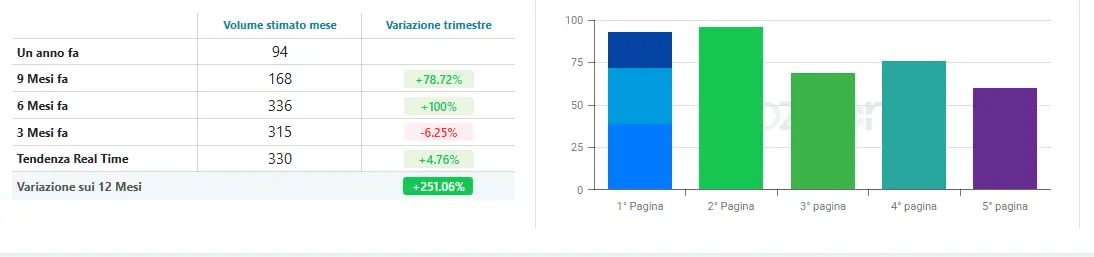
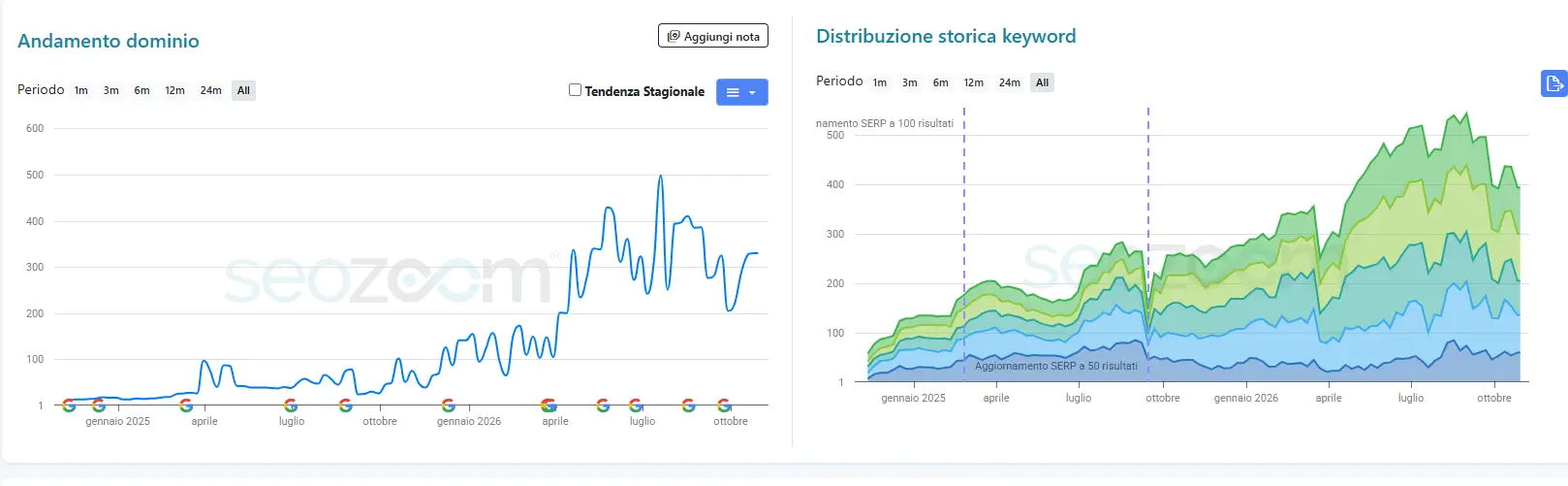
Looking at the domain’s trajectory today, I see growth I consider meaningful, especially for a project I manage on my own in such a competitive field. As of the November 2, 2026 snapshot, SEOZoom tracks 396 ranking keywords, 93 of them in the top ten positions and 21 in the top three. Estimated monthly organic traffic went from 94 to 330 over twelve months, a 251% increase.
These are estimates, of course, and I always cross-check them against actual Google Search Console data. Over the past 16 months, Search Console shows roughly 418,000 impressions and 1,280 clicks, along with an improving average position over the period.
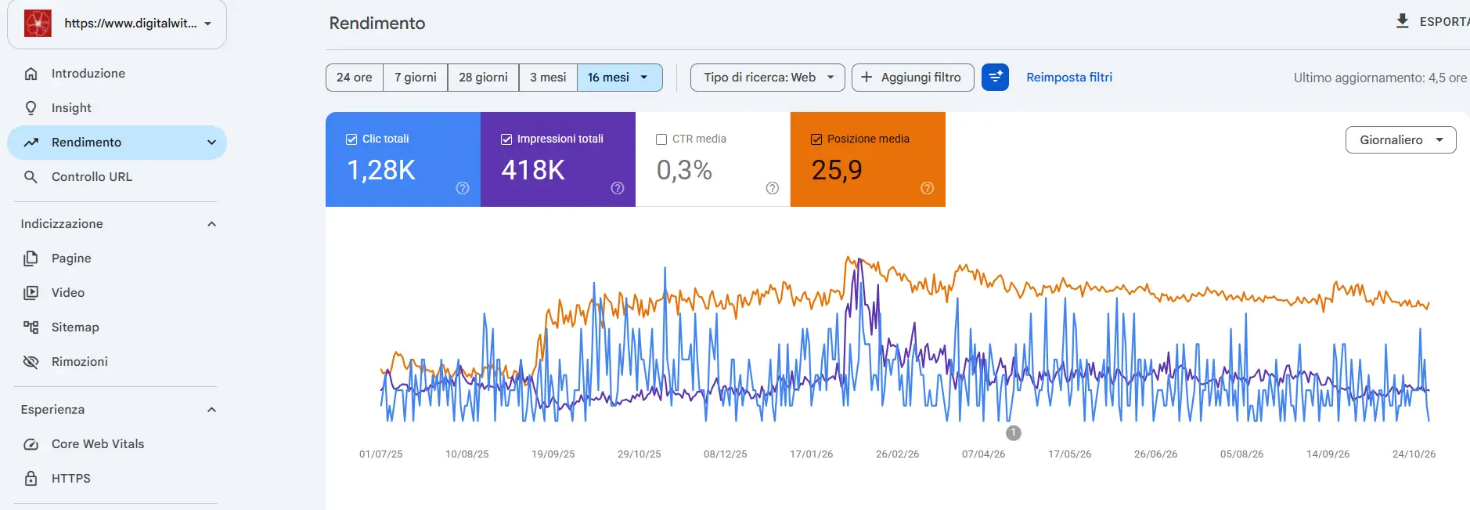
SEOZoom calculates its estimate from the keywords a site ranks for and their search volume, the same way for every domain: it’s meant to track a project’s direction and compare it with competitors. Search Console records how often pages showed up in results and the clicks they got: that’s real data, the kind that tells you how well a good ranking actually converts into visits.
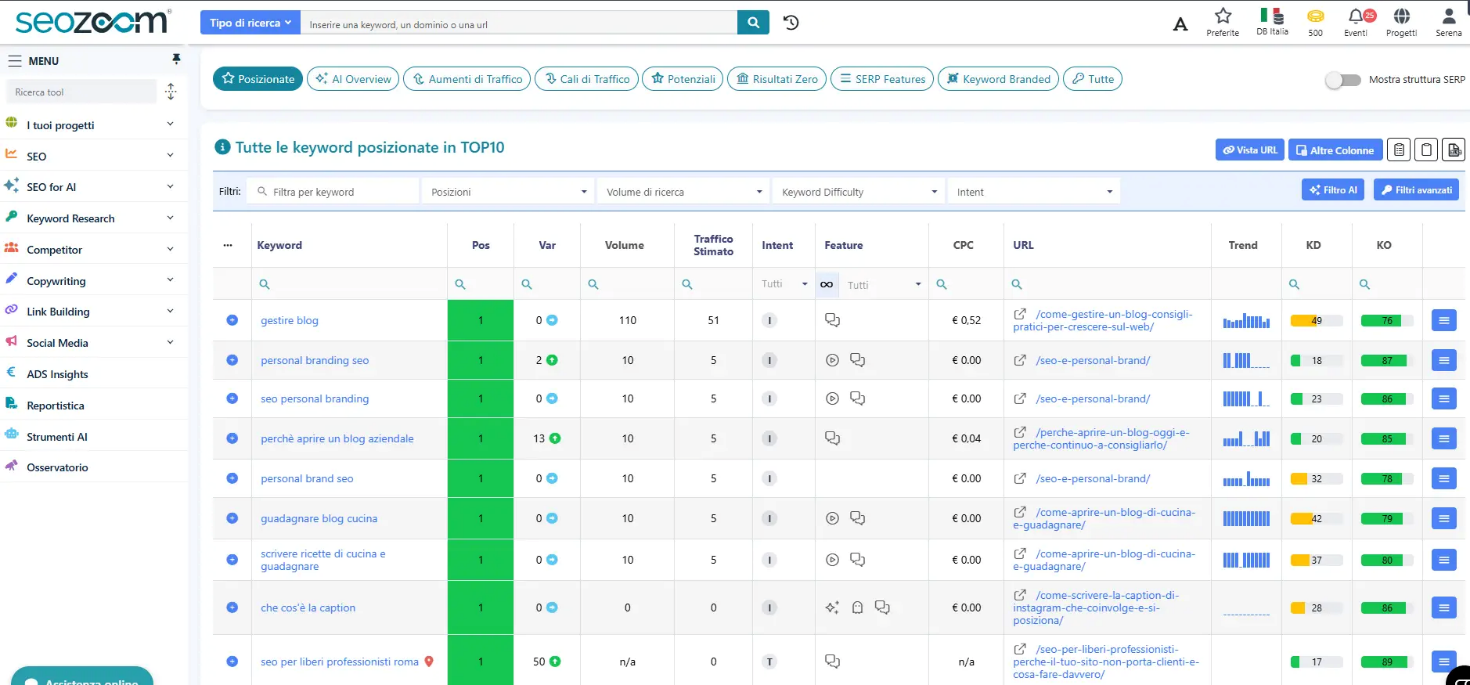
To me, these numbers are a positive signal: focusing on specific topics let me carve out space for myself, step by step. Among the searches where the site reached the top spot are, for example, “gestire blog” (managing a blog), “personal branding seo,” “perché aprire un blog aziendale” (why start a business blog), and “guadagnare blog cucina” (making money with a food blog). These keywords weren’t picked at random. They represent exactly the areas I chose to focus my work on.
A SERP worth reading before you write
SEOZoom is one of the tools I use every day, both for my own projects and for clients’ work. The features I rely on most are Keyword Research, Search Intent analysis, and the Editorial Assistant.
I start from the main keyword, check its volume and ranking opportunities, then dig into related keywords and search intent. This analysis helps me decide which topic to develop, which aspects to cover in depth, and whether to create new content or update an existing page.
I don’t stop at the tool’s data, though. I also look directly at the SERP, because I want to understand what content Google is showing and, above all, what answer the searcher expects. Only then do I move on to writing, using AI support as well. But the editing, fact-checking, and editorial decisions stay in my hands.
This is where SEOZoom’s Editorial Assistant comes in, which I use mainly as a verification tool. I particularly appreciate the target audience analysis, the topic suggestions and the new features tied to AI search. I’m not necessarily chasing a perfect score, but looking for signals that help me understand whether the content truly meets the reader’s needs.
Rewriting an academic guide with her own experience
One article that captures my approach well is How to Manage a Successful Blog: a complete guide to growing online. It’s one of the first pieces I wrote for Digital with Sere, back in 2023.
I still remember the SERP analyses, where I found major publishing portals and very in-depth content. My first approach had been fairly academic: I’d tried to create a complete guide, covering every aspect of blog management. The article had started to rank, timidly, but in the meantime my career had changed direction.
Blogging had become increasingly central to my work, both in the training I gave to bloggers and freelancers and in the editorial strategies I proposed to clients. I was also already running Cooking with Sere, my food publishing project. At some point I realized that article explained how to manage a blog, but still said too little about my own experience.
So on September 7, 2025, I decided to revisit it. Using SEOZoom, I reassessed the keywords, related searches and intent, pairing the data with a direct look at the SERP. I reworked the structure of the content and changed the title, moving from “How to Manage a Blog: Practical Tips to Grow Online” to “How to Manage a Successful Blog: A Complete Guide to Growing Online.”
But the bigger change was something else: I gave more room to my own point of view and my direct experience. I added references to Cooking with Sere, links to other content, and updated the introduction to tackle an increasingly relevant question: does it still make sense to invest in a blog in the age of social media and AI? I wanted an answer that wasn’t just informationally complete, but also carried something of my own.
More than a year later, I analyzed the article again using SEOZoom’s Analyze URL feature. The chart shows that, starting in November 2025, estimated monthly organic traffic went from around 16 to 60, peaking at about 75 in July 2026. The growth wasn’t linear, but the page progressively built a stronger organic presence.
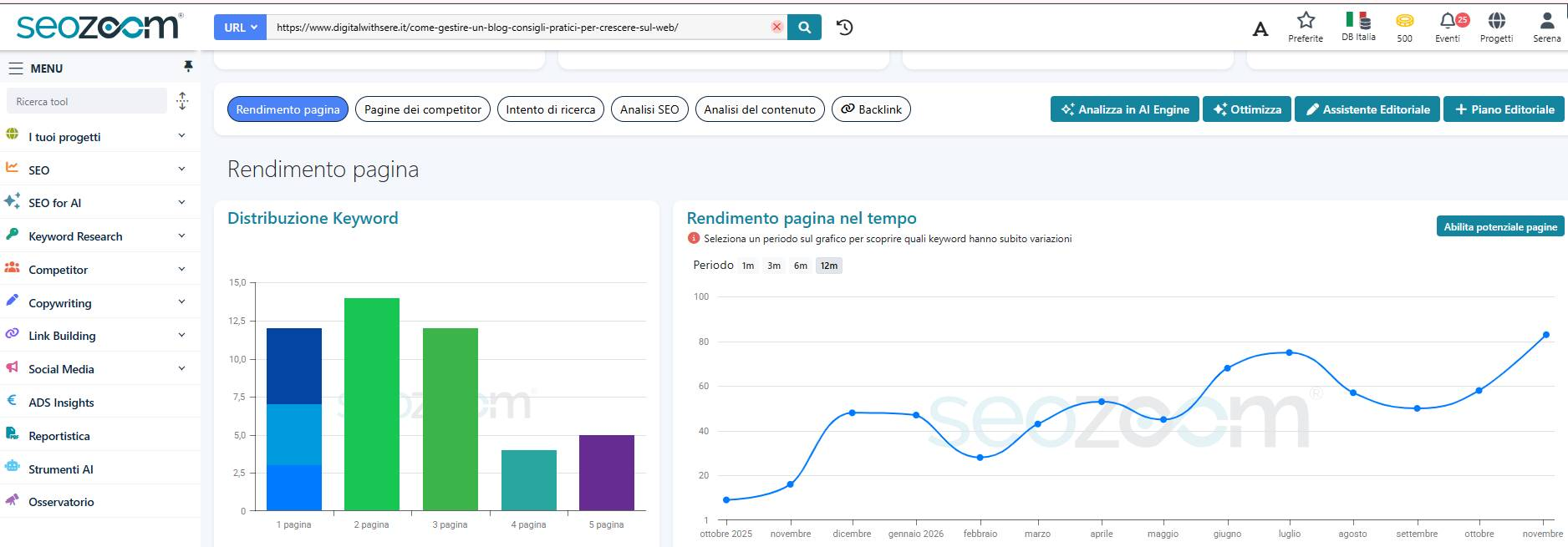
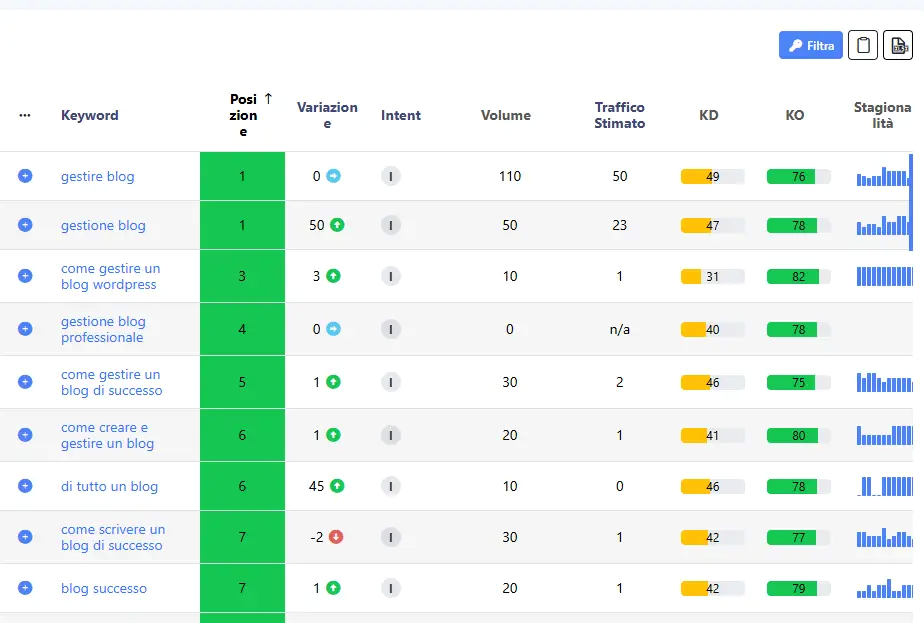
As of the November 2, 2026 check, SEOZoom shows 46 ranking keywords, 11 of them in the Top 10, including the number one position for “gestire blog”.
I also reloaded the content into the Editorial Assistant, getting a score of 81% and an Intent Match of 70% for the keyword “gestire un blog.” These are current readings, useful for spotting any further improvements worth making. Another interesting detail: the article shows up among the sources of an AI Overview for the search “blog di successo.”
I can’t credit every result solely to the 2025 revision, but I can describe the path I followed: I started with content that no longer fully represented me, and I used SEOZoom to rethink it without giving up my voice.
A video instead of an article
With Cooking with Sere, I apply the same principles, but in a very different context. The project is mainly focused on recipes, with an emphasis on air fryers, and it runs across the blog, YouTube and other channels.
To analyze the site’s performance, I often use the integration between SEOZoom and Google Search Console, which is especially useful in a niche where a significant share of traffic comes from Recipe rich results, which aren’t always fully captured by visibility estimates.
I also want to share another example, tied to using Keyword Research for an editorial decision. In 2026, I decided to create an informational video about how an air fryer works.
Before starting production, I began with keyword analysis through SEOZoom. I wasn’t just interested in search volume, but above all in understanding what results Google was actually showing. By analyzing search intent and SERP Features, I noticed a significant presence of video content.
That led to a clear decision: to create a YouTube video deliberately designed with SEO in mind, aiming to capture searches made on Google and not just those happening within YouTube. I used Keyword Research and user questions to build the outline, combining that data with my own direct experience and the questions I get from my community.
The result was the video How Does an Air Fryer Work? Everything I Wish I’d Known, published on May 31, 2026. It’s over 21 minutes long, organized into chapters, covering how the appliance works, its programs, the most common mistakes, and various practical aspects of using it. I wanted to create an informational resource that could be found and consulted over time.
First in the Video block and a source for the AI Overview
The data that came in after publication gave me real satisfaction. As of the November 2, 2026 check, Google Search Console, filtered to that single video, shows the following over the last three months:
- 5,520 clicks;
- 250,000 impressions;
- average CTR of 2.2%;
- average position of 5.
The top queries confirm the intent I had identified: “friggitrice ad aria come funziona” generated 335 clicks, “come funziona la friggitrice ad aria” 298 clicks, and “come si usa la friggitrice ad aria” 289 clicks, all with an average position around second place.
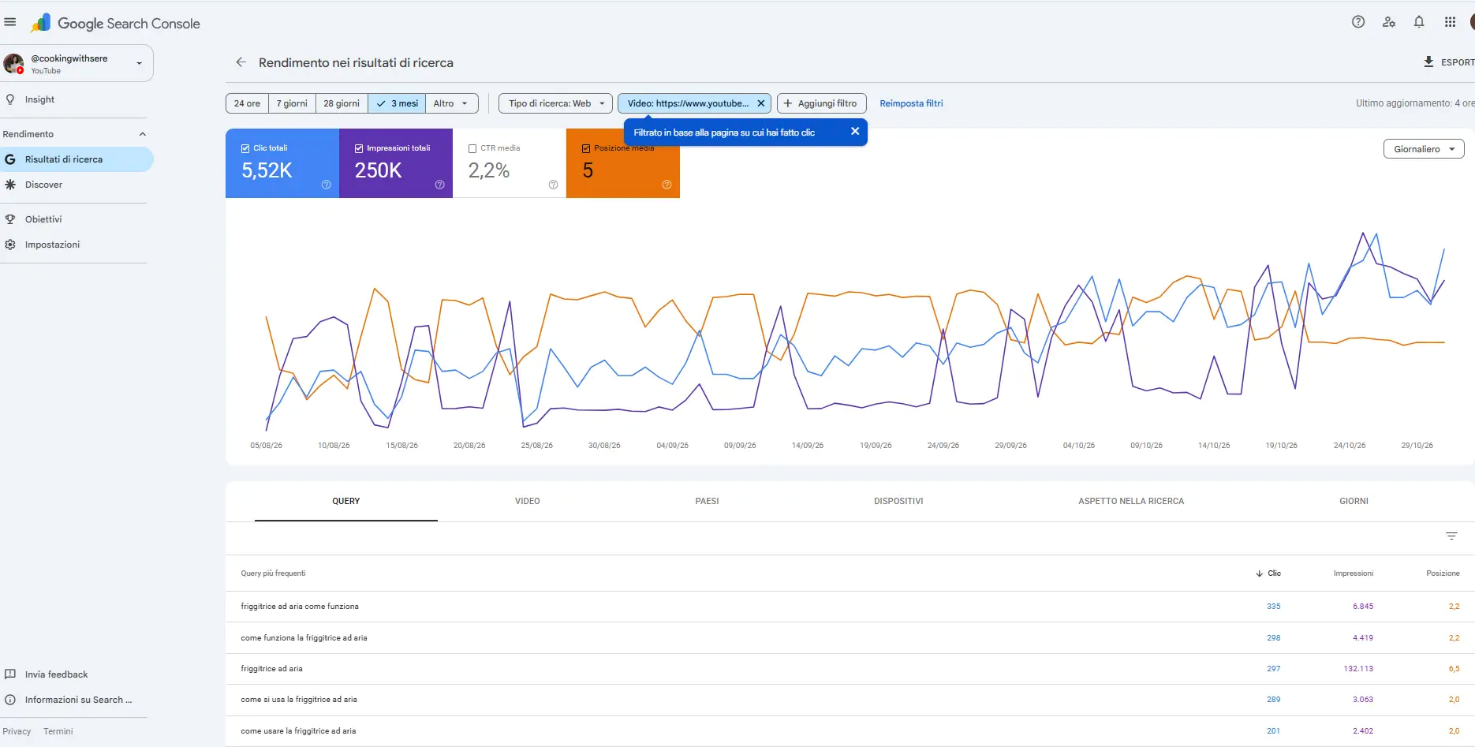
The 5,520 clicks come from Google search results, not YouTube views. Search Console measures these through platform properties: once you connect a YouTube channel, or an Instagram, TikTok, or X profile, it reports the clicks, impressions, CTR, and average position that content earns in Google Search.
I also checked Google’s SERP directly. For the search “how does an air fryer work” (in Italian), the Cooking with Sere video shows up as the first result in the Video block and, more interesting still, it’s also listed among the sources cited in the AI Overview.
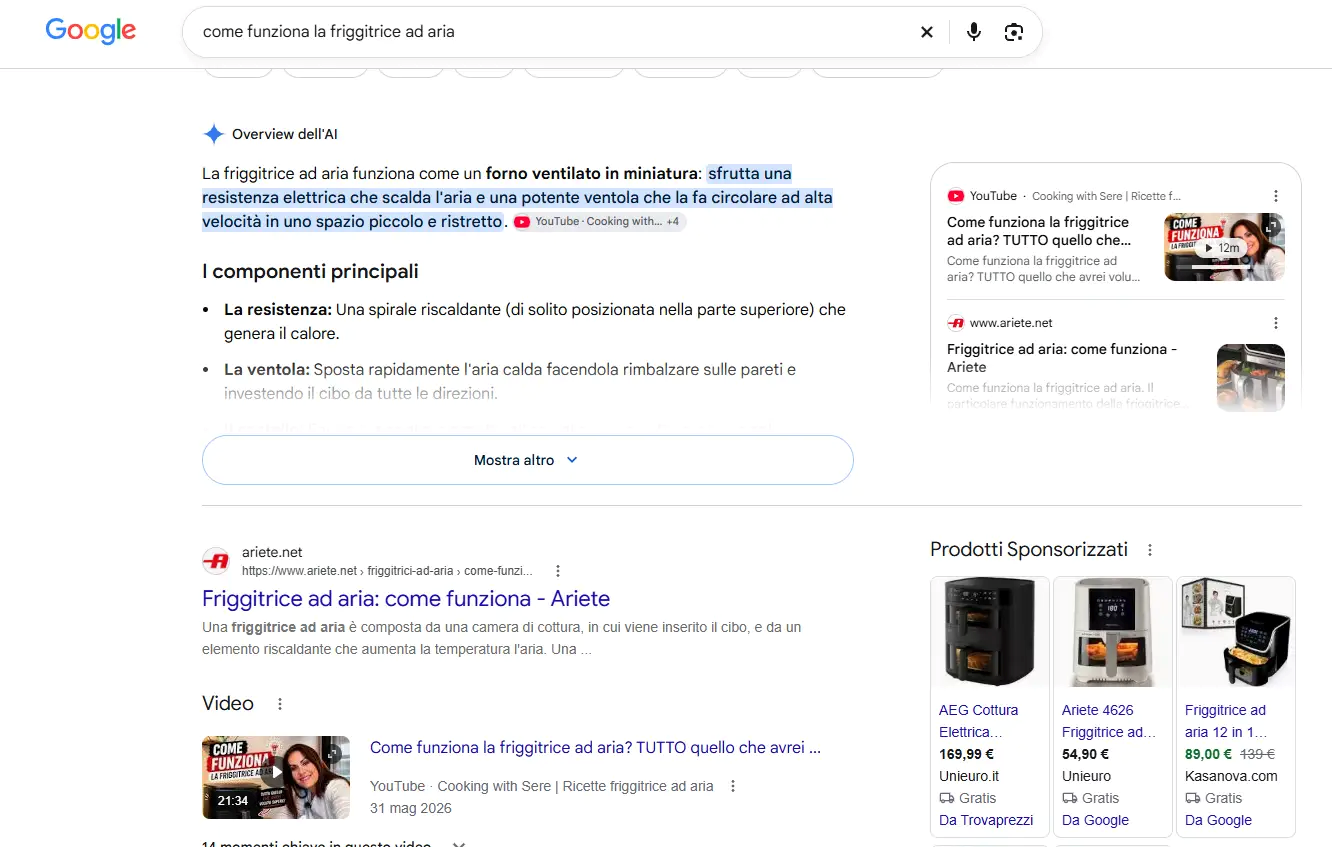
That citation shows up in SEOZoom too. In Keyword Analysis, the AI Overview panel for “how does an air fryer work” lists the sources behind the answer and ranks the Cooking with Sere video first, while the SERP Features include a video carousel and two YouTube results appear among the social pages in the top 10.
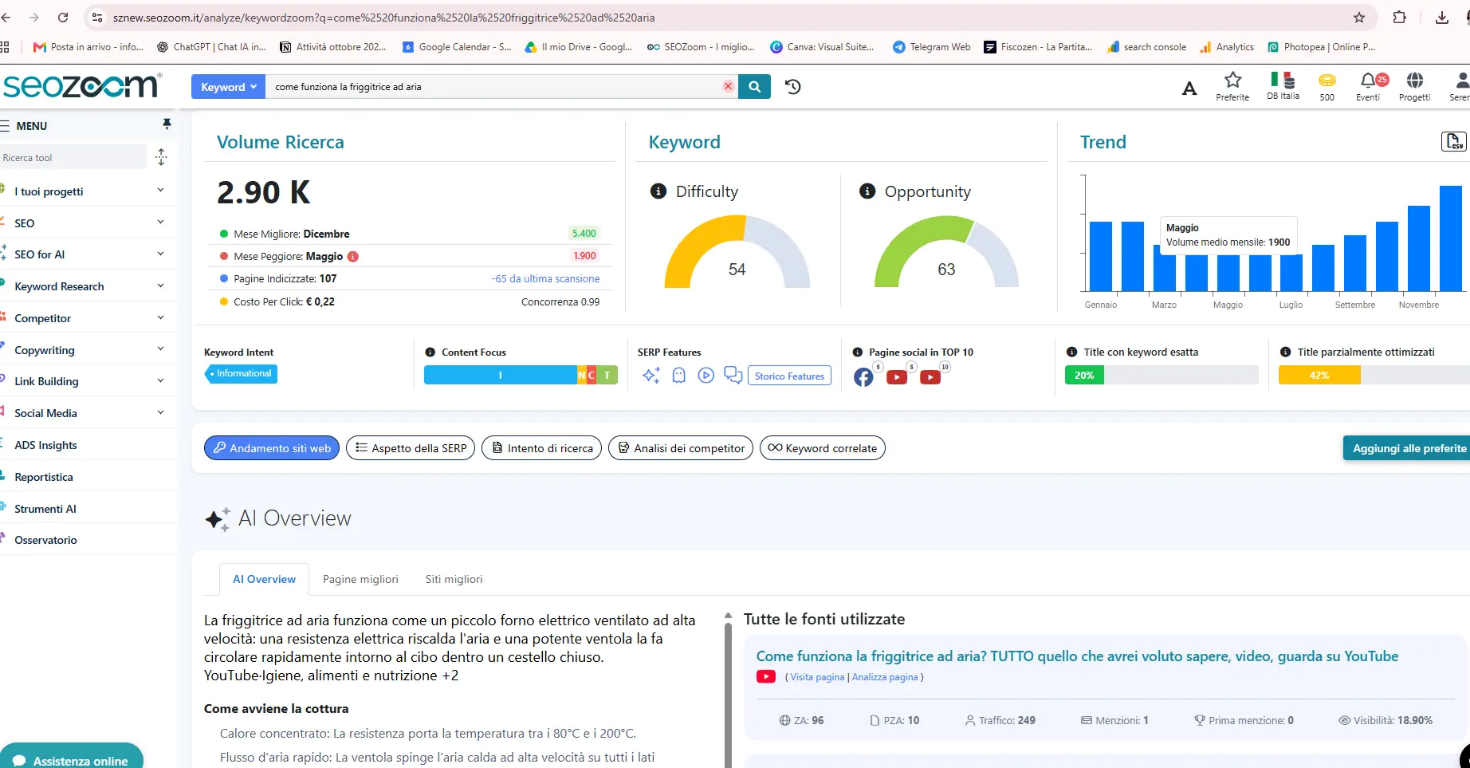
When I designed this content, getting a citation in AI answers wasn’t my specific goal. My choice came from SEO reasoning: analyze the intent, look at the SERP, identify the best-fitting format, and build content that answers what users actually need.
Showing up in the AI Overview is an extra result, observed in the SERP on November 2, 2026, while the Search Console data lets me evaluate the video’s performance over a longer stretch of time. This example confirmed something I consider important: SEO analysis doesn’t just help you pick which topics to cover, it also helps you decide which format to develop them in.
The question to start from, even with AI search
Digital with Sere and Cooking with Sere are two very different projects, but I apply the same method to both. With the first one, SEOZoom helped me build a specialization strategy and revise existing content. With the second, analyzing the SERP helped me choose a different format, which led me to invest in a YouTube video.
To me, that’s what SEO tools are for: understanding data, spotting opportunities, and making more informed decisions. Professional experience comes next, and it’s still what turns that information into content that actually helps people.
Even in the age of AI search, I still start from the same question: what is this person actually looking for, the one I want to reach, and what’s the best way to answer them?
A consulting site and a food blog, read through SEOZoomWhen Serena decided how to answer people asking how an air fryer works, what guided her was the makeup of page one more than search volume. The keyword analysis in SEOZoom showed a video carousel among the SERP Features and YouTube pages among the top results; her video took that spot and from there made it into the AI Overview’s sources, built from the results Search has already selected. Applied to “managing a blog” (translated from Italian), the same analysis highlighted large editorial portals, and the lever for competing was the personal point of view she used to rewrite the guide.
Google Search Console records the actual impressions and clicks a piece of content gets once it’s live, and in SEOZoom projects you connect it to cross-reference that data with the rest of the analysis. But deciding what to produce happens before publication, and at that point Search Console has nothing to measure yet. That’s where SEOZoom’s Keyword Analysis comes in: for any search, it shows how the SERP is composed, AI Overview sources included. The same panel shows how demand trends over the months: for air fryers it bottoms out in May, the month the video came out, then climbs back up toward December, meaning the clicks recorded afterward arrived ahead of peak season. Without the platform, you’d have to redo this work by hand, query by query, on pages that change depending on where and when you open them.
On your own site, reading the SERP flips the usual order of work. The question of what to write comes after the question of how Google already answers it, and that often leads to choices far from the keyword you started with: narrowing a topic down to the point where your own experience matters, or changing format before you even open the outline.


 Verified reviews on Trustpilot