How to rank first on Google in a small niche: the Alessandra Bianchini case study
If you work in a small niche with low monthly search volume, every move you make carries extra weight: here's what worked for this case study and which strategies you can apply…
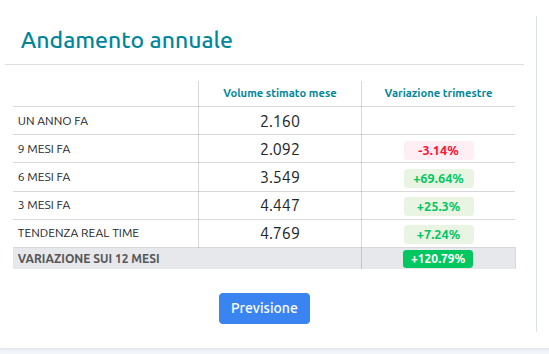
Alessandra Bianchini’s site, a wedding designer since 2018, speaks to couples planning their wedding, to wedding planners who want to delegate the design side of a wedding, and to aspiring colleagues in the wedding industry who follow her courses. Today the guide to her profession ranks first on Google for “wedding designer”, her course pages sit among the top five results, and over the past year the organic traffic estimated by SEOZoom has more than doubled, up 120.79%.
Loris Bodei, who works in SEO and website development in the Mantua, Brescia, and Verona areas, built the site and has tracked its organic visibility ever since. Loris walks through the work done with SEOZoom and explains how he read the traffic drop that occurred in October.
Wedding Designer or Wedding Planner?
As soon as the site was live, I ran into my first obstacle: ranking it on Google for “wedding designer,” a term that’s not widely known and is frequently confused with “wedding planner”. Both figures work on the wedding, but in everyday language the more familiar term tends to swallow up the other.
SEOZoom’s data still confirms today just how widespread that confusion is: among the frequently asked questions the platform associates with the search “wedding designer,” most are actually about wedding planners, asking what they do, what education you need to become one, who the best-known ones are in Italy. Some simply ask what the person who organizes weddings is called, a sign that part of the audience is searching for the role before even knowing its name.
My main goal became getting Google to recognize Alessandra’s profession under its correct name, through a guide explaining who a wedding designer is, what she does, and why her work is significant and different from a wedding planner’s. To build it, I needed to figure out which content to include and whether ranking first would also require other supporting pages.
A Guide Built on Google’s First Page
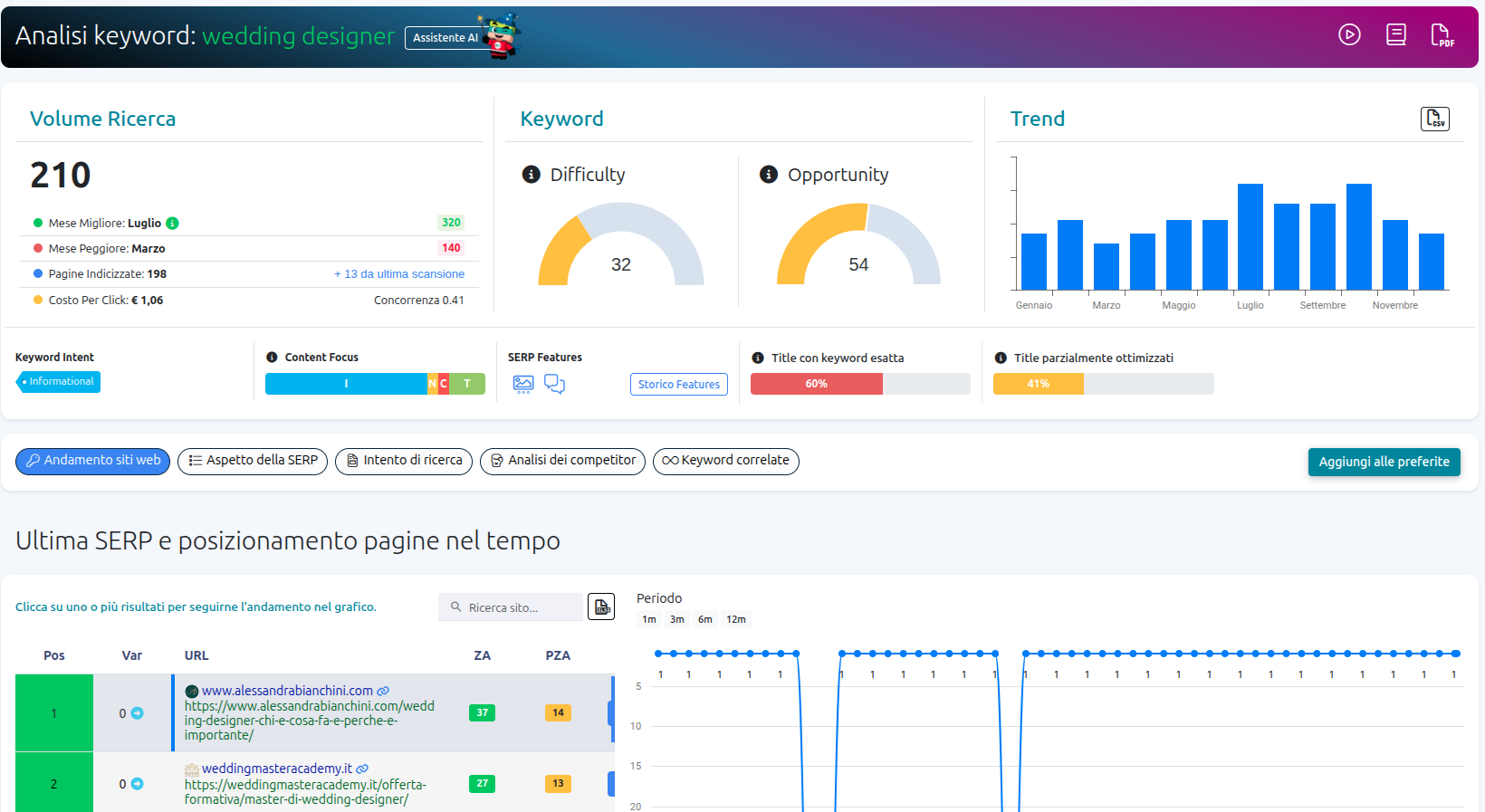
I started from what Google was already rewarding, because the first-page results for “wedding designer” represent what the search engine considers the best answer to that query, and they showed me what the guide needed to offer to compete. There were four questions to answer: who held the top positions, which keyword to build around, how competitors were using it, and which doubts and topics to cover. I found the answer to each one in a SEOZoom tool.
I got a picture of the competition from Keyword Analysis, the SEOZoom tool that studies a keyword and the pages Google serves up for it: at the top of the screen I found the search intent and its difficulty, and in the Site Trend tab, the domains ranking on page one and how they had moved over time.

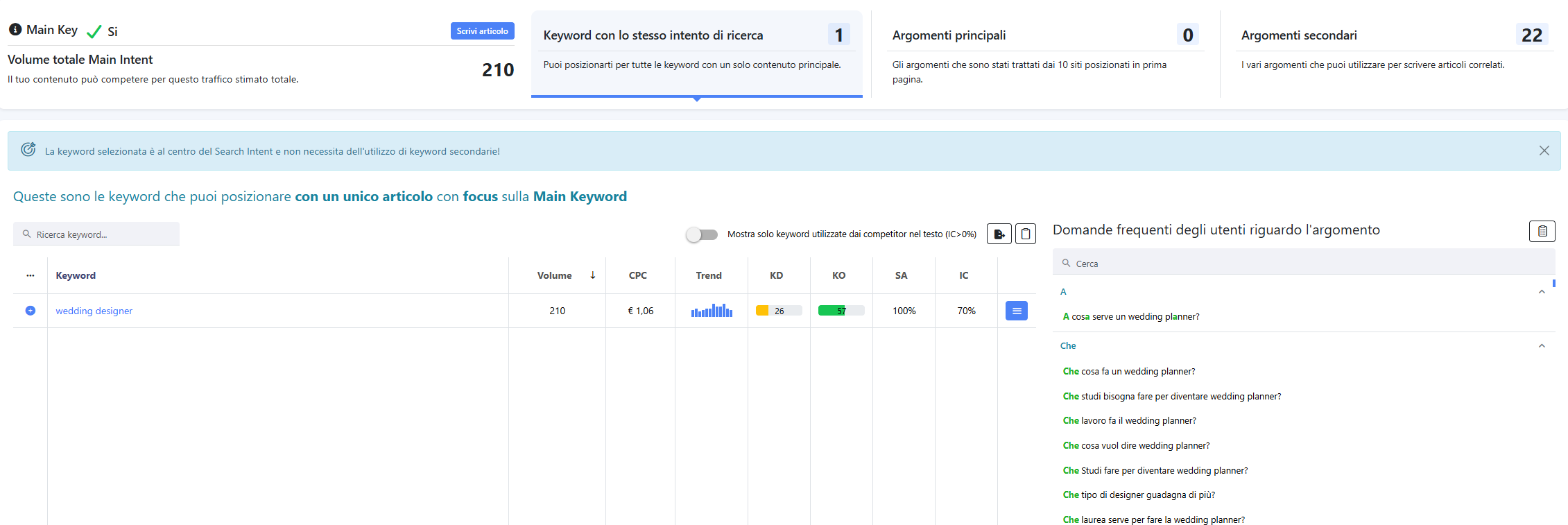
Before writing a single line, I wanted to be sure that “wedding designer” was really the term to build the guide around, and not just a variant of another keyword. The Search Intent tab in Keyword Analysis groups searches that share the same intent and flags the main one. “Wedding designer” was the main keyword, so I could keep it at the center and cover the group’s variants with a single piece of content, which became secondary keywords in the guide. If it hadn’t been the main keyword, I would have shifted to the term SEOZoom suggested instead.
What remained was figuring out where to use it, and I found the answer in the Competitor Analysis tab, which compares the top-ranking pages across the entire search intent, showing the title, URL, and internal headings for each. By looking at how competitors used the keyword, Alessandra and I decided whether and where “wedding designer” should appear in the guide.
For the questions to address, I relied on Question Explorer, a tool in SEOZoom’s Keyword Research section that collects questions from the “People Also Ask” boxes in the SERP, and I picked which ones to cover in the guide from that list. For the topics, I used Topic Explorer, which analyzes content already ranking for a keyword and pulls out recurring themes, which became the outline for the text.
Using this material, Alessandra and I wrote the guide, broken down into headings, subheadings, and paragraphs, and we’ve updated it over the years: the data told us what Google expected, and she added the parts she considered essential for describing her profession from the inside.
Turning Confusion with ‘Wedding Planner’ Into an Advantage
The questions about wedding planners also revealed an opportunity, because they show how people search for a professional like Alessandra: using more familiar, far more searched terms than her own, starting with “wedding planner,” which according to SEOZoom gets 14,800 monthly searches compared to 210 for “wedding designer.”
A single guide, though, couldn’t also answer “wedding planner,” “wedding,” or “event designer” without drifting away from its own subject, the wedding designer profession. To capture those searches, we built supporting pages around the guide, each dedicated to one term, for example the meaning of wedding planner, the meaning of wedding, and the event designer role.
To choose them, I went back to Keyword Analysis: in the Search Intent tab, under Secondary Topics, SEOZoom lists topics related to the main keyword that you can develop into separate articles. We pulled these from that list, building each one with the same method. We linked them to the guide with internal links in both directions, so the lesser-known name would connect to the more popular terms around it.
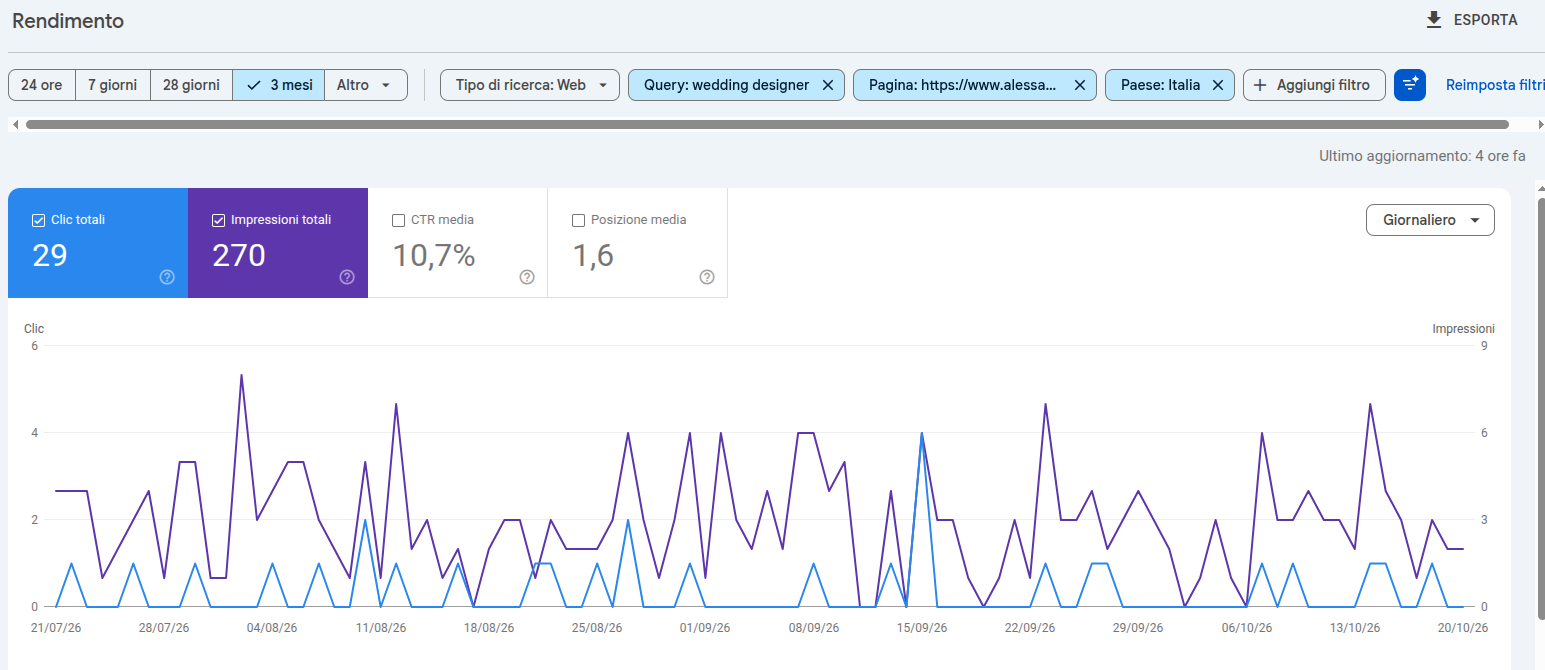
With this structure, we’ve managed to get the guide to the top spot for “wedding designer”, as shown by both SEOZoom and Search Console, which has recorded an average position of 1.6 over the last three months.
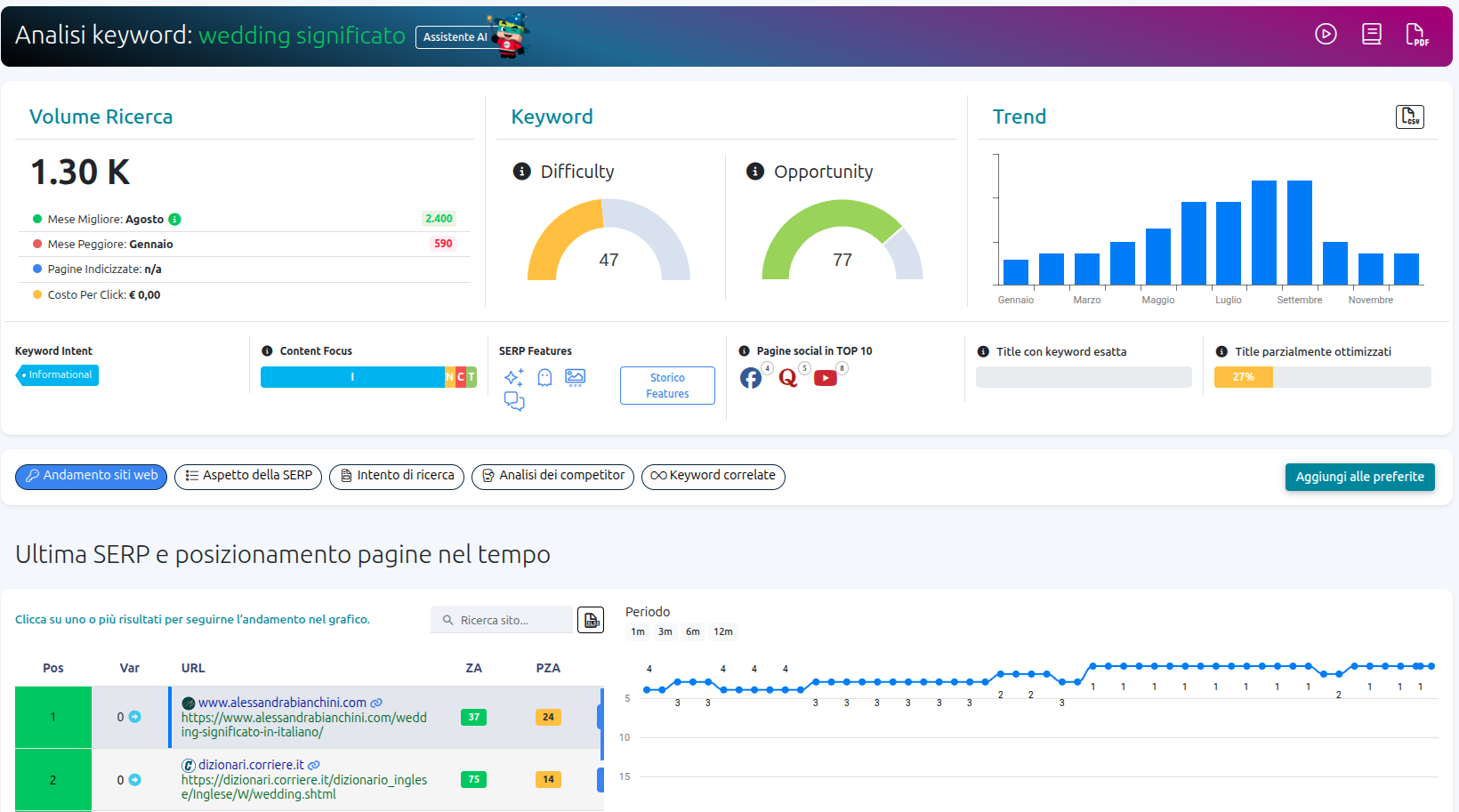
Support pages also appear among the top results: the page on the meaning of “wedding,” for example, ranks first for “wedding meaning.”
What a Keyword With 20 Monthly Searches Is Worth
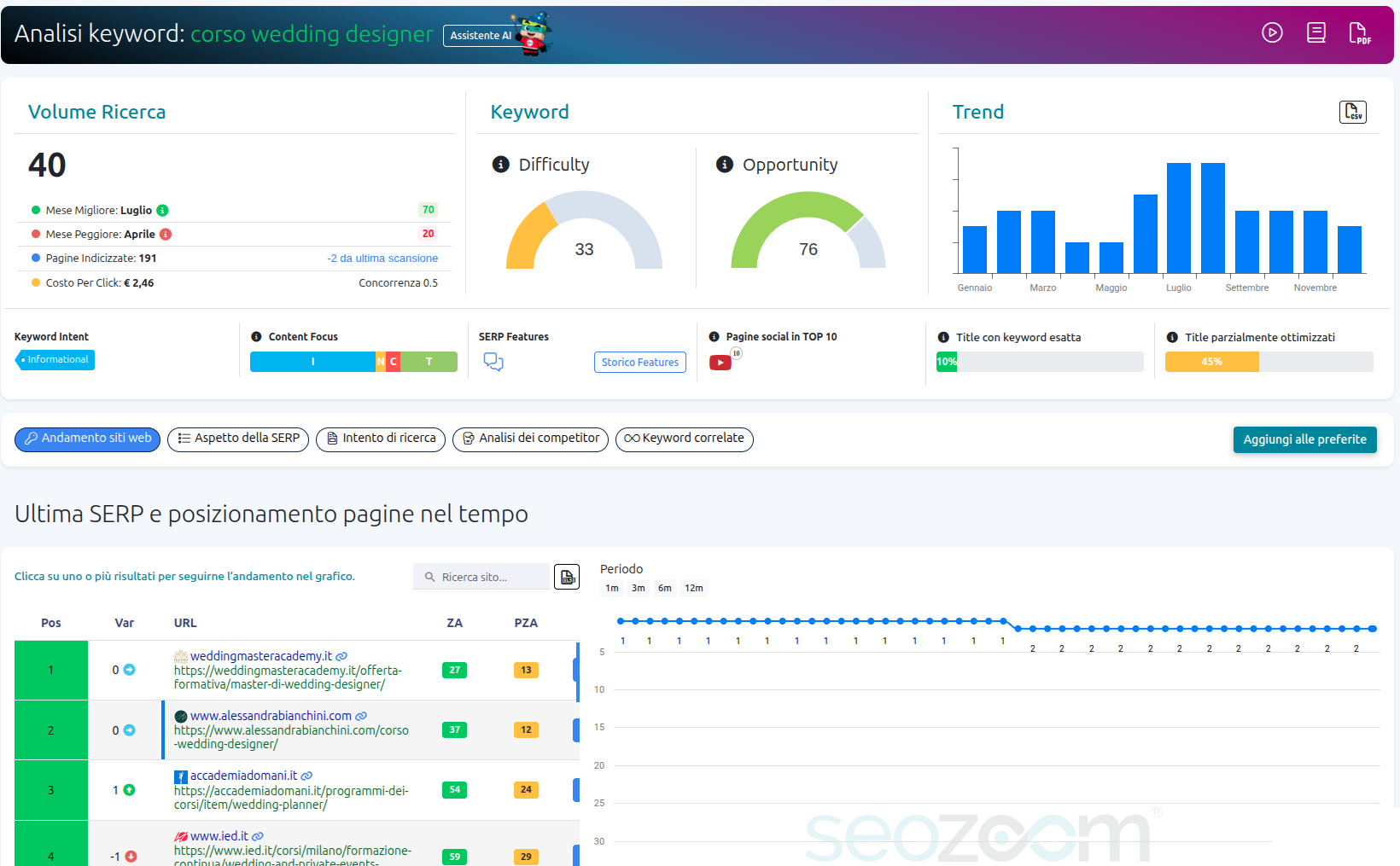
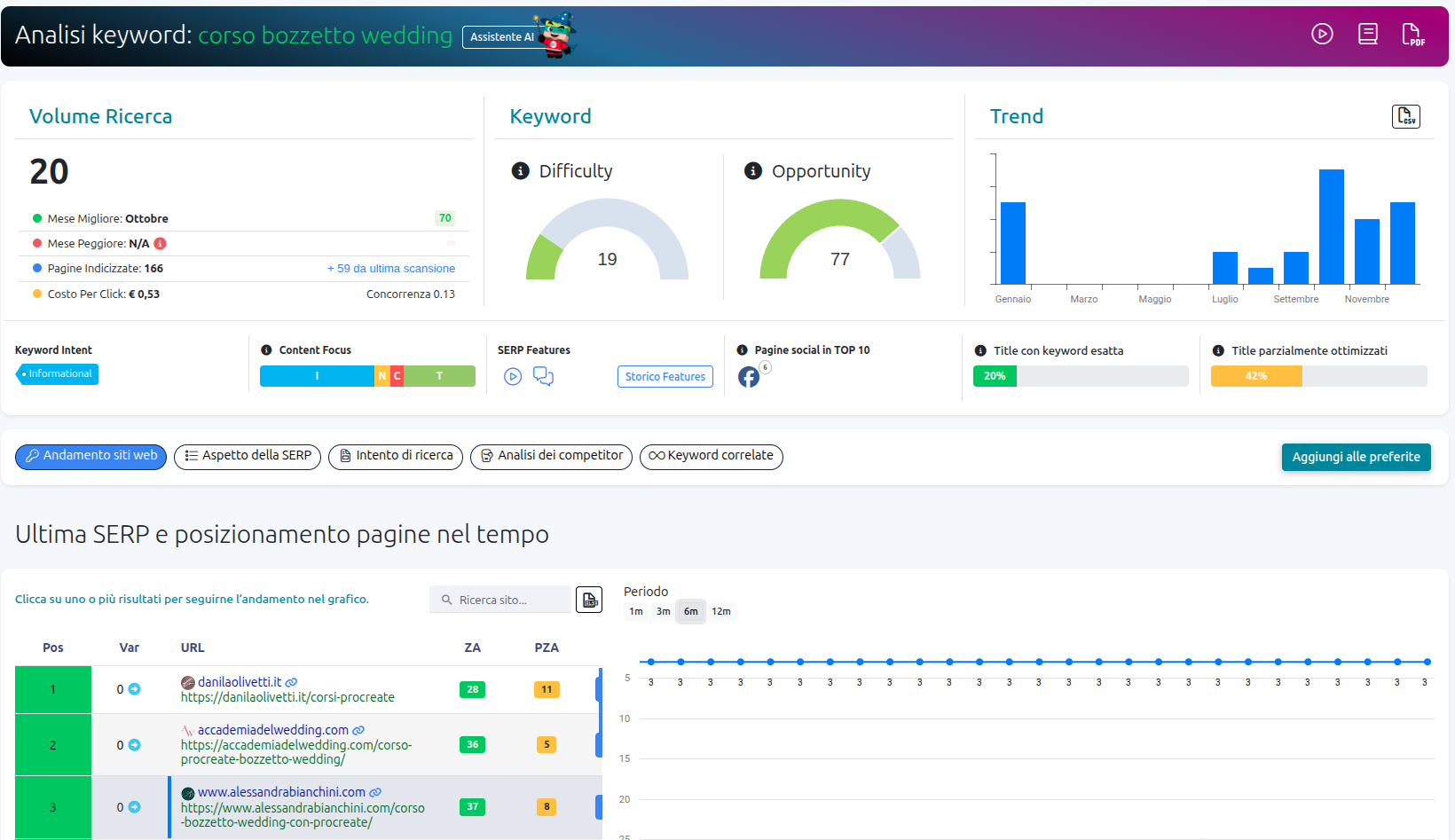
The second goal was to optimize the course pages for the courses Alessandra teaches for those looking to enter the industry, such as the wedding designer training course and the wedding sketch course using Procreate. Looking at the numbers alone, I might have given up: in Keyword Analysis, the two searches have a low volume – 40 per month for “wedding designer course” and 20 for “wedding sketch course” – and Keyword Intent, the metric SEOZoom uses to classify a keyword’s intent, labels both as “Informational.”
However, I wasn’t convinced by this label, because people searching for a course usually want to enroll, and the SERP confirmed this: for “wedding designer course,” the top positions are occupied by training programs, including offerings for wedding planners from Accademia Domani and IED. Even the “Content Focus” metric in Keyword Analysis – which measures which intents the top 10 results satisfy – assigned a higher share to the transactional component than it did for “wedding designer.” So, despite the search volumes, we decided to dedicate a separate listing to each course: these were searches with high commercial intent, and therefore more likely to result in conversions.
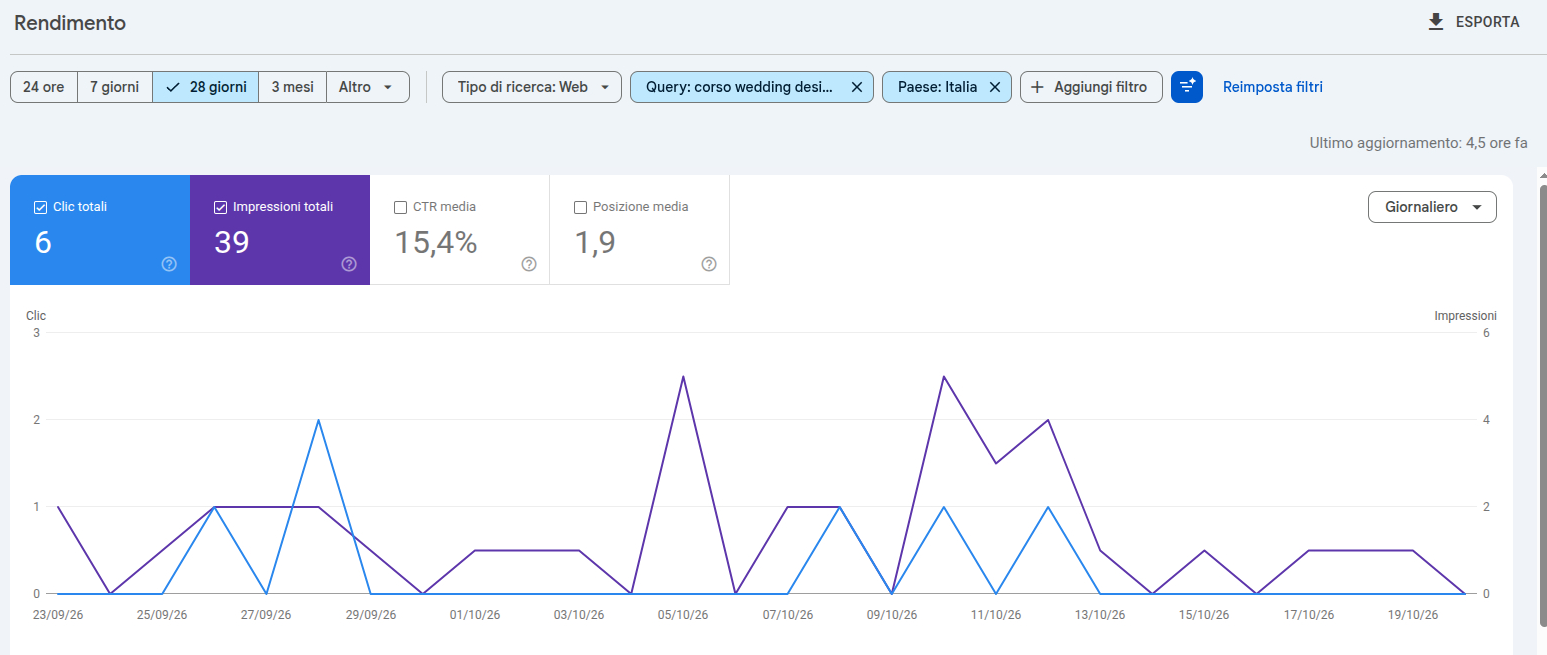
I created the profile for “wedding designer course” following the guide’s method, and today it fluctuates between the first and second results, with an average position of 1.9 in Search Console over the last 28 days.
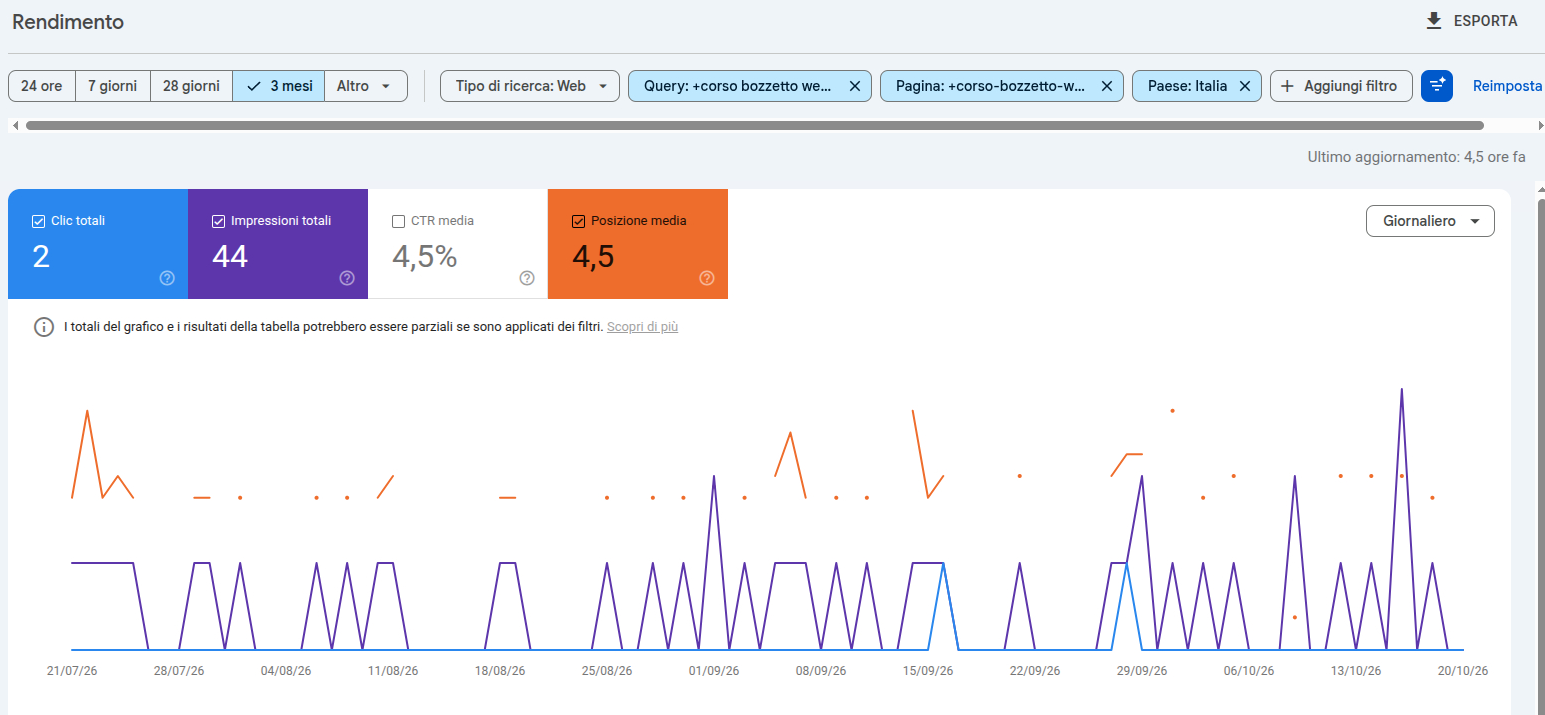
The same campaign, targeting the keyword “wedding sketch course”, has consistently kept the listing for the Procreate sketch course among the top five results, with an average ranking of 4.5 over the past three months.
The October Drop Was Limited to Generic Terms
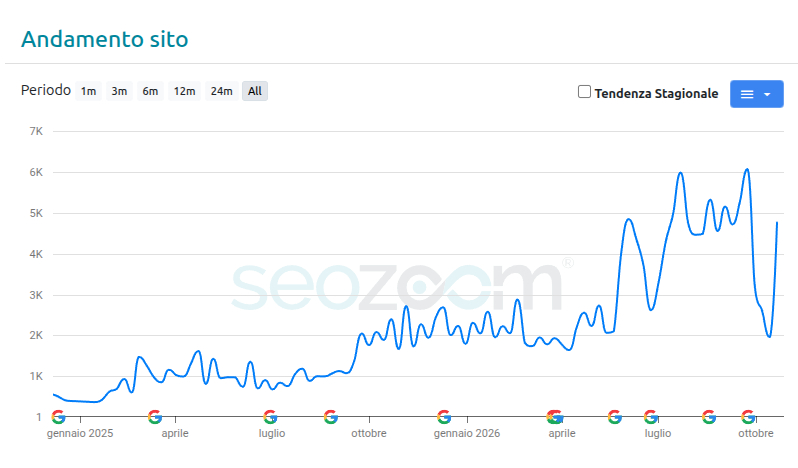
When the Website Analysis curve, the SEOZoom section that tracks performance across an entire domain, started to drop in October, I wanted to understand where the site was losing ground before touching any content. The drop could have hit the pages that bring in clients and course sign-ups for Alessandra, or the pages built to support them.
To find out, I opened Time Machine, the SEOZoom tool that compares each keyword’s rankings between two dates and shows which page ranked before and after, along with estimated traffic gained or lost. I picked September 2 and October 21 as checkpoints, which let me see which page was losing ground for each declining keyword.
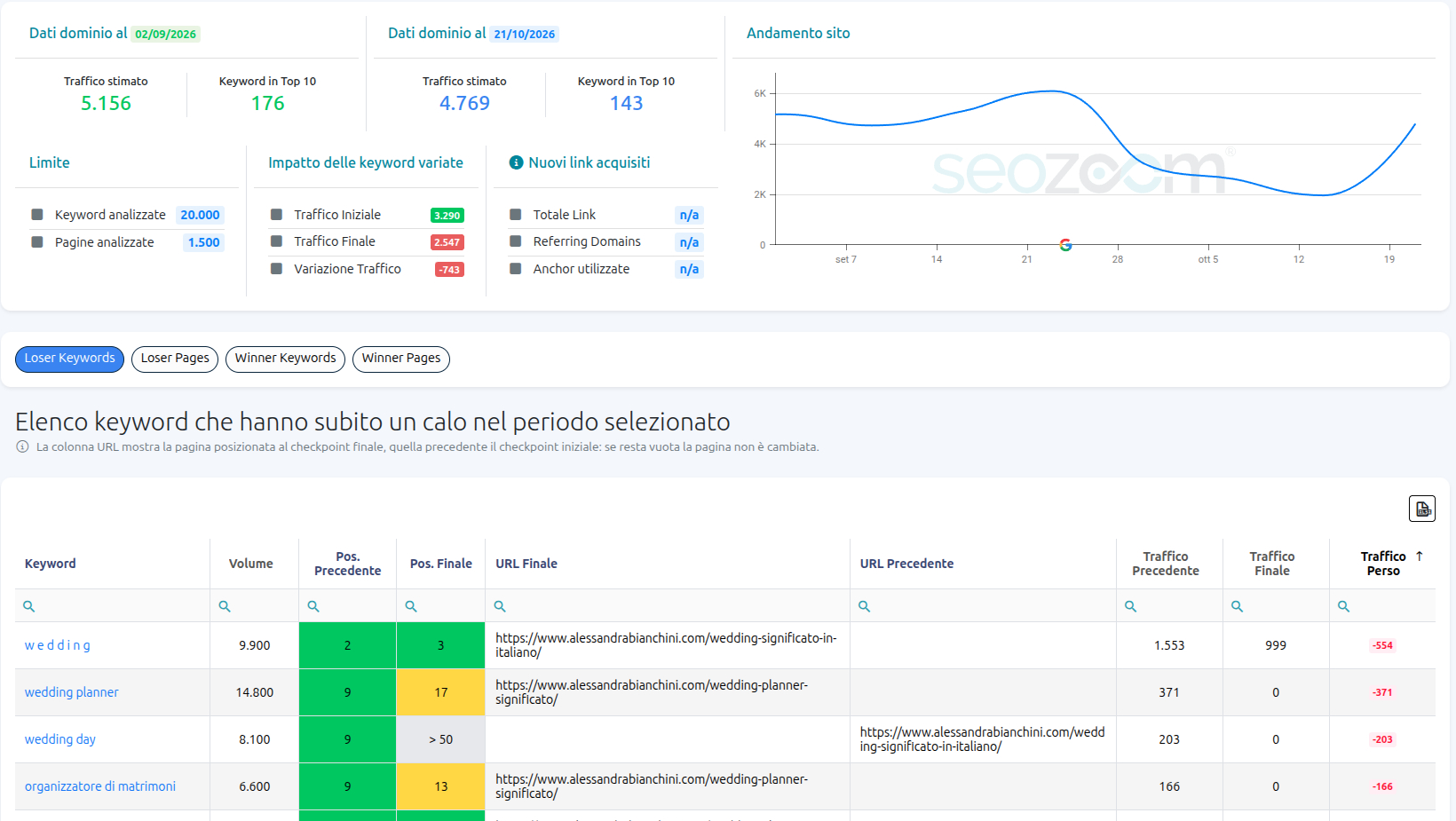
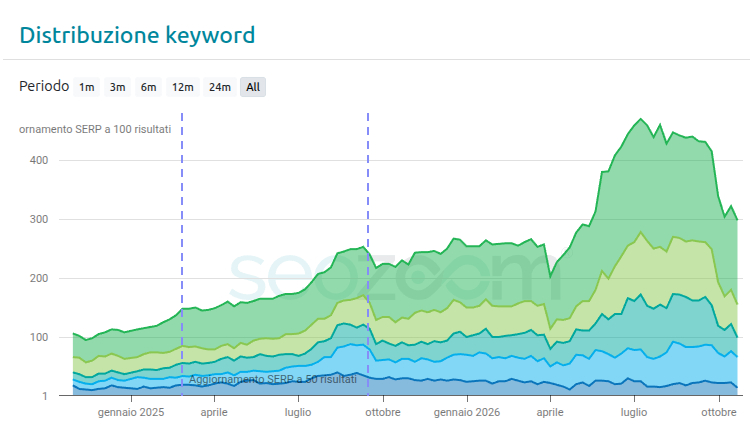
Looking closely, the drop was limited: between the two checkpoints, estimated traffic went from 5,156 to 4,769 and keywords in the top 10 dropped from 176 to 143, while the Site Performance curve had already started climbing back by the end of the period, and the 12-month change remains at +120.79%. These figures are SEOZoom estimates, calculated from keyword volume and position; for actual clicks, I still rely on Search Console.
Just to be sure, I checked which keywords carried the most weight: “wedding,” “wedding planner,” “wedding day,” and “wedding organizer.” They were all informational – with no immediate purchase intent – and all linked to the supporting pages created to round out the semantic field around “wedding designer.” The biggest drop came from “wedding,” which, according to SEOZoom, accounts for 9,900 searches per month and had fallen from second to third place: with such a high search volume, even a single-rank drop is enough to shift the estimated traffic by hundreds of visits. These keywords have a marginal impact on Alessandra’s business, but I’m keeping an eye on them anyway.
Searches related to her profession and her courses, on the other hand, held steady: in Keyword Analysis, the guide remains first for “wedding designer,” the wedding designer course page second, and the sketch page third. The confirmation I was looking for came from Search Console, which measures actual clicks and rankings. The time periods I mentioned above extend through October 20 and therefore include the weeks of the decline, yet the guide and the two course pages – the pages that form the backbone of Alessandra’s business – maintain average positions of 1.6, 1.9, and 4.5.
Una nicchia da poche ricerche, letta con SEOZoomNel caso di Alessandra i numeri sono piccoli: «wedding designer» conta poche centinaia di ricerche al mese, i corsi qualche decina. A questa scala il volume orienta poco, e le scelte dipendono da come Google interpreta ogni singola keyword e da quali risultati le preferisce. La prima posizione di Alessandra viene da questa lettura, fatta ricerca per ricerca.
Without the platform, Loris would have had to open and manually note down competing results for each search, then piece together on his own the topics that kept recurring in their content. As for the drop in traffic, the only option would have been to compare two Search Console periods query by query: the actual clicks are there, but the volume that shows how much each keyword matters to the market is missing.
When you’re dealing with a name that gets few searches, or that gets confused with another one, the first thing to check is Keyword Analysis. The Search Intent tab, opened on the term that describes your service, tells you what to keep on the main page and which topics deserve a separate page. For searches with just a few dozen monthly queries, the SERP matters more than volume. And when traffic drops, Time Machine shows you exactly which keywords and pages were affected before you touch your content.


 Verified reviews on Trustpilot