Which Part of a Brand Makes It Into AI Answers? A Look at Ferrari and Havaianas
We analyzed Ferrari and Havaianas to see how memory, sources, queries, and data decide which part of a brand makes it into AI answers
If your brand is strong, it will carry weight in AI answers too. After all, you spent years making it recognizable and tying it to its category, getting it into people’s minds before they even made a choice, and that should be enough to get you noticed when a generative engine talks about your market.
A generative answer, though, uses you more selectively. It starts from a specific question, looks for material that answers it, and lets in only the portion of you that question activates and that sources can back up. Brand awareness gets you to the threshold of the answer. Which part of you crosses it, though, is decided by the sources, the queries, and the data you manage to get cited.
To see this clearly, we took two brands with no shortage of recognition, Ferrari and Havaianas, and ran them through SEOZoom’s AI audits. The results tell opposite stories, and both are useful for you.
Brand awareness is a measure you need to separate out
From the outside, brand awareness looks like a single value. A well-known brand takes up space in people’s memory, in conversations, in searches, in marketplaces, in reviews, and in everyday work it’s convenient to treat all of this as one thing, assuming that whoever is famous also gets pulled into generative answers.

An engine, though, breaks that strength apart. To build an answer, it goes through several steps, and fame carries different weight at each one. It recognizes you as an entity, and here a well-known name starts ahead. It makes you show up, or not, in the real answers for your market. It places you in a position, and the gap between opening the answer and closing it is worth a lot. It builds a picture of you through certain sources and not others, and that’s where it’s decided which part of you gets through. It assigns you an identity, more or less faithful to the one you’ve stated. Five layers, five outcomes that almost never line up, and even a very strong brand on one layer can be left exposed on the others.
SEOZoom’s AI audits read these layers as they split apart. GEO Audit looks at the model’s memory, the identity that settled in during training: this is what the AI learned in school, and carries with it even when it’s not searching the web for anything. AEO Audit, instead, looks at answers built on the spot, using the sources engines pull up while answering, meaning what the AI sees right now. Alongside these, AI Visibility measures actual presence query by query, and AI Competitor Analysis shows who takes up the space when your name doesn’t show up, often someone who doesn’t even sell your kind of product.
We chose Ferrari and Havaianas as a testing ground because their fame is already at its peak, so you can set it aside and look at everything that usually stays hidden underneath. The analysis covers the Italian market; AEO Audit looks at ChatGPT, Perplexity, and Gemini, while AI Visibility and AI Competitor Analysis also include Google AI Mode. The brands come in with different windows and sample sizes, so we’re putting them side by side to read the gaps that show up, not to rank one against the other.
Ferrari makes it into the answers, Formula 1 steals the show
As you’d expect, Ferrari is one of the most present brands in AI answers in its market, starting from a high presence score and an average position close to second place.
In the monitored period, between November 2025 and July 2026, AI Visibility scores 57 out of 100, with 759 mentions and 118 first mentions. Perplexity and Google AI Mode together account for nearly two-thirds of the monitored presence; ChatGPT comes in last, at 13.9%.
The foundation holds up in live answers too. AEO Audit gives ChatGPT 83 out of 100, Perplexity 83, and Gemini 84; two readings three weeks apart return the same overall values. The signal stays stable over the observed period.
The problem is that once Ferrari gets in, it’s almost always the same part of the brand that takes center stage. AI Competitor Analysis makes this clear, because the competitors AI engines pair with the Prancing Horse aren’t Lamborghini, Porsche, or McLaren, but Fanpage, Gazzetta dello Sport, Sky Sport, FormulaPassion.
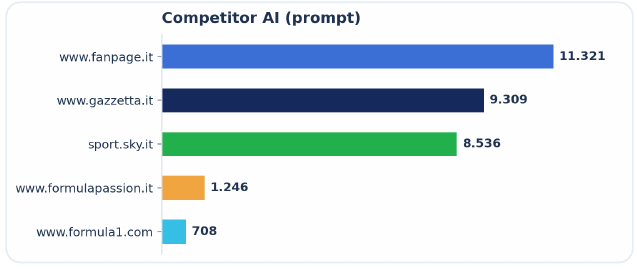
Sports outlets, not carmakers: Ferrari competes with outlets that cover Scuderia news day by day, not with companies that build cars. It shares 11,321 prompts with Fanpage, 9,309 with Gazzetta dello Sport, 8,536 with Sky Sport. There’s a practical reason for this: AI engines draw on whatever material is abundant, and Formula 1 produces a nonstop stream of content; every Grand Prix generates recaps, standings, analysis, all fresh and repeated, easy material for a summary to latch onto. And in fact, the visibility curve peaks between April and May and drops off in the following months, a pattern that tracks with the intensity of the racing calendar.
The road car, the engineering, the driving experience all have to compete for that space against a much denser sports news flow, and they end up on the margins of the answers. The racing team ends up outweighing the product.
The name stays solid, mission and vision lose ground
The GEO Audit pushes the analysis into even more sensitive territory: declared identity. Name recognition hits 98 out of 100, and the engines get sector and geography right too, pointing to a luxury sports car maker, Maranello, global relevance. There’s not much higher to climb.
The gap shows up on mission and vision, still stuck in the AI’s memory with the words the brand used to describe itself almost ten years ago, layered together with heritage, emotion, and prestige.
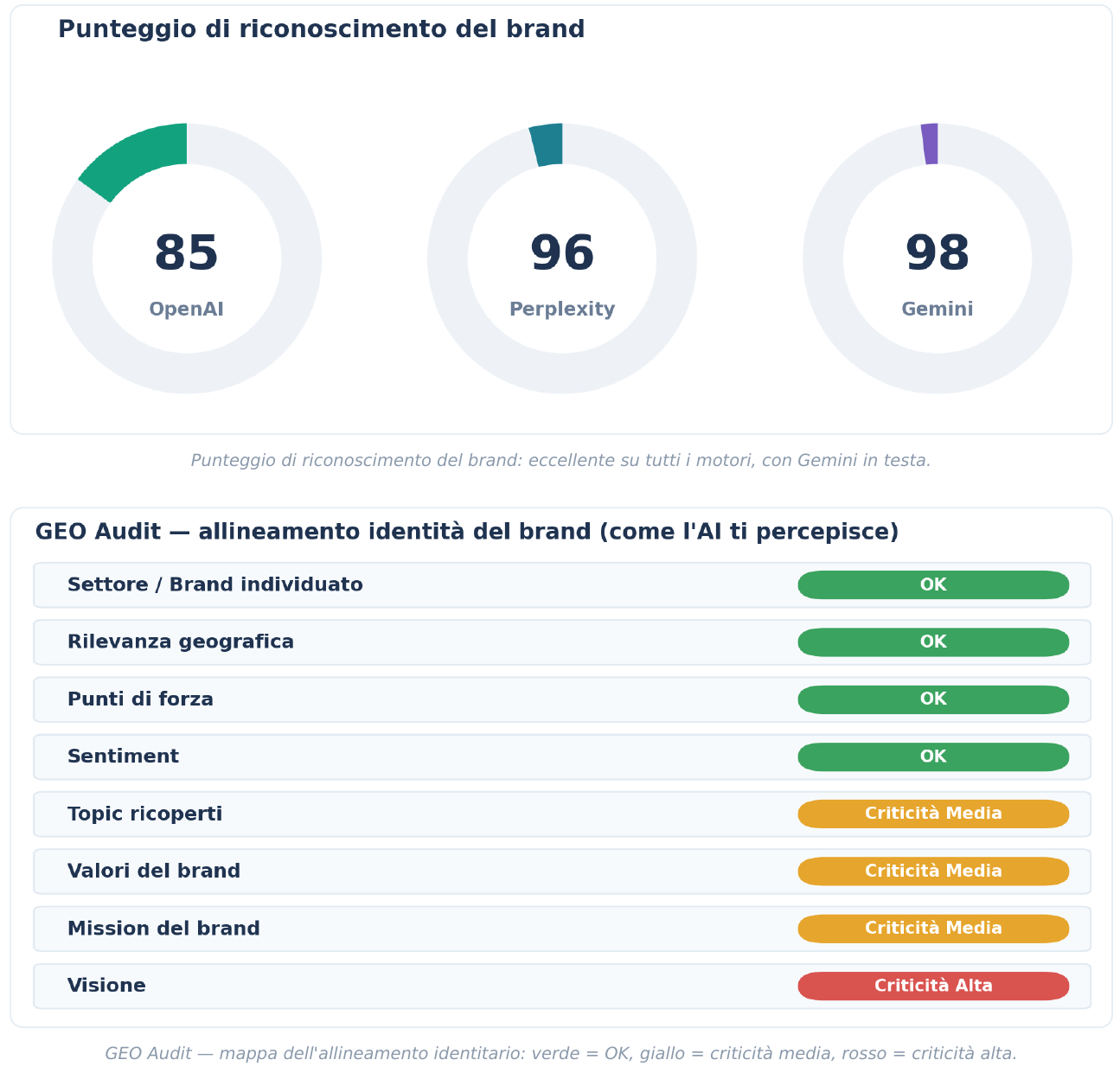
The audit flags the phrase “Ferrari, l’eccellenza italiana che fa sognare il mondo” (“Ferrari, the Italian excellence that makes the world dream”), while today the corporate site has shifted its center of gravity toward passion, human potential, and “timeless icons.” This more recent version of Ferrari is already on the official pages, but it hasn’t yet claimed the same space in the knowledge absorbed by the models. That’s the long timeline of GEO.
Fame hits its limit here: it has locked in an identity so strong that updating it takes a lot of work and time. Changing the wording on the website only starts the process; the new direction then has to work its way through press releases, structured data, institutional pages, and third-party sources before it becomes the most stable, recognizable version.
Ferrari’s first electric car and the brand’s two speeds
We’re watching the practical difference between GEO and AEO timelines play out right now. In late May 2026, the company unveiled the Ferrari Luce, its first fully electric model. It’s a huge shift for a brand that built much of its appeal on the roar of a combustion engine, and it inevitably split enthusiasts between those crying betrayal and those who saw it as the natural evolution of a brand that has always made innovation a badge of honor.
A big story, in other words. Yet depending on where you look for it inside the AI, that story either exists or it doesn’t.
In model memory, the layer the GEO Audit reads as locked in during training, the electric Ferrari barely exists, because that snapshot was taken before the launch. The AEO Audit runs on the faster timeline of live sources, yet it still doesn’t return Luce as a fully absorbed company fact. It has, however, already picked up the conversation surrounding it, with Gemini capturing the split between those defending combustion and those accepting the shift to battery power.
Public debate moves faster than company facts. Outlets, social media, forums, and comments amplify the controversy almost instantly; the AI reads it, measures it, and surfaces it in its answers. That signal says a lot about the climate around the brand, much less about what will happen to the product.
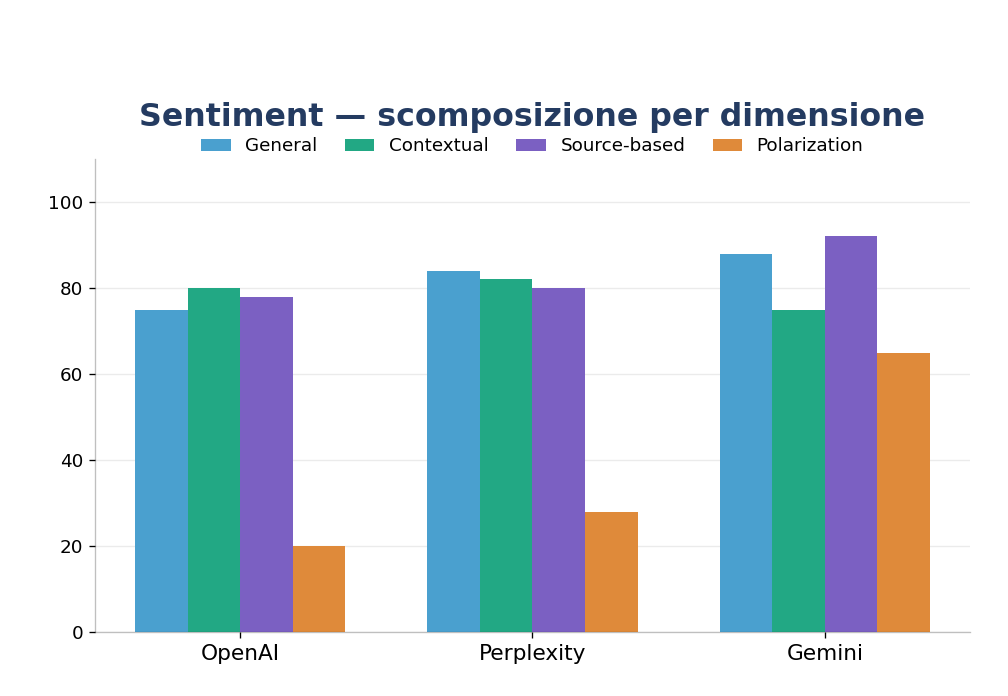
Luce proved this within weeks. According to the Financial Times, Ferrari hit its 2026 sales target in under two months. The purists’ pushback was real, and so was the demand for the car: the reputational conversation and the market went their separate ways.
In short, the sentiment and reputation the AI captures reflect what people say socially about a brand, but orders, sales, and business results live on a different plane. Keeping an eye on the first matters, since it’s a good gauge, but treating it as a verdict on market outcomes is a misread.
Havaianas dominates on name recognition, loses ground on purchase choice
The Havaianas case tells a different kind of story: it shows up in answers with a recognizable identity and positive sentiment, but the advantage thins out once the name drops out of the question and the user stops looking for the brand directly to pick a pair of flip-flops.
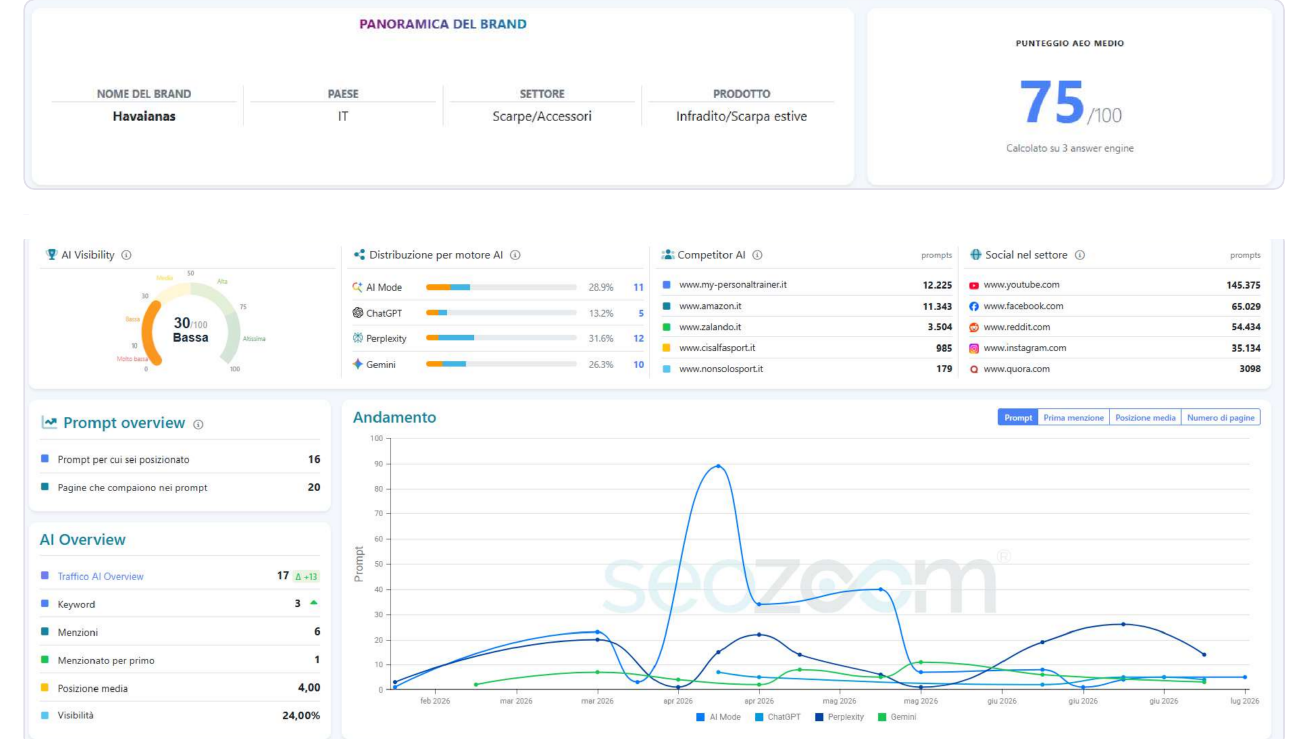
The AEO Audit measures the quality of how the brand gets represented and scores it 75 out of 100. AI Visibility stops at 30, because on category queries that good representation doesn’t translate into much presence. Well described, rarely seen.
The prompt type makes the difference. If the user asks how much Havaianas cost, how to spot an original pair, or which models are more comfortable, the brand holds first or second position, because the brand name already written into the request narrows the field. Broader, category-level questions change the picture: for “most durable flip-flops” Havaianas drops to eighteenth place, for “most comfortable espadrilles” it comes in seventh, and only for “best flip-flops” on Gemini does it hold sixth.
Here the user isn’t searching for the brand, they’re looking for a decision criterion, and durability, comfort, and comparison outweigh the immediate association with summer or the Brazilian lifestyle. And the competition widens: the AI Competitor Analysis shows Crocs and Birkenstock, but also my-personaltrainer.it, cisalfasport.it, amazon.it, and zalando.it, pages that offer a product listing, a comparison, a purchase experience, and that count for more in an answer than a brand because they offer something more ready to cite. When the user searches for the product instead of the name, marketplaces, retailers, and informational sites enter the race, alongside product competitors.
The evidence that shifts the answer
Eighteenth place on durability is the most sensitive spot, because it touches a nerve that sources are already talking about. Durability, wear, and straps that rub show up among the critical signals the engines pick up; in the sample analyzed, though, no Havaianas page emerges that brings materials, intended use, and durability testing into the answer. Reviews, marketplaces, and portals end up filling a space where the brand’s own voice stays weak.
“Are Havaianas comfortable,” “what are Havaianas,” “how will I know that Havaianas is original”: the pages that put the brand at the top share a recognizable structure, with the question in the title, a short answer up front, and the detail right after. This format cuts down the extraction work, since it hands the summary a sentence that’s already defined and easy to quote. The limit is coverage, since today this format mostly covers questions where the Havaianas name is already in the query.
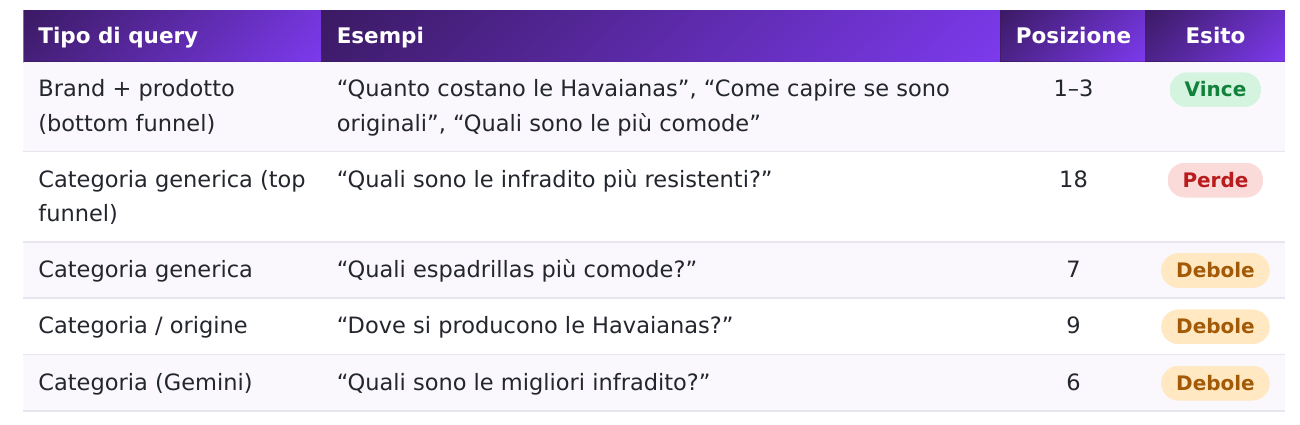
The less-covered queries ask about other things: durability, real-world lifespan, comparisons between models, travel use, rubber maintenance. Applying the same structure to those questions would put a brand page right in the space currently occupied by marketplaces, reviews, and informational sites.
The real difference comes down to verifiable evidence. Birkenstock stakes a stronger claim on foot health, ergonomic comfort, quality, and durability, and it scores 95% on Knowledge Graph presence against Havaianas’ 75%. The semantic gap measures this distance: 40 for Havaianas versus 10 for Crocs and 5 for Birkenstock, and the higher the number, the more absent the brand is from the topics that feed AI responses. Vacation, color, Brazilian spirit remain solid territory for the brand, but they carry little weight when the question is about arch support or technical comparisons.
Crocs holds another useful territory: innovation, inclusivity, material, functional recognizability. Its positioning keeps showing up in sources through consistent, recurring language, and that consistency helps the model reconstruct the reason for the citation without having to find new footing every time.
Ipanema makes the problem visible. It has lower authority than Havaianas and shares the same Brazilian imagery, yet it takes up more space on the environmental topic because it gets associated with PVC recyclability and recycled material content. Havaianas has more concrete numbers than the responses let on: the official reCICLO page cites over 500,000 pairs collected and more than 170 tons of rubber recovered. The data exists, but it stays out of the AI narrative. Publishing proof and getting it into the response are two different jobs.
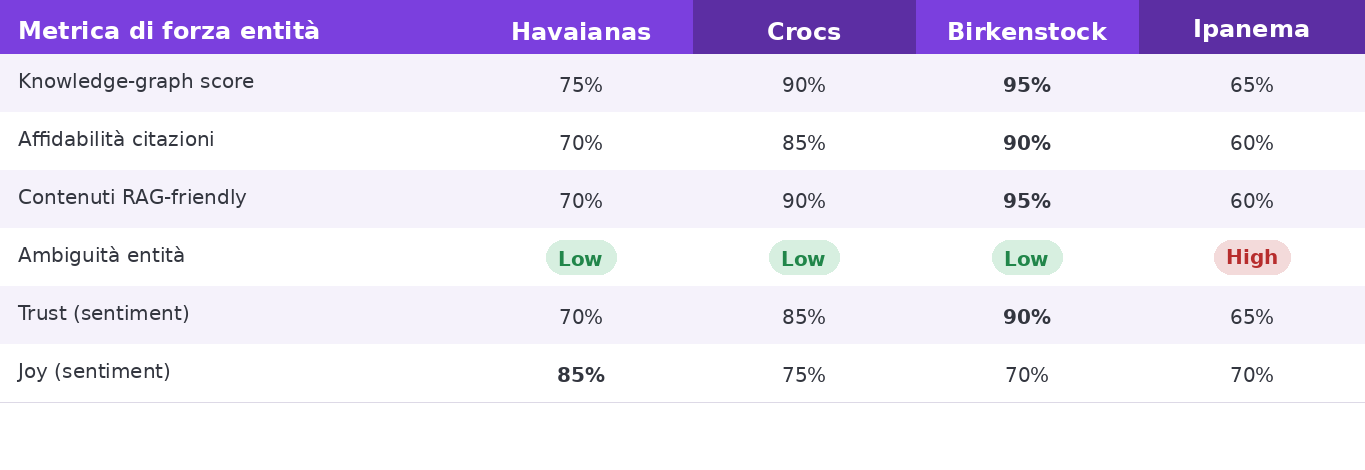
Emotional capital, meanwhile, remains a real advantage. On the Joy KPI, which measures how strongly a brand is associated with joy, Havaianas hits 85%, the highest score in the group, holding onto territory built on summer, color, Brazil, and lightness. That territory, though, doesn’t answer the category question: on durability and comfort, brands that bring verifiable elements to back up the choice get more space.
Memory holds on to Havaianas, the web reshapes its profile
In the GEO Audit, mission, values, and Brazilian origin come through in the right form. Right alongside them, price, perceived durability, and competition also surface: memory holds onto the brand well, carrying along the doubts that have settled around the product over time.
When the response pulls from the web, the picture changes depending on the sources retrieved. Perplexity draws on news outlets and marketplaces, from Corriere to Zalando, and returns a solid Havaianas. Gemini pulls in Trustpilot and post-purchase reviews, where shipping, returns, and customer service issues surface. ChatGPT sits in the middle, between Amazon and editorial sources.
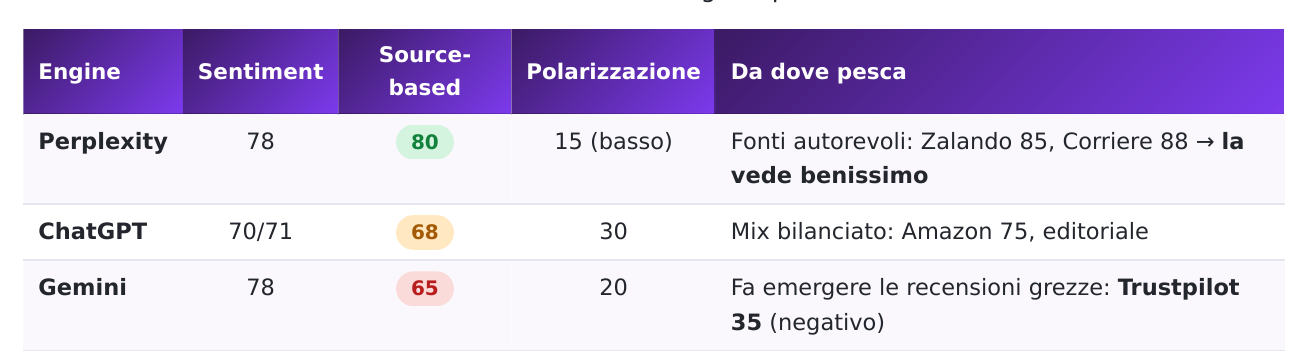
The official page and seasonal campaign cover the part the brand controls directly. Product listings, reviews, forums, and marketplaces fill in the rest. Live reputation takes the shape of whatever experience each engine manages to retrieve.
Priorities after the audit
The same analysis applies to your brand, whether it’s big or small. Ferrari and Havaianas both start from the same strength, brand awareness, and stumble at different points.
Ferrari comes in strong and loses precision on identity. Near-perfect recognition coexists with a mission that the models reconstruct only partially, because the stated formulation carries too little weight in the sources they read. Havaianas keeps its character intact and loses ground on money prompts, when the question turns into a choice.
Your gap can open up elsewhere: between what you claim and what the models remember, between overall sentiment and the sources that surface, between the presence of your name and your position on the queries that drive the final choice.
You can be recognized and still be stuck with a version of yourself you’ve already moved past. It can hold up as long as your name is written into the question, and disappear the moment the user asks the AI to choose. In news coverage you look solid; in reviews, returns, shipping, and customer service, the picture changes.
These are different problems that call for different work, and audits exist precisely to tell them apart. If the AI remembers an outdated version of your brand, your new identity needs to move beyond the corporate page and spread across the whole web. If you’re losing ground on money prompts, you need proof, comparisons, and data that can support a decision. If reviews alone are enough to change the tone of the response, the problem is already inside the customer experience.
For a smaller brand, these cracks are opportunity. The giants occupy memory and leave specific questions, selection criteria, and proof points uncovered. A hard number instead of an adjective, a page that actually resolves the doubt, a source that makes a claim verifiable, these can outweigh fame.
Brand awareness remains an advantage. Citability decides which part of the brand actually makes it into the response.


 Verified reviews on Trustpilot