


March Update: twelve days, many earthquakes, a new balance
The rollout lasted twelve days, with a wave of volatility that began to rise well before the official announcement and remained high even after the market closed. Google’s March 2026 Core Update began on March 27 and concluded on April 8, 2026, marking the first major intervention of the year on the core ranking systems.
Google called it a regular update to improve the quality of results, but in Italy the impact was certainly felt, even if it didn’t follow the pattern of an update that upends everything in a matter of days. The changes were selective, extending just enough to shift the balance in several areas of search. And the data from our Observatory, cross-referenced with international evidence, helps us understand where and how.
What the March 2026 Core Update Was Like and What Was Seen in Italian SERPs
The Google March 2026 Core Update was officially released on March 27, 2026 and completed its rollout on April 8, 2026, lasting a total of 12 days. It is the first broad core update of the year, preceded shortly by the March 2026 Spam Update, and comes after an already turbulent phase in Google search.
Formally speaking, the script remains the now-familiar one for core updates: no surgical intervention on a single factor, but a broad update, intended to recalibrate the overall quality of results. The most useful analysis, however, looks beyond the official dates, examining the timing and manner in which that redistribution is reflected within the SERPs.
The wave of volatility recorded by the SEOZoom Observatory actually began to rise sharply as early as mid-February, over a month before the official rollout, and extended well beyond the end date announced by Google, with a peak detected on April 10 and a pace that only slowed around the 17th of the month. The pressure built up beforehand, developed during the update, and continued afterward: for this reason, defining the update as a twelve-day event tells only part of the story.
The data reveals an update that had a selective and layered impact. It was not a sudden earthquake, with no textbook “before and after.” Volatility changed as if following gradual reallocations, with measurable effects on rankings, top-10 keywords, and traffic estimates. The landscape left behind by the update differs in some highly recognizable hubs of Italian search.
All data from the Google March 2026 Core Update
The volatility curve recorded by the SEOZoom Observatory during the period moves through three distinct phases.
The stable baseline, between December and January, remains contained, with fluctuations roughly between 6.47% and 7.48%. This is the normal behavior of a SERP operating without disruption. It is the post-December 2025 update period, a sign that the changes imposed by that update have begun to settle in.
The acceleration begins on February 6 with the volatility at 8.26% and continues in a straight line: 9.93% on February 13, 11.45% on February 20, 13.34% on March 13, 14.13% on March 20. When the official rollout begins on March 27, volatility is already at 12.06%, higher than the overall average for the period (9.23%).
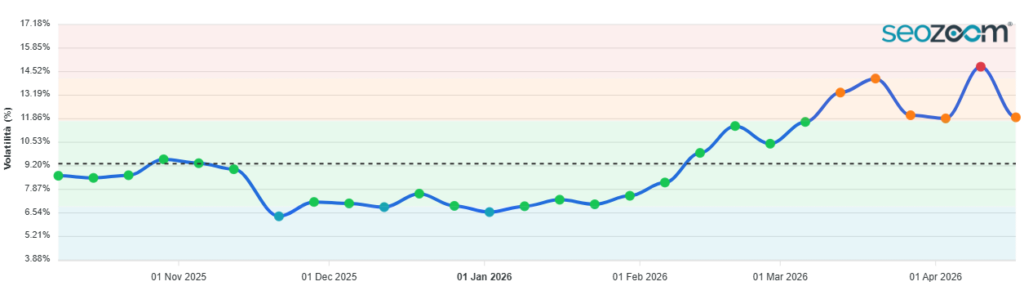
The long tail is the least intuitive yet most significant data point. Once the rollout was formally completed, the 11.88% recorded on April 3 rose to 14.80% on April 10. It wasn’t until April 17 that the curve returned to a value close to the norm (11.94%).
An average of around 9% and a peak above 14% indicate an update that tangibly increased the intensity of traffic fluctuations without turning into an indiscriminate surge.
The update as seen by foreign analysts
The analyses released by the international SEO industry largely align with what was observed in SEOZoom’s Italian data, revealing similar dynamics but with important nuances. High volatility in the weeks leading up to the rollout is a common theme, as is the reshuffling that did not end with the official release.
A recurring finding in international analyses is the average gain recorded by the news sector, in contrast to the widespread struggles faced by major news aggregators and general reference portals—dictionaries, online encyclopedias, translation sites, and reference sites. Even the YMYL sectors, particularly finance and health, appear to be treated with greater caution, showing less pronounced movements.
Overall, the international narrative describes a broad, layered core update consistent with a continuous evolution of the core ranking systems, rather than a sudden change in direction. The same trend emerges when looking at Italy.
SEOZoom’s analysis of Italian SERPs
The general data is enough to show that Italian SERPs have shifted significantly. To understand where, we need to drill down a level. Our aggregated sensor allows us to delve into two levels: distribution by sector and the behavior of the top 100 Italian domains.

The analysis points to a selective redistribution of visibility, with some sectors far more affected than others, and an Italian top 100 that, while remaining relatively stable at the very top, shows more noticeable shifts as you move down the rankings. In other words, the broad core update left less dramatic traces at the top and far more revealing ones in the middle tier and in the verticals where Google has readjusted the balance.
The update’s impact on sectors – who felt it most
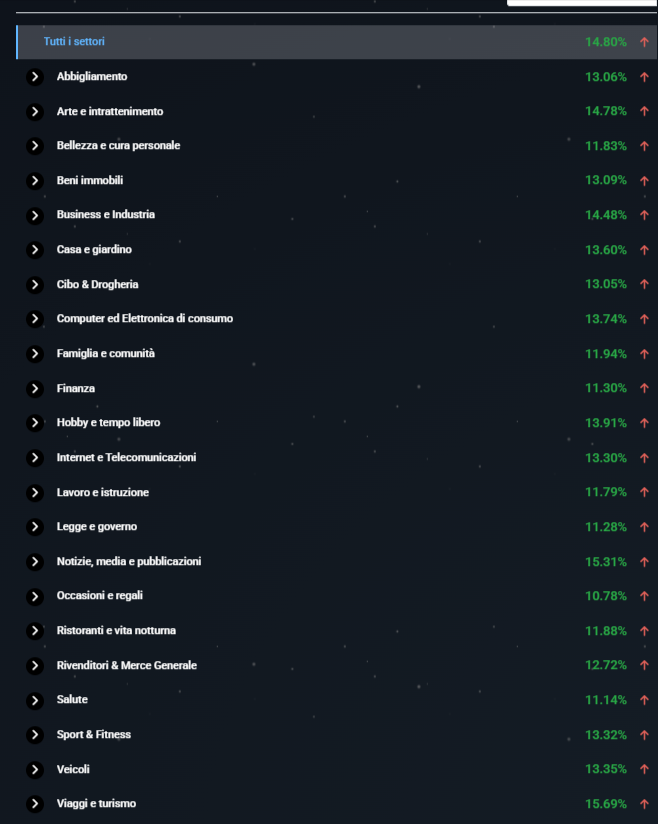
The aggregate figure for all sectors stands at 14.80%, representing a change of +24.59% compared to the previous period. The gap between the most volatile sector and the most stable one exceeds 4.5 percentage points and reveals the nature of the update better than any average.
The sectors that exceeded the aggregate figure are few and easily identifiable.
- Travel and tourism (15.69%, +22.51%): this is the highest figure in the entire basket. Google has focused primarily on queries where immediate utility, practical organization, comparison, and quick answers matter. In a sector with very concrete search intent, any realignment immediately affects the distribution of visibility.
- News, media, and publications (15.31%, +20.25%): the second-highest absolute figure. The sector presents a fragmented picture, with irregular movements involving general-interest publishers, sports publications, service pages, and content related to television programming. It is one of the sectors where the update has most clearly demonstrated its selective nature.
- Art and Entertainment (14.78%, +14.55%): slightly below the aggregate figure but at high levels, with strong focus on movies, series, celebrities, and TV schedules—highly recognizable queries that Google continues to recalibrate, prioritizing direct and readable responses.
A broad range between 13% and 14.48% encompasses Business and Industry, Hobbies and Leisure, Computers and Electronics, Home and Garden, Vehicles, Sports & Fitness, Internet and Telecommunications, Real Estate, Clothing, Food & Groceries. The update made significant changes here without generating headlines.
At the opposite end of the spectrum are the anchors of stability:
- Deals and Gifts (10.78%, +1.33%): the lowest value overall and the smallest change in the basket. A balance maintained in an area that usually fluctuates significantly.
- Health (11.14%, +17.29%): confirms the resilience already observed in December. The percentage change is growing, but the absolute level remains modest—a more conservative approach to the YMYL sector, consistent with the international landscape.
- Law and Government (11.28%) and Finance (11.30%), again with values consistent with a less aggressive approach to sensitive sectors.
The gap between the most shaken verticals and the most stable ones reflects the nature of the update: a recalibration that chose where to push and where to maintain the balance. Where the intent is more fluid, experiential, and tied to freshness, Google has rewritten the weights. Where trust is already established, it preferred to keep the configuration unchanged.
Movements in SEOZoom’s top 100 ranking
The Italian top 100 confirms this interpretation. At the top, there are few real upheavals: the major domains continue to occupy the top positions, and the March 2026 Core Update does not produce a dramatic shake-up of the top spots. In fact, the very top positions remain unchanged—Wikipedia, YouTube, Facebook, Instagram, Amazon, and Google Play form the core infrastructure that transcends the normal logic of ranking—while the real movement begins just below, in the middle range, where we see measurable and significant shifts.
In summary, cross-platform services and strong offerings for high-intent queries are growing; certain vertical projects with clear immediate utility are gaining strength; and interesting trends are emerging in specialized health sectors. On the flip side, certain sectors related to consultation, definition, and reference—that is, sites that for years have enjoyed a very stable presence in SERPs and now seem more exposed to the reshuffling caused by broad core updates—are showing greater fragility.
Three patterns are particularly clear.
Weather is being rewritten from within. ilMeteo gains 6 positions and re-enters the top 10 at 7th place, with over 60 million estimated visits: a clear recovery following the sharp decline recorded in the December 2025 Core Update. Meteoam also rises (+25), while 3Bmeteo drops one position and Meteo.it slips 8 places, down to 98th. This is not uniform growth across the sector, but rather an internal redistribution.
The sports sector is losing its cohesion. Sportmediaset records the sharpest drop in the entire ranking (-33 positions), sport.sky.it and UEFA both fall by 11 places, Skysports by 2, and Juventus.com by 6. The only exception on the rise is Tuttosport (+9). It is a widespread decline affecting both traditional sports publishers and club websites.
General news sites reverse their trend compared to December. Repubblica (-6), Corriere (-6), and ANSA (-20) slip in the rankings after a previous core update that had seen them rise. Bucking the trend on the opposite end, some service platforms and vertical magazines are making a leap: Wired Italia gains 34 positions, the most surprising movement of the rollout, followed by Primevideo (+25), Google Translate (+23), Google Maps (+16), Libero (+15), Mediaworld (+12), and Skyscanner (+11). The overall picture paints a ranking that rewards those with clear objectives and operational services, while downplaying those that rely on generic news coverage.
Winners & Losers of the Update: What the SEOZoom Data Reveals
Let’s delve into the domains to understand who gained and who lost visibility. As is our tradition, we’ve isolated a significant sample of Italian sites that recorded anomalous changes during the period, cross-referencing Zoom Authority (ZA) movements with organic traffic estimates and filtering out seasonal fluctuations as much as possible.
The update also affected sites with high Zoom Authority, though without completely overturning their values. The winners share some recognizable traits: they address clear needs, respond well to vertical or highly identity-driven queries, and have a direct connection to search intent. The clearest losers are concentrated in environments that rely on consultation, definition, or explanation, or in assets that have lost their grip on the queries that historically supported their visibility.
The same principle always applies: when sites with very high Zoom Authority move, even by a single point, it is never a marginal event. It is a signal that Google is recalibrating significant balances, and it does so by redistributing space, not by rewarding or punishing in a dramatic way. That is where it is worth looking.
The main sites gaining visibility
Among the winners, signs of net growth, consolidation, or recovery following previous periods of weakness prevail.
Between February 18 and April 15, 2026, estimated traffic rose from 18,473,095 to 25,622,398, a gain of over 7.1 million visits. Keywords in the top 10 grow from 2,274,114 to 2,529,354, while the total number of keywords drops from 8,240,534 to 7,435,130. Zoom Authority rises to 87, gaining 6 points compared to the same period in 2025.
This data should be viewed as a whole: Reddit is increasing the weight of the queries that matter, consolidating its presence in the most lucrative areas of the SERP, and transforming massive coverage into more selective visibility. The comparison with twelve months ago makes the picture even clearer—on March 19, 2025, estimated traffic stood at 7,136,773; today, we’re over 25 million. It was already growing steadily a year ago, but this explosion was perhaps impossible to predict. With SEOZoom, we reported, foresaw, and explained it: Google is increasingly ranking social content and discussion platforms in its SERPs, and Reddit is the most recognizable face of this trend.
- IMDb
Between March 12 and April 9, 2026, estimated traffic rose from 10,128,031 to 12,960,552, an increase of over 2.8 million visits. The number of keywords in the top 10 grows from 525,182 to 534,605, while the total number of keywords rises from 1,692,569 to 1,966,887. The ZA remains unchanged.
IMDb confirms the trend of vertical databases capable of capturing highly recognizable queries. This is consistent with the prominence the Arts and Entertainment sector has had in this update: Google continues to reward projects that directly answer questions about movies, casts, profiles, and high-intent content.
- MioDottore
Between March 18 and April 15, 2026, estimated traffic grew from 2,677,294 to 3,118,832, keywords in the top 10 rose from 190,768 to 203,253, while the total number of keywords fell from 666,242 to 601,147. Zoom Authority remains unchanged.
In a sector that has been less volatile than others, a case like MioDottore carries more weight: more traffic, more top 10 rankings, and less dispersion in the long tail. This signals a rigorous selection process that rewards a brand capable of dominating medical and service-related queries with a very clear identity.
- GuidaTV.org
Between March 18 and April 15, 2026, estimated traffic rose from 1,573,809 to 2,332,469, an increase of over 758,000 visits. The number of keywords in the top 10 grows from 10,734 to 11,491, while the total number of keywords decreases slightly from 26,810 to 24,923.
The site gains ground on queries that define its scope—TV shows, schedules, what to watch in the evening, and highly timely content. When the intent is clear, Google rewards those who respond directly.
- GranFarma
Between March 4 and April 15, 2026, estimated traffic rose from 106,677 to 926,479, an increase of over 819,000 visits. During the same period, the number of keywords in the top 10 drops from 8,305 to 7,773, and the total number of keywords falls from 49,350 to 36,412, while Zoom Authority rises from 56 to 64.
The jump is real and significant enough to place the site among the period’s winners, but the trend remains abrupt compared to other examples and requires verification of its sustainability in the coming months. The useful takeaway, for now, is that even within a less dynamic sector like healthcare, Google has allowed for sudden growth among very specific vertical players.
- Codifa
Between November 12 and December 31, 2025, the domain suffered a sharp drop, falling from 1,888,955 to 73,822 in estimated traffic, with a parallel decline in ZA from 68 to 61. It had been one of the hardest-hit losers of the December 2025 Core Update.
The recovery began as early as February, when traffic returned to 1,531,220, and consolidated on April 15, 2026 with a further jump to 2,162,080. The number of keywords in the top 10 grew from 31,578 to 36,003 between February 25 and April 15, while the ZA rose to 69, surpassing the pre-crash value from November.
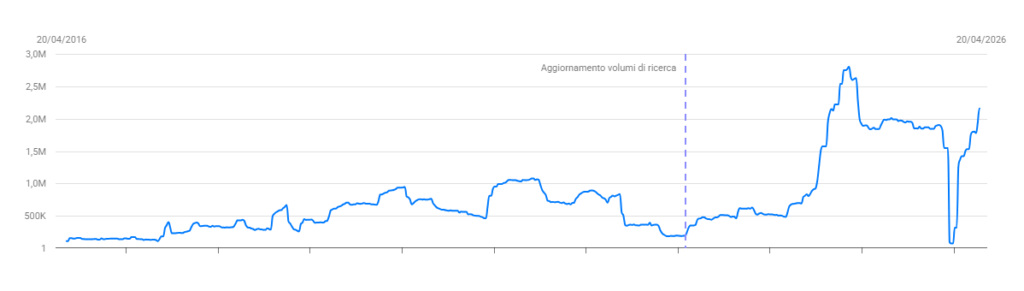
Not linear growth, but a rebound after a major setback. The March 2026 Core Update not only rewarded sites that were already on the rise, but also accelerated significant recoveries in verticals where quality signals had stabilized once again. Proof, once again, that a core update does not deliver definitive verdicts.
The main sites that lost visibility
And now let’s look at the other side of the coin: the sites that ended the period on a negative note, impacted by the update.
- Wikipedia Italia
Between February 25 and April 8, 2026, estimated traffic dropped from 603,063,454 to 496,538,563, with a loss of over 106.5 million visits. The number of keywords in the top 10 dropped from 4,386,687 to 4,181,219, the total number of keywords fell from 9,434,675 to 8,752,578, while the Zoom Authority remained unchanged at 98.
Such a figure goes beyond a mere episodic decline. It affects one of the major encyclopedic hubs of the Italian web and reinforces a pattern that recurs several times in this analysis: reference and definition sites seem more exposed to the reshuffling caused by broad core updates, especially when Google recalibrates the value of concise, immediate, and easily replaceable answers in SERPs. ZA’s stability indicates that we are not facing a loss of technical authority, but rather a reduction in the space that the SERP allocates to that informational function.
- Treccani
Between March 18 and April 15, 2026, estimated traffic dropped from 57,851,478 to 50,720,296, losing over 7.1 million visits. Keywords in the top 10 drop from 636,265 to 614,217, while the total number of keywords drops from 1,719,918 to 1,653,716. Here too, the ZA remains stable.
Same trend as Wikipedia, different scale, very similar significance. The loss is consistent with an update that reduced the weight of certain historically very strong definitional and informational domains. Alongside Wikipedia, Treccani makes one of the central themes of the Italian update more readable.
- Context Reverso
Between February 25 and April 15, 2026, estimated traffic drops from 10,667,154 to 9,624,039, with a loss of just over 1 million visits. The number of keywords in the top 10 drops from 252,846 to 244,547, while the total number of keywords falls from 755,864 to 740,692. The ZA remains unchanged.
Rounding out the list of losers are reference sites. Definitions, translations, meanings, quick-reference content: a piece of the same mosaic as Wikipedia and Treccani, which strengthens the overall reading experience.
- sport.sky.it
Between March 18 and April 15, 2026, estimated traffic drops from 25,372,739 to 17,135,605, with a loss of over 8.2 million visits. The number of keywords in the top 10 drops from 137,534 to 133,218, while the total number of keywords rises slightly from 457,955 to 460,847. The ZA drops from 80 to 79.
The loss is significant even with overall coverage remaining nearly unchanged. The problem is not the absence from SERPs, but the different weight of the targeted queries—the discrepancy clearly illustrates how this update has impacted the relative quality of visibility rather than the quantity of ranked keywords. The decline is consistent with the domain’s drop of 11 positions in the top 100 ranking.
- Google Blog
Between March 25 and April 15, 2026, estimated traffic plummets from 597,716 to 40,716, with a loss of approximately 557,000 visits. Zoom Authority drops from 62 to 53, keywords in the top 10 decrease from 4,129 to 3,894, and the total number of keywords falls from 24,099 to 20,620.
What’s interesting isn’t just the numerical drop, but the nature of the loss: the domain loses ground precisely on queries within its own ecosystem, where one would expect a stronger foothold. This signals a lot about the selective nature of the update and the reduction in guaranteed traffic even for heavily branded assets. No one, not even an official Google blog, is immune to the reassessment of informational value.
What’s happening in AI Overview?
A granular analysis of winners and losers also reveals another finding: the relationship between organic search and AI Overviewdoes not follow a linear pattern. Growth and decline in traditional SERPs are not automatically reflected in Google’s AI responses, and it is precisely this lack of symmetry that makes the March 2026 Core Update more intriguing.
Losing organic visibility does not necessarily imply an equivalent loss in AI Overview, just as growth in SERPs does not guarantee an immediate strengthening in generative surfaces, which SEOZoom measures through keywords, mentions, first mention, average position, and visibility.
The clearest examples are found in the encyclopedic, definitional, and reference domains. Wikipedia Italia, Treccani, and Context Reverso show a consistent decline in organic search and confirm a broader fragility in their generative presence as well. When a site loses ground on the queries that historically underpinned its strength, this decline can extend to AI surfaces as well.
The picture becomes more complicated for growing sites. The winners analyzed do not exhibit a single pattern: in some cases, organic traffic improves more decisively than AI Overview, while in others, presence in AI responses remains weaker or more selective than expected. Google continues to treat organic traffic and AI Overview as two interconnected but not overlapping levels. The March 2026 Core Update primarily affects the redistribution of visibility in classic SERPs; AI Overview accompanies these shifts, confirming them in some cases and contradicting them in others.
A case like blog.google illustrates this difference well. The domain loses ground precisely on queries belonging to its own ecosystem, a dynamic that carries more weight than a simple numerical difference. AI Overview does not function as an automatic balancing mechanism for organic results, nor does it always replicate the same hierarchy as classic results. It behaves as an autonomous surface, unsynchronized with the rebalancing effects of core updates. The absence of correlation itself becomes useful information: it indicates where to look for signals and where a mechanical interpretation risks leading one astray.
What We Take Away
A cross-sectional analysis of all these cases allows us to identify certain recurring dynamics, beyond the specificities of individual sectors.
Not even the big brands are immune. Wikipedia Italia loses over 100 million estimated visits while maintaining its ZA unchanged. Treccani and Reverso follow the same fate. Repubblica and Corriere, which were among the winners in December, are now falling in the top 100 rankings. Sport Sky, UEFA, Sportmediaset, and ANSA are losing key positions. At the same time, other equally strong brands are consolidating or strengthening their positions. The core update does not favor the small over the big: it redefines the balance of power between the major players and reaffirms that a strong brand remains central, but is not untouchable.
The world of reference is the most recognizable thread of the update. Wikipedia, Treccani, Context Reverso, and traditional dictionaries: all moving in the same direction, and always on the queries that historically underpinned their strength. A trend that also emerges in international analyses. Google is reducing the space the SERP allocates to purely definitional answers in favor of more specific, practical, or experiential content. Reddit’s growth is the other side of the same coin.
The most exposed sectors are those where intent is fluid and freshness matters: travel, news, entertainment. These are the same sectors that have seen the highest volatility, and where sector-level and domain-level data tell the same story.
Finally, a confirmation that is worth more than many others: core updates are not final verdicts. The Codifa case, which took a hit in December and fully recovered by March, shows that ranking systems constantly recalibrate and that authority can be regained when quality signals stabilize again. An important message for those who suffered losses in previous phases: the direction of the next rollout is never predetermined.
How to Turn Information into a Method with SEOZoom
To understand whether your traffic drop is due to these dynamics or specific issues, start with the overall behavior of the SERPs. It’s the first methodological step—and also the most overlooked. If you start immediately with a domain that has lost traffic, you end up attributing to the update what is often just a local consequence. With SEOZoom, the work always begins earlier, upstream.
Use the Time Machine by setting the dates to March 20 (pre-rollout) and April 15 (post-rollout). Don’t just look at the total number of keywords lost: filter for keywords that dropped out of the Top 10. If the lost keywords are generic or off-target, the effect is a redefinition of the scope. If you’ve lost your core keywords, the impact is structural and requires a review of your content strategy.
Also check the Zoom Authority in the project tab. A fluctuation of one or two points during this period can be an important indicator of trust reassessment, more stable than daily traffic fluctuations. Pay particular attention to the relationship between ZA and traffic trends: when ZA remains stable while traffic drops sharply, the decline often reflects the space the SERP allocates to a specific informational function, rather than the domain’s technical authority. This pattern consistently emerges in the case of the reference sites observed in this update.
Finally, broaden your focus to AI surfaces. With AI Visibility, GEO Audit, and AEO Audit, you can see how the brand performs in generative responses and verify whether the organic decline is accompanied by a reduction in prominence as an AI source or if the two metrics move independently. This is particularly useful today, precisely because the correlation between SERPs and the AI Overview has once again proven weaker than many assume.
Remember: by definition, a core update neither punishes nor rewards. It rebalances, redistributes, narrows, or expands spaces. The optimization method works when you stay grounded in the numbers, and SEOZoom is designed precisely to avoid automatic interpretations and help you focus on what is measurable: rankings, keywords, authority, and trends.