Google Ads and ChatGPT Ads: what you’re buying and where to put your budget
Ads rarely show up on ChatGPT, and the traffic they bring converts worse than traffic from Google Ads: running both together only makes sense in specific cases.
You’ve heard that ChatGPT, too, now sells ad space. The idea intrigues you, but you’re already putting part of your budget into Google Ads and aren’t sure how to move. Do you pause some Search campaigns to fund the new option, launch an exploratory test, or leave things as they are? And if you use both, what is each one actually for?
There’s no one-size-fits-all rule. It depends on your market, who your customers are, and how the systems talk about you today. If you’re not clear on what you’re buying with each one, every euro you spend becomes a shot in the dark.
ChatGPT Ads alongside Google Ads
ChatGPT Ads is OpenAI’s advertising platform: companies use it to show their ads to ChatGPT users, below the assistant’s answers. The ad is a box separate from the text and labeled as such, with the advertiser’s name and logo, a headline, a short description, an image, and a link to the site. Also in testing: a multi-image format that appears while ChatGPT generates an image the user requested, and sponsored agents, which OpenAI is rolling out to some advertisers. From the box, the customer starts a chat with a brand assistant, which answers questions about products and services and drives traffic to the site.
Not every word the customer reads below the answer is yours, though. The ad system introduces the ad with a line of its own, tying it to the current request, and by default it can also rewrite the headline and description to fit the conversation and send the click to a different page on your site. You can turn off these optimizations; if they stay on, the new versions go live without you seeing or approving them one by one.
With Google Ads you’re buying a different spot, on the results page, for the searches you choose: when a potential customer searches for what you sell, above and below the organic results they’ll find text ads labeled as sponsored and, for many products, listings with photos, price, and store name. On ChatGPT, it’s the system that decides which conversations your ad shows up under.
In the Italian market you can already buy ads on ChatGPT, even on your own through Ads Manager, OpenAI’s panel for advertisers, and the ads do reach users: an Italian agency, Marketing Arena, showed its ads to the Italian audience more than 270,000 times in about two weeks in September. OpenAI is rolling them out gradually, though, and doesn’t place one under every response, so users who ask the assistant for advice still run into them rarely. When you decide where to put your next euro, you’re choosing between an advertising market you already know, crowded with competitors, and one that just opened.
Who sees ads below the answers
Google shows its ads to anyone who uses the search engine. With ChatGPT Ads you only reach part of the hundreds of millions of people who use the assistant: those on the free tier, those on Go (the cheapest paid plan), and those without an account. People who pay for Plus, Pro, or a business or education plan don’t see ads, and neither do users OpenAI identifies as minors.
If you sell to other businesses, the plan your customer uses to access ChatGPT matters. A purchasing manager working from a business account won’t see ads, so your campaign won’t reach them while they’re asking the assistant which vendor to choose. A similar limit applies if you sell health-related products or services: OpenAI doesn’t show ads in conversations about physical or mental health, or in conversations about politics.
As in the rest of the European Economic Area and in Switzerland, ChatGPT in the Italian market doesn’t personalize ads, and for these users OpenAI even advises against setting up custom audiences, meaning groups of people the advertiser defines on their own. Only the conversation in progress matters: your ad reaches whoever is talking about the right topic at that moment.
What it costs to launch a campaign
When you set up a campaign, the first figure you enter is the daily budget, meaning how much you authorize the platform to spend each day. Google Ads doesn’t set a minimum. ChatGPT Ads won’t accept less than 15 euros a day, and it calculates that as a weekly average: on one day it may spend up to double that, and less on another, but the weekly total won’t exceed seven times the figure you set. At the minimum budget, a month-long trial costs around 450 euros. Compare that to what you’re currently spending on Google Search campaigns: if that’s a few hundred euros a month, a trial on ChatGPT costs as much as everything you have running now, or more.
You also have to choose what you’re paying for. In Search campaigns you pay per click, meaning each time someone sees your ad, clicks it, and lands on your site: if the ad shows up and nobody picks it, you spend nothing. On ChatGPT, when you create the campaign, you choose between paying for clicks and paying for impressions, in blocks of a thousand. OpenAI offers this second option to advertisers who want maximum visibility: in that case you pay every time the ad appears in front of someone, even if they don’t click, and the risk of spending without getting any visits is yours.
An auction sets the price of the click, on Google just as on ChatGPT. Every time someone runs a search or asks a question that matches your ad, the platform compares the advertisers competing for that spot. On Google you set the maximum amount you’re willing to pay for a click, or you let the system handle bidding with a target cost, and you usually pay less than you bid: just enough to beat the advertiser right behind you. Besides the bid, Google also weighs the quality of the ad and the landing page it leads to, and a competitor with a better ad can outrank you while spending less.
On ChatGPT, before the auction, an OpenAI model dedicated to ads goes to work: it reads the whole conversation, not just the last question, and decides whether there’s room for an ad. If there is, it looks for matching ads and scores them on relevance, the likelihood they’ll be clicked and drive the outcome the advertiser wants, and their performance so far. Only ads that clear a minimum relevance and value threshold make it to the auction, where the bid and the quality score decide the winner. In new campaigns, the system bids on your behalf: you set the budget and, if you want, a target average cost, per click or per conversion, and the system bids higher or lower at different times to stay on that average, while the winning bid sets the price you pay.
To estimate what you might pay, Google Ads gives you your own campaign data, including the average cost per click, and for searches you’ve never bought you can check the estimates in Keyword Planner, in the same account. For ChatGPT you don’t have any history to go on: OpenAI’s guide suggests $3 to $5 per click as a starting point, and Ads Manager warns you when your bid risks limiting how often your ad appears. A target cost set lower than what the campaign is currently achieving has the same effect: the system shows the ad less often, and part of the budget may go unspent.
In ChatGPT Ads you can set sales as your campaign objective, but you don’t pay for sales. The system uses that signal to decide who to show the ad to and how much to bid in auctions, while your invoice still charges you for clicks or impressions. Even in Google Search campaigns, when you tell the system to target sales, you’re still paying for clicks. Whether the person who lands on your site actually buys or not depends on your page, your price, and your terms.
The value of a cheap click
Marketing Arena, the Italian agency that published the results of its first ChatGPT campaigns, ran three of them for the Italian audience in September: two for clients and one for itself. Out of 4,123 euros in spend, it paid an average of 0.77 euros per click, far less than the $3 to $5 OpenAI cites as a starting point. The cost per click and the click-through rate were in line with what the agency gets on Google and Meta.
In an auction, the price goes up when many advertisers want the same spot and down when few do. The 77 cents Marketing Arena paid suggests that, for the Italian audience in September, competition was still low. The market, though, is growing fast: OpenAI says more than 100,000 advertisers have already run ads on ChatGPT, and the price you see in a few weeks of campaigns won’t tell you what you’ll end up paying. The daily budget is also a cap: if the system shows your ad less often, the campaign spends less, and you only pay for the clicks or impressions it actually got.
On some days, Marketing Arena’s campaigns showed no ads at all, “basically for no reason,” the agency writes. In the system OpenAI describes, there’s more than one possible reason for that. Besides the selection that happens before the auction, there are checks that can exclude an ad if the campaign has run out of budget, if the system prefers to spend it at another time of day, if the person writing is outside your chosen regions or using a different language, or if the ad doesn’t fit that type of conversation. And even when an ad wins the auction, it may still not show up, because the system decides it’s out of place in that chat or because it isn’t ready by the time the response finishes. None of these cases get fixed by raising your bid.
The cost per click, though, tells you little about what the visit actually brings you. For the agency, a conversion from ChatGPT cost much more than one from Google or Meta. In the United States, where these ads have been running longer, a study still under review by two researchers from the Vienna University of Economics and Business and the Frankfurt School of Finance & Management points the same way, looking at 102 advertisers: on average, a visit from a ChatGPT ad brought in $0.89 in sales, versus $2.45 for a visit from a Google ad, and among advertisers buying on both platforms, 97% earned less from a ChatGPT visit than from a Google one. If you get in now, you pay little for each click, but you don’t know how many people will see your ad from one week to the next, or how much each visit will be worth, and to find out you have to look at your own data.
What you know after paying
Ads Manager tells you how many times your ad was seen, how many clicks it got, how much you spent, your average cost per click or per thousand impressions, and how many conversions it logged, broken down by device, country, and platform. It doesn’t tell you which responses it appeared under, or what the assistant had just written right above your ad box. If you let the system rewrite your ad, the numbers cover all its versions together, so you can’t tell which headline the customer read before clicking.
Instead of keywords, ChatGPT Ads has you write context cues, short phrases describing what you offer, who it’s for, and in which situations. These don’t guarantee your ad will show up in specific conversations, and they don’t let you exclude topics you don’t want to appear in: OpenAI only grants negative exclusions to select advertisers. And you don’t know who else is buying the same space: OpenAI doesn’t publish a searchable archive of running ads, the way Google does with its Ad Transparency Center, so the only competitor ads on ChatGPT you ever see are the ones that happen to show up under a response you got.
In your Google Ads account, on the other hand, you’ll find the search terms report: the list of the exact searches that triggered your ads, excluding those made by too few people. The report is there even when an agency or a colleague manages the campaigns, and it’s the most concrete record you have of what your customers are actually asking for, in their own words. From there, you decide which searches to keep showing up for and which to exclude. Google also rewrites headlines and descriptions and can send the click to a different page, through AI Max, the AI features for Search campaigns, but you’re the one who turns them on, and in that case, next to each search, you see the headline and URL it used.
Part of the page, though, is out of your reach too: when an AI Overview appears above the results, the box where Google summarizes the answer with AI, your ad can end up above or below it, but you don’t choose the position and the reports don’t show it.
Laid side by side, the line items that eat into your budget point to two different purchases, even where the cost per click looks similar.
| Item | Google Ads, Search campaigns | ChatGPT Ads |
|---|---|---|
| Where the ad appears | Above and below organic results, sometimes next to AI Overviews | In a box below the answer; in testing, also while ChatGPT generates an image |
| Who writes the ad | The advertiser; with AI Max enabled, Google adapts headlines, descriptions, and the landing page | The advertiser, but the system adds an intro line and, by default, can rewrite the headline and description and change the landing page |
| Who sees it | Anyone searching on Google | Free, Go, and logged-out users; not Plus, Pro, business and education plans, or minors |
| Minimum budget | None | 15 euros a day, averaged over the week |
| What you pay for | The click | The click, or per thousand impressions |
| How you bid | A maximum cost-per-click bid, or automated bidding with a target cost | The system bids within your budget and, if you set one, toward a target average cost per click or per conversion; maximum bids remain available only for existing campaigns, through the end of 2026 |
| What decides who shows up | Bid and ad and page quality | A relevance and value threshold to enter the auction, then bid and quality |
| What you choose before launch | The searches you want to appear on and the ones to exclude | Contextual guidance only, with no guarantee of appearing; exclusions available to only some advertisers |
| What you know afterward | The exact searches, in the search terms report, and with AI Max the headlines and pages used | Impressions, clicks, spend, and conversions; not the conversations or which ad versions were shown |
| Competitor ads | Viewable in the Ads Transparency Center | No public archive |
| How you tell the traffic apart in GA4 | “Paid Search” channel | With your own link tags; free traffic arrives tagged with utm_source=chatgpt.com |
The platform’s own numbers alongside yours
The clicks Ads Manager counts don’t match the visits you find in Google Analytics: a page that doesn’t finish loading, a redirect, rejected cookie consent, or an ad blocker all cause you to lose some visitors between the click and the arrival on your site. In its September campaigns, Marketing Arena also ran into the opposite problem: its CRM, the system that collects leads, showed requests coming from ChatGPT that Ads Manager hadn’t recorded. The platform can also credit your ad with purchases made within a day by people who saw it without clicking. You can strip these out of your reports, but either way, the conversions that get counted are decided by whoever sends you the bill.
The most reliable benchmark is Google Analytics 4, which already splits visits by source: traffic from search engine ads lands in the “Paid Search” channel, traffic from ChatGPT, Gemini, and other assistants lands in the “AI Assistant” channel, and traffic from Google results, including AI Overviews and AI Mode (the conversational mode of Google Search), lands in “Organic Search.” Visits ChatGPT sends you for free, when it mentions you in a response, already carry a tag in the URL, the parameter utm_source=chatgpt.com. To identify the ones you pay for through ads, set your own tags in the campaign: Ads Manager adds them to the landing page URL when it publishes the ad, and in Analytics you can find those visits listed separately. As a test, by asking your OpenAI account manager, you can even connect Google Analytics 4 to Ads Manager: OpenAI imports the property’s aggregated data, including conversions and revenue, so you can compare the two counts and optimize your campaigns.
The answer above your ad
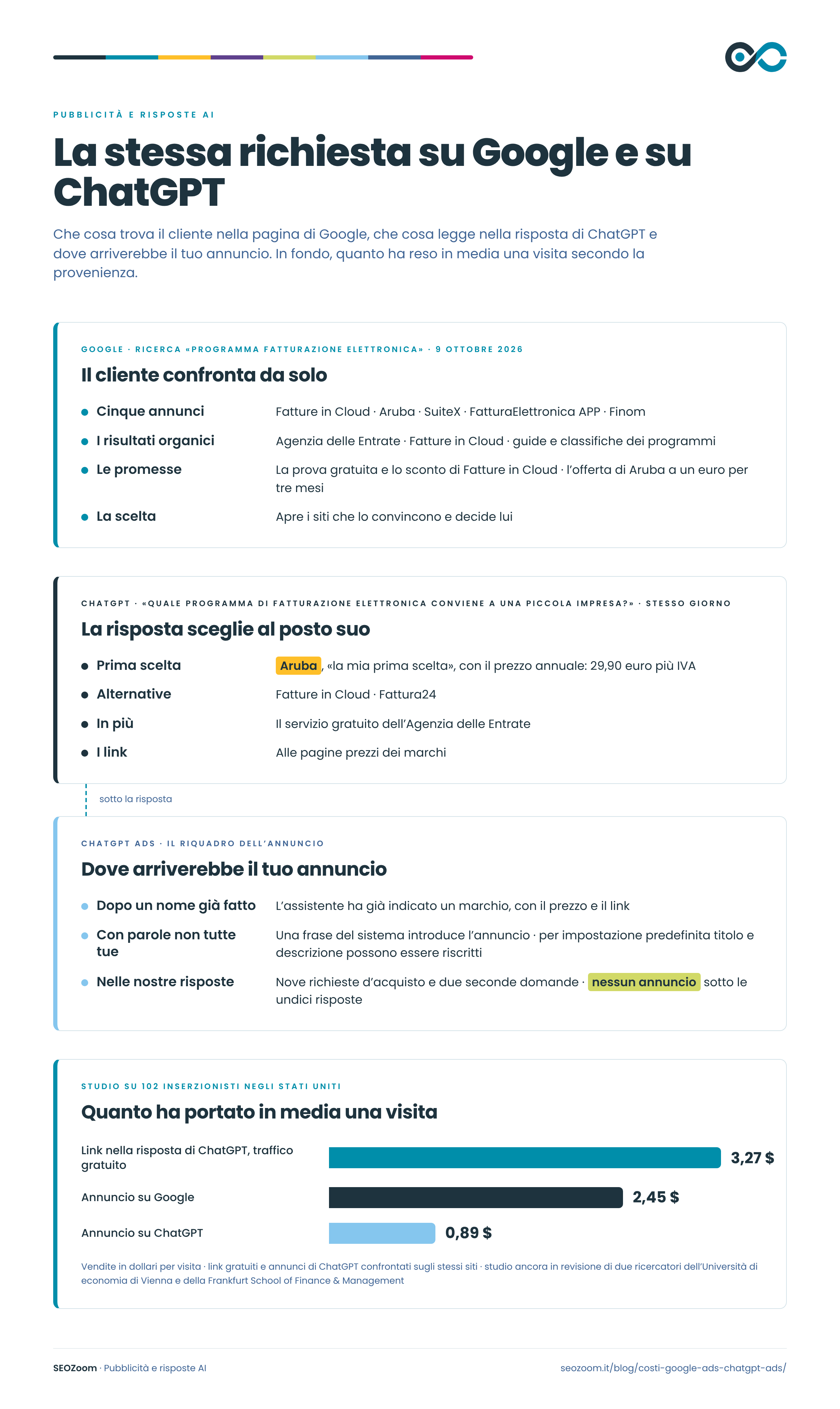
On October 9, 2026, we searched Google for “electronic invoicing software”: the page showed five ads, from Fatture in Cloud, Aruba, SuiteX, FatturaElettronica APP, and Finom, followed by organic results: the Italian Revenue Agency, Fatture in Cloud, guides, and software rankings. The potential customer compares on their own: they read the ads’ promises, the free trial and discount from Fatture in Cloud, Aruba’s one-euro-for-three-months offer, open the sites that convince them, and decide.
That same day we brought the request to ChatGPT, phrased the way a small business owner would: “Which electronic invoicing software is best for a small business?” The answer chooses on their behalf: it names Aruba as “my top pick” and reports its annual price, 29.90 euros plus VAT, suggests Fatture in Cloud and Fattura24 as alternatives, notes that the Italian Revenue Agency offers a free service, and links to the brands’ pricing pages.
Queries where the person already knows the category and asks the assistant to narrow down the choice are what we call Money Prompts, and this is where an advertiser wants to show up. We ran nine of them on ChatGPT, without an account, across different categories, including an air fryer under 150 euros and a VPN to use on both phone and computer. In seven cases the assistant named a top pick, almost always with a price and a link to the brand’s site or a retailer. For running shoes it used the same formula as for Aruba, for smartphones under 400 euros it named the “most balanced” model, for the VPN the “overall best” service, for a November weekend in Rome a specific hotel.
At the bottom of many answers, a form asks about budget, intended use, or skill level. On the follow-up question, which we asked in two separate conversations, the assistant narrowed things down even further: for the hotel it named where to book, among the official site, Booking, and KAYAK. Under none of the eleven answers did an ad appear.
Your ad, in responses like these, shows up after the assistant has already named a brand, with price and link, and the visits that come from the response are worth more than the ones that come through the ad box. In the Vienna and Frankfurt study of 102 U.S. advertisers, the traffic ChatGPT sent for free through links in its responses generated an average of $3.27 in sales per visit, compared to $0.89 for traffic bought through ads, on the same sites.
When you’re the top pick, you already have the link to your site, for free. Paying for the ad box below is about not leaving it to a competitor: OpenAI selects the ad based on the conversation, and below your name the ad that shows up could belong to someone who targeted the same topic. But if the response leaves you out or doesn’t mention you, your ad ends up next to advice the customer just read and that you don’t control.
Not every conversation, though, ends with the assistant naming a brand. Through context signals you can describe the situations and needs your offering addresses, and the system can show your ad when someone describes a problem without yet knowing which product they need: the business owner struggling to keep invoices and deadlines organized, before even asking which software to use. Above your ad box, in that case, there might be no brand name at all, and yours becomes the first name the customer reads. A U.S. agency that works with B2B software companies is betting specifically on these conversations, and its early tests report a cost per click similar to Google’s, much lower engagement, and few conversions.
Knowing which answers your ad would appear under
Before spending a single euro on ChatGPT, open the search terms report in your Google Ads account, the list of searches that triggered your ads, and pick out the ones where customers are trying to buy what you sell, setting aside the ones from people who just want information. Turn them into questions and ask ChatGPT the way a customer would, phrased differently and on different days, since the answer changes from one time to the next. For each answer, note the role it gives you, meaning top pick, alternative, or not mentioned at all, who it names instead of you, and which sites it cites as sources. Add a few questions phrased the way someone with the problem you solve would ask, without yet knowing the solution: this tells you whether the assistant already names brands in those conversations. Within a few hours you’ll know which answers your ad would end up under and what would be written above it.
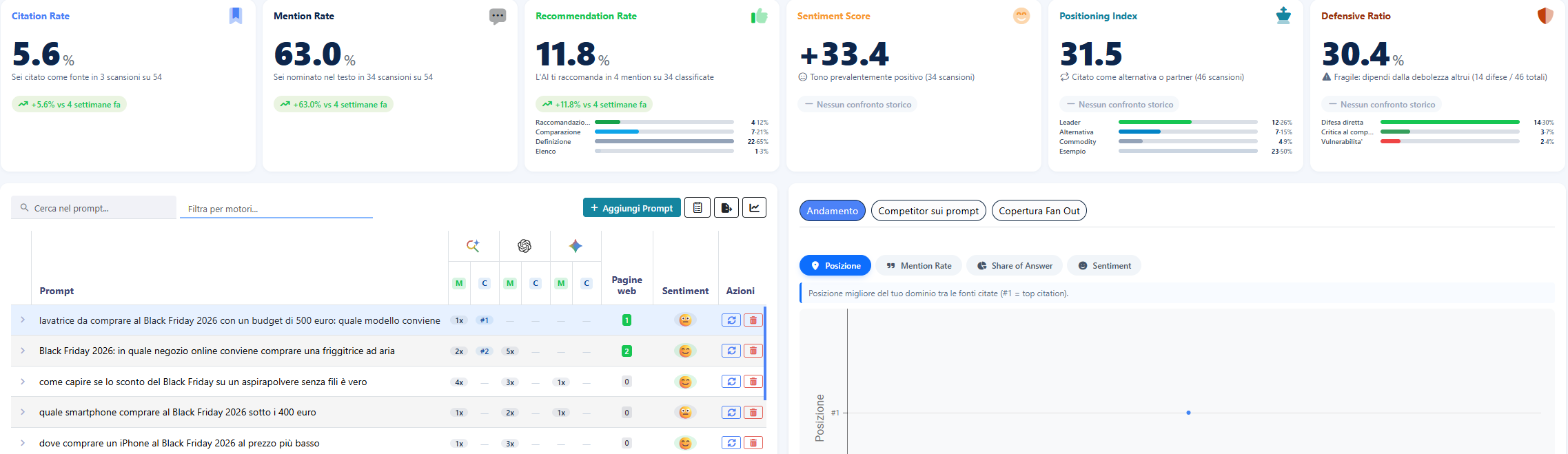
To track those queries over time in SEOZoom, you set them up in AI Prompt Tracker, inside your site’s project. The tool runs them every week on ChatGPT, Gemini, and AI Mode, and records whether you get mentioned, cited as a source, recommended, and which competitors show up in the answers instead of you. While you decide where to invest, you know whether your presence in the answers is growing or shrinking.
How a brand makes it into the answer
Google doesn’t accept payment for organic results, and OpenAI selects ads through a system separate from the one that writes the answers, with different models and code: advertisers buy the box below, and the text above stays untouched. There’s still the question of whether heavy Google spenders end up in the answers more often anyway, simply because they’re better known or more present online.
In early October, using AI Prompt Tracker, we collected ChatGPT, Gemini, and AI Mode answers to seven Black Friday purchase queries, including air fryers and perfume gift sets, and compared them against the advertisers paying on Google for the same needs. Seven out of ten advertisers didn’t show up in any answer. And almost half the stores the assistants named weren’t on Google’s first page at all, neither in ads nor in organic results.
We also ran the check the other way, starting from the brands ChatGPT had picked or named across our nine queries. Using SEOZoom’s ADS Insights, which shows the Google ads running for any domain, who’s paying for them, and over what period, we counted each brand’s active ads: this measures a brand’s presence on Google, not its spending.
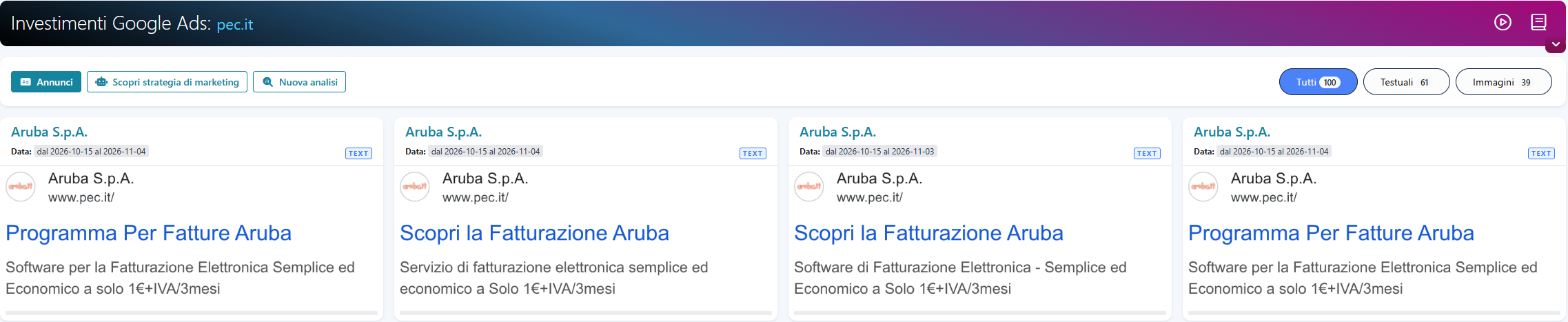
In the answers, you find brands with a hundred or more active ads right next to brands with two or none: Fattura24, which ChatGPT names among invoicing alternatives, hasn’t bought Google ads since late January 2026. Between NordVPN and Surfshark, with similar ad counts, one gets picked and the other stays an alternative: what you spend on Google doesn’t decide your spot in the answer.
| Query to ChatGPT | Brand | Role in the answer | Active Google ads |
|---|---|---|---|
| Electronic invoicing for a small business | Aruba | Top pick | 100, across the entire pec.it domain |
| Electronic invoicing for a small business | Fattura24 | Alternative | None, the last one ran in late January 2026 |
| VPN for phone and computer | NordVPN | Top pick | 116 |
| VPN for phone and computer | Surfshark | Alternative | 113 |
| VPN for phone and computer | Proton VPN | Alternative | 30 |
| Air fryer under 150 euros | Cosori | Top pick | 2 |
Where the assistant gets what it writes about you
In the answers we collected, ChatGPT cited publications and comparison sites like Altroconsumo, TechRadar, and Tom’s Hardware, meaning reviews and comparisons written by others, and for services, brands’ pricing pages. These are the sources where the assistant also finds stores and brands that don’t appear on the search engine’s first page.
For electronic invoicing, the response quoted Aruba’s annual price and cited Aruba, Fatture in Cloud, and Fattura24 as sources. Aruba’s ads on Google, during the same period, were selling the trial for “only €1+VAT/3 months.” The assistant pulls the price, the description, and the judgment the customer reads about you in its answer from the pages it checks, yours and your competitors’. The ad system also starts from the page the click lands on when it rewrites your ad’s title and description: a price or promotion you haven’t updated can end up in that box. If a comparison site lists an outdated rate, the customer may find it in the AI’s answer, above your ad.
You can link a feed, meaning the file listing your products, to ChatGPT ads, and at this stage OpenAI uses it only for advertising. Reviews matter for ads too: when the system searches feeds for what to suggest, it factors in positive and negative ratings. The products the assistant shows in its answers, though, it picks on its own, by checking store pages and the structured data that describe them, sometimes through third-party providers.
AI Overview and AI Mode select which pages to check using the same systems as Google Search, so showing up there requires SEO. AI assistants that search the web, ChatGPT included, rely on search engine indexes, mostly Google’s, and ChatGPT crawls sites with its own crawler, OAI-SearchBot, which your site must not block: if your pages aren’t indexed and have no organic visibility, those searches won’t find them. SEO rankings for your pages are the foundation, and alongside that, your presence on the sites the assistant reads matters, which you build through editorial content and digital PR.
What’s left when you stop paying
When you turn off a campaign, the ad stops showing within a day, on Google as on ChatGPT, while the pages, reviews, and comparisons that mention you stay online and keep feeding into the answers. A new review or an updated comparison can show up in an answer within days, whenever the assistant searches the web: that’s the work we call AEO. What the model knows about you from training changes over months, and that’s GEO.
Getting mentioned for free, though, doesn’t mean getting visits. Many people read the answer and stop there, the same way they already do with zero-click searches on Google. What you gain in these answers is measured mainly as share of presence, or Share of Model: how often the assistant mentions you, in what role, and alongside whom. Visits are only part of the outcome, and you’ll find them under the “AI Assistant” channel in Analytics.
Where to put your next euro
If you turn off Google Search campaigns to pay for a ChatGPT trial, you give up a flow of visits you can predict and measure, and that convert better, in exchange for ads that, in the Italian market today, users barely see. You also lose part of the search terms your search query report shows you every day, meaning the words your customers use when trying to buy, which you also need to understand how the assistant treats you. And none of that money gets you into the answers.
The questions you ask ChatGPT, mirroring your customers’ searches, tell you where you stand. When the assistant names you as the top pick, a minimum-budget campaign has one job: keep your spot under that recommendation. Tag your links, compare cost and sales against your Search campaigns for the same queries, and judge the results using your own site data.
If it mentions you but rules you out, for price reasons say, put your first dollar into the sources behind that judgment: reviews, comparison pages, and the page on your site that explains what you charge and why.
If it names your competitors and not you, paying for an ad under its answers doesn’t make much sense. Keep winning ground on Search, through both campaigns and organic results, and put the rest into those sources until the assistant starts naming you too.
But if, in conversations about the problem you solve, the assistant doesn’t name anyone, your ad has no recommendation standing in its way. That’s where a minimum-budget test makes sense, as long as you judge it by sales, not by cost per click.


 Verified reviews on Trustpilot