ChatGPT Shopping in Italy: what works today and what to get ready
ChatGPT Shopping is the ChatGPT feature that helps people decide what to buy, and in Italy it already names products and stores in its answers.
You sell online and you know where your customers’ choices are made: in Google’s SERP, in Google Shopping listings, on Amazon, in comparison sites. You know the rules for each, or at least where to look. In ChatGPT, the choice runs through different channels: it answers a purchase question with product cards and a list of stores to buy from, and it decides which products and which stores by its own rules, separate from advertising.
Those cards already show up in Italy, but the program through which OpenAI receives store catalogs refers to users in the United States, and the only direct path that can open up for sellers who operate only in Italy, Business Hub, is still in beta and requires a review. Your products can end up there even if you did nothing to get them in. To find out where you stand and what’s up to you, we asked ChatGPT 100 purchase questions drawn from the ones people actually search on Google, and opened the store panels by hand.
What ChatGPT Shopping is
ChatGPT Shopping is how ChatGPT handles purchase questions within a conversation: it compares products and prices, shows them in cards, and indicates where to buy them.
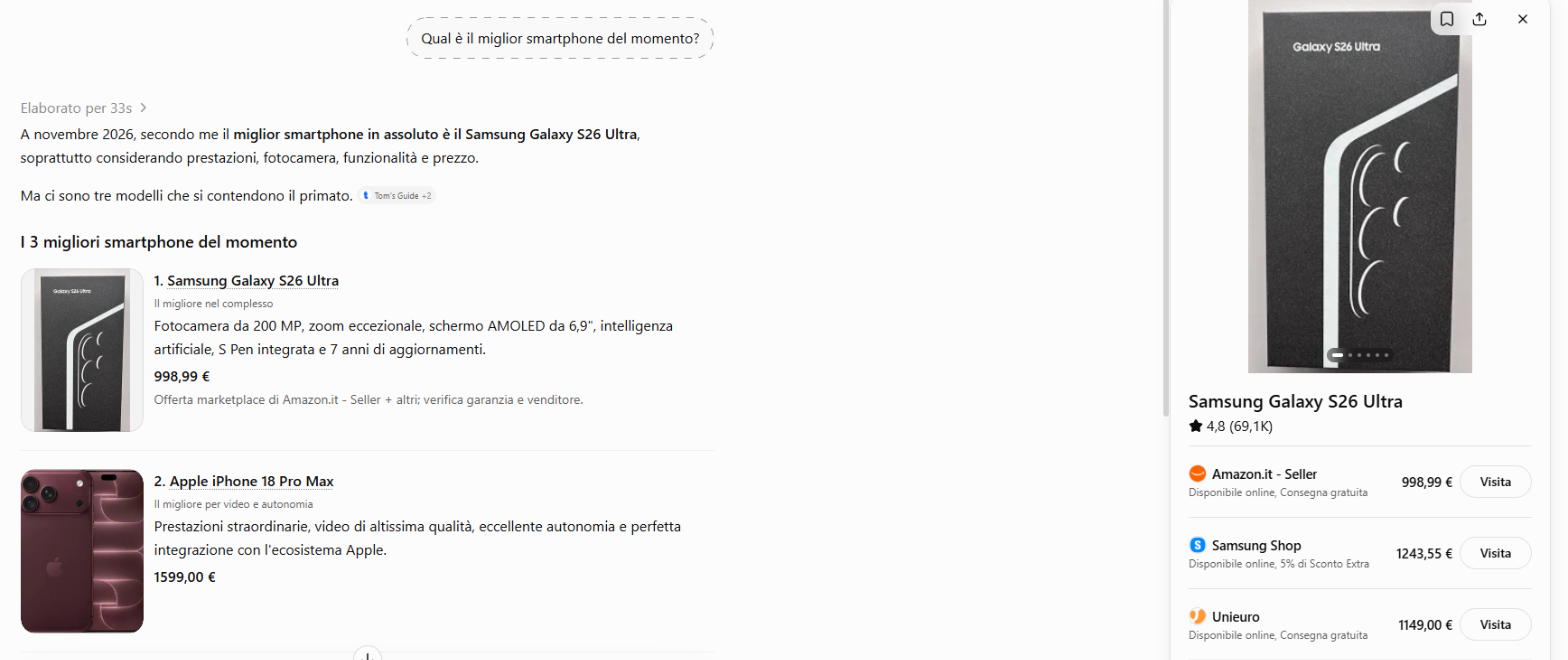
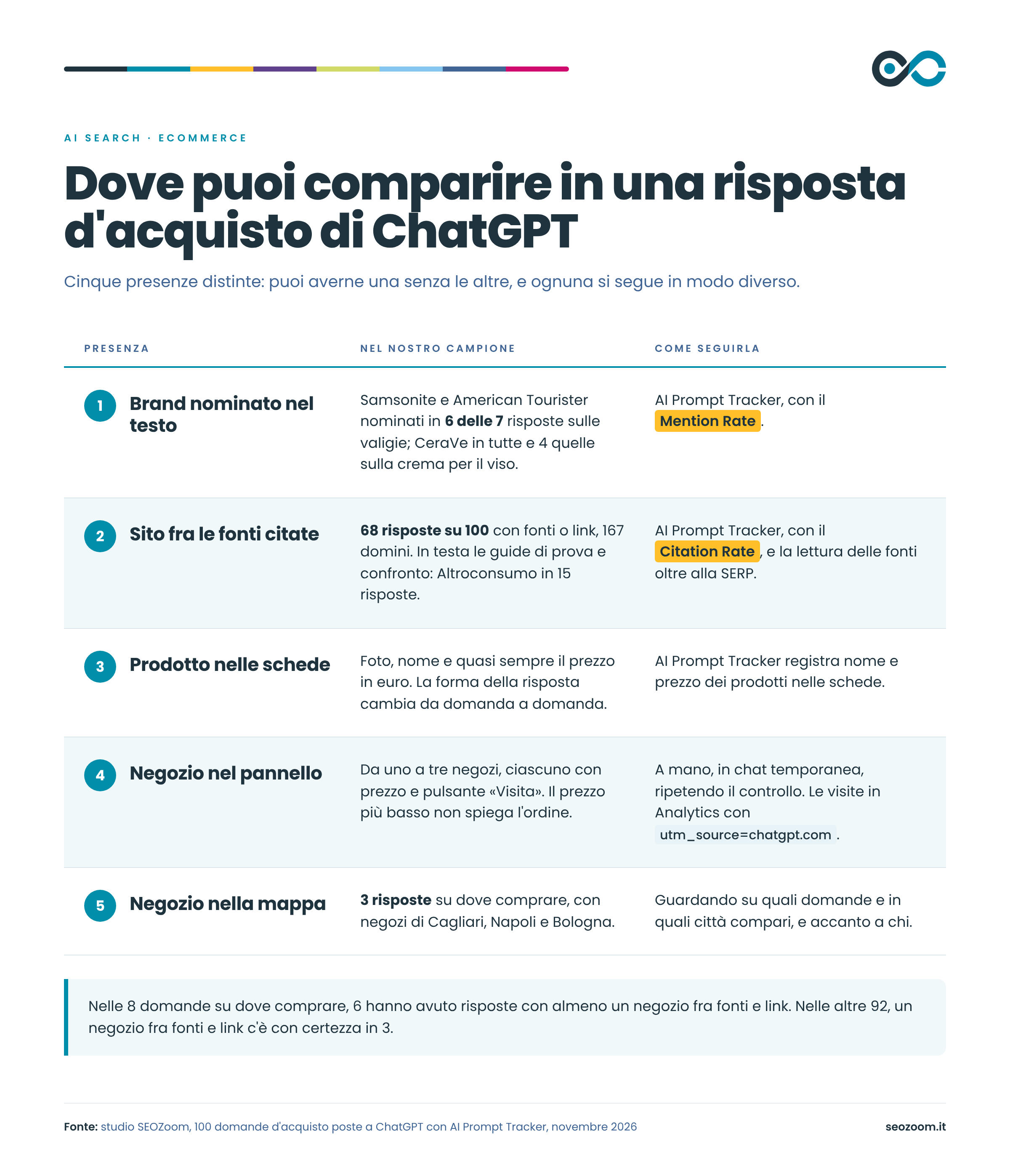
In our tests, the card showed a photo, a name and almost always a price in euros, and clicking it opened a panel with the average rating, the number of reviews, and one to three stores, each with its own price and a “Visit” button leading to the product page on the seller’s site. In a single answer, you can show up in different spots: with your brand named in the text, with your site among the pages ChatGPT cites, with your products in the cards, with your store among the sellers in the panel. These are different kinds of presence, and it pays to look at each one separately.
OpenAI lists what factors into the selection without saying how much weight each one carries: the request and the conversation’s context, structured metadata it receives from direct and third-party providers, third-party content, and the model’s own output. Prices come from third-party providers. Ads, which as of August 24, 2026 also appear to Italian users on the Free and Go plans, stay outside this selection, as do commercial deals. So the choice of which products to recommend draws on pages and information you don’t control, like reviews written by other people and data that other companies pass to OpenAI, and no ad budget can override that.
The shape of the answer, in turn, changes from question to question. On November 12, 2026, we asked ChatGPT one question for each of ten categories, from a Plus account in a temporary chat. For smartphones, coffee makers, face cream, running shoes and coffee beans, we got cards with stores; for the best women’s shoe brands and the best suitcase brands, we got brands with one photo each and no stores; for consoles, four models with a price written into the text; for the best-selling Christmas gift and for antivirus software, text only. The question about the best running shoe brands was an exception: built the same way as the suitcase question, it returned cards for seven models. You can end up in a line of text, in a card, or not at all, and the only way to know is to look at what ChatGPT returns, question by question.
Where ChatGPT Shopping stands in Italy
If you sell only in Italy, the first thing you want to know is whether any of this already applies to you. The answer is yes: the panels we opened included Italian stores like MediaWorld, Maxisport and Fotopharmacy, alongside foreign stores. Yet the official access programs are aimed at the United States. The page OpenAI dedicates to merchants, even in its Italian version, states that shopping is “currently available to ChatGPT users in the United States,” and Shopify brings catalogs into ChatGPT only for stores that also sell to customers in the United States, no matter where they’re based.
OpenAI doesn’t explain how those Italian stores ended up in the panels. Its documentation states that the feed isn’t necessary if ChatGPT is already crawling the site, and product data also comes from third-party providers: your catalog can show up either from what ChatGPT reads on your pages or from what others feed it.
Starting November 10, 2026, you can ask to be featured directly in ChatGPT through Business Hub, currently in beta: a business claims its listing, connects a feed with prices and availability, and checks the stats. OpenAI is rolling it out “in countries where ChatGPT is available and the required verification is supported,” with conditions that vary by country and business type. From Italy the page loads, but whether your ecommerce passes the application review and the identity verification needed to connect the feed is something you find out only after applying. Even once verified, OpenAI warns that claiming your listing doesn’t guarantee more visibility, and that the feed “doesn’t guarantee that ChatGPT will recommend your products.” It’s worth trying anyway, since this is where you get to feed ChatGPT your own data; the stats appear once interactions cross the minimum threshold OpenAI sets for reporting them, and the actual effect on recommendations is still unclear.
In the responses we reviewed, purchases happened on the store’s own site. In the United States, OpenAI launched Instant Checkout in September 2025, letting you pay inside the chat, then on March 24, 2026 shifted its focus to product discovery and merchant checkout; its help center still notes that for some products, ChatGPT can show an option to complete the purchase in chat.
We checked these details on November 12, 2026, on OpenAI’s page for merchants, its Business Hub guide, and Shopify’s help center, and we’ll revisit them during our Black Friday data collection.
| Path | What it does | Requirement | For an online store that sells only in Italy |
|---|---|---|---|
| OpenAI’s merchant program | Receives catalogs; the feed is optional if ChatGPT already crawls the site | Shopping stated as “available to users in the United States” | No access indicated |
| Shopify agentic storefronts | Bring the Shopify catalog into ChatGPT, with purchase completed on the store | The store also sells to customers in the United States | Excluded |
| Business Hub (beta) | Listing claim, feed with prices and availability, stats above a minimum interaction threshold | Supported country and business type, identity verification | Possible, with the outcome decided after reviewing the application |
| Business agents | Business Hub feature | Online stores and services in the United States | Excluded |
What we found in 100 purchase answers
Ten tests are enough to see what a response can contain. To find out where there’s room for an ecommerce business, we used SEOZoom’s AI Prompt Tracker to ask ChatGPT 100 questions pulled from Google’s “People also ask” boxes, ten per category, ranging from electronics to food, gifts to services like hosting and insurance. We chose the categories; the questions come from Google. This sample shows what happens with these specific questions, not how much weight they carry among everything Italians ask ChatGPT. The tracker logs the text and sources of each response, along with the product name and price for any product cards. The responses are from November 11, 2026, except for one from November 13, each captured once; during Black Friday week we’ll repeat the data collection to see what’s changed.
Broken down by question type, the responses reveal two things that matter to you: how often ChatGPT cites where it got its information, and how often it lands on a price in euros. Product and cost questions frequently end up with a price. For brand questions, ChatGPT cites sources in most cases, but gives a price in euros only once out of 17. For services, it always cites someone, often the providers themselves, while for gifts it relies on just a handful of pages. A price in euros, though, is just an indicator: a response can mention figures without linking to any seller. These are trends within the sample, pointing to where to look; any individual response can go a different way.
| Question type | Example from the sample | Questions | Answers with sources or links | Answers with prices in euros |
|---|---|---|---|---|
| Which product | What’s the best air fryer right now? | 50 | 31 | 28 |
| Which brand | What’s the best suitcase brand? | 17 | 13 | 1 |
| Which service | What’s the best hosting? | 11 | 11 | 3 |
| What to gift | What gift should I buy for my mom? | 10 | 3 | 6 |
| Where to buy | Where’s the best place to buy a TV? | 8 | 7 | 2 |
| How much it costs | How much does a good washing machine cost? | 4 | 3 | 4 |
| Total | 100 | 68 | 44 |
Review and comparison guides
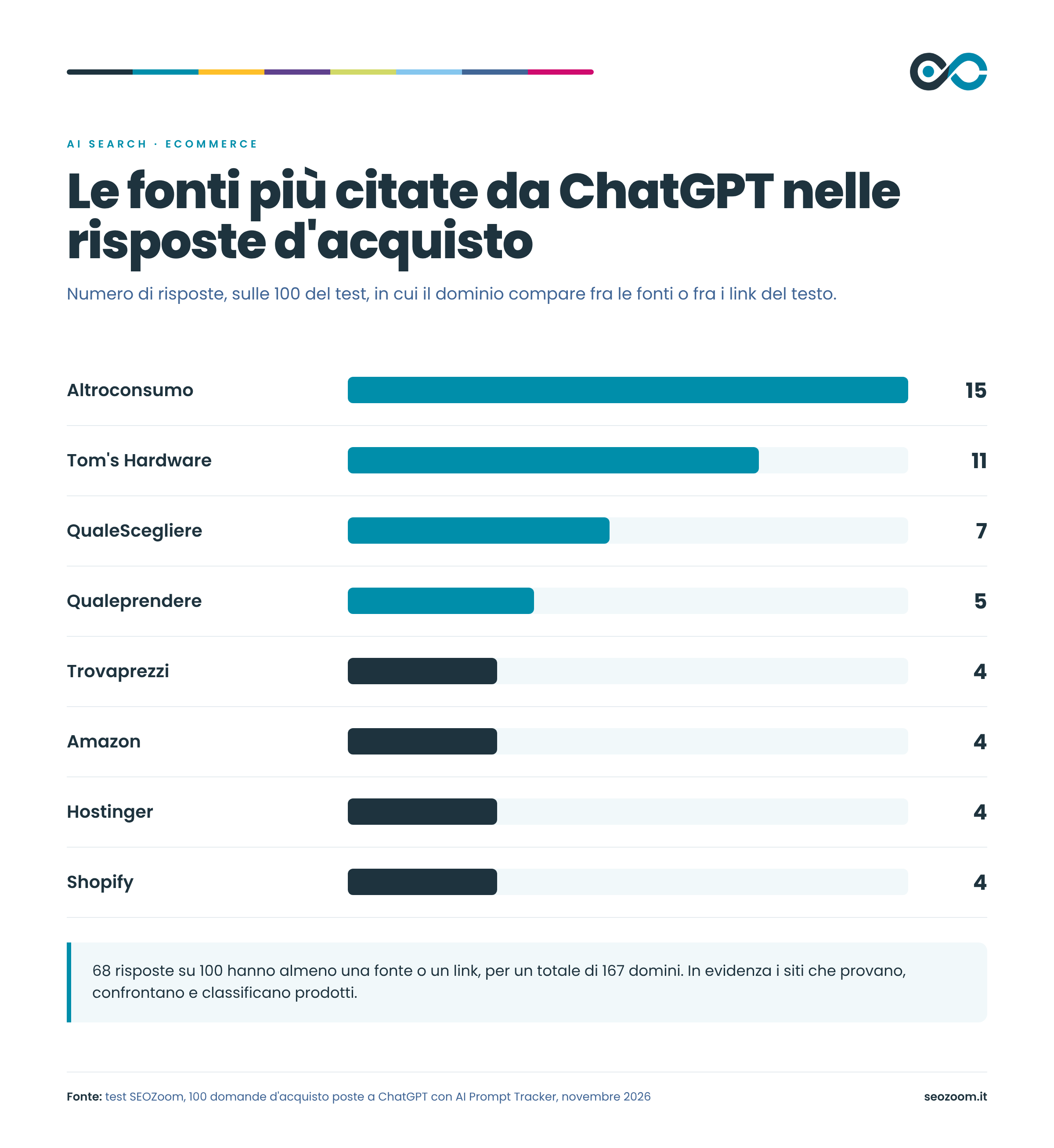
When ChatGPT does cite where it got its information, in most cases it points to sites that test, compare, and rank products. Across the 68 responses with sources or links, there are 167 distinct domains, with the most frequent being Altroconsumo (15 responses), Tom’s Hardware (11), QualeScegliere (7), and Qualeprendere (5); Trovaprezzi, Amazon, Hostinger, and Shopify follow, each appearing in 4 responses. Alongside these are category-specific publications, like Gambero Rosso and La Cucina Italiana for food, Vogue and GQ Italia for beauty, and provider sites for service-related questions: Hostinger and SiteGround for hosting, Shopify and WooCommerce for ecommerce platforms, insurance companies for travel insurance.
What caught our attention was where those pages rank on Google for the same question we asked ChatGPT. In the SERP SEOZoom tracks for “best coffee machine for home,” the Altroconsumo comparison tool cited by ChatGPT ranks seventh, while Tom’s Hardware’s guide ranks thirty-fifth; for “best budget smartwatch,” Cinquecose’s guide doesn’t crack the top 40 results, and neither does ifarma.it’s guide for “best anti-wrinkle face cream.” That’s three questions and four pages where ChatGPT’s sources didn’t match Google’s top results. One possible explanation lies in how ChatGPT searches. According to OpenAI’s help center, it sometimes relies on other search providers, and in those cases it rephrases the request into one or more targeted queries: the search engines then receive a different question than the one your customer actually typed. To find out who ChatGPT cites in your category, you need to read the sources in its responses, not just check the SERP.
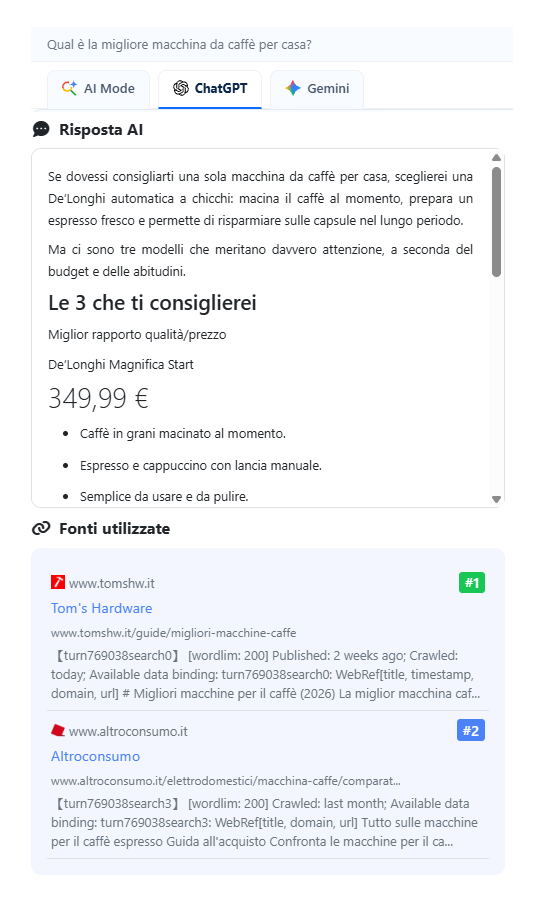
You might wonder whether the products in those cards come from the guides themselves. We took the 8 responses that had both cards and sources and looked for each model in the guides we could actually open; we weren’t able to access the Altroconsumo and Qualeprendere guides. For home coffee machines, all three product cards match the three models recommended by Tom’s Hardware, and for the budget smartwatch, two of the three models appear in Cinquecose’s guide. The cards for electric bikes feature models that don’t show up in either of bicicheamore.it’s two guides, while ifarma.it’s guide on anti-wrinkle cream mentions two of the three brands, but with different products. The guides we found are the part of the response you can actually read and compare against the product cards; how much influence they had on the selection is a separate question that the data doesn’t answer.
Where the store comes in
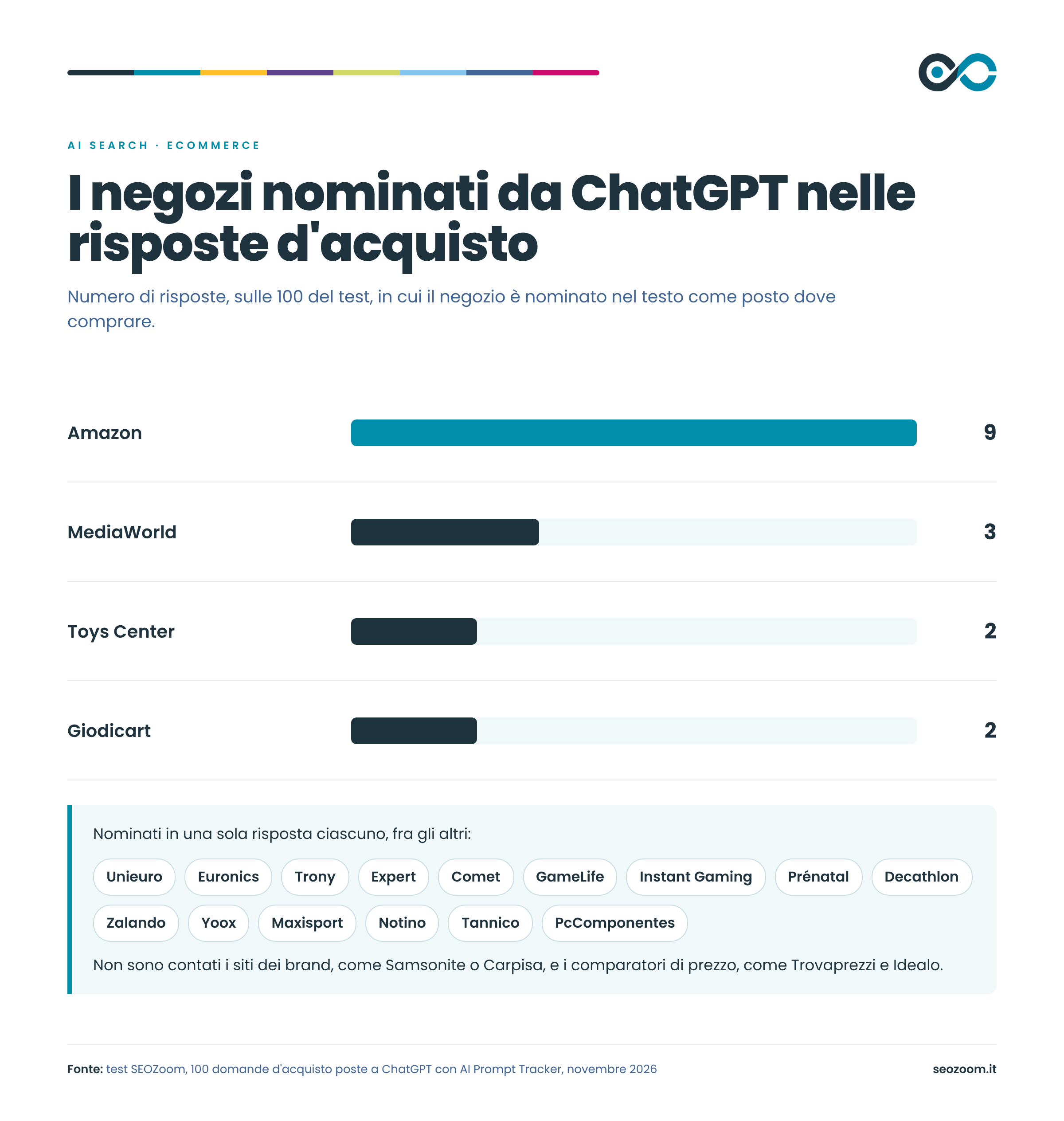
Store links cluster around questions that ask where to buy something: 6 of the 8 questions in the sample got answers with at least one store among the sources and links. For “Where’s the best place to buy a TV?” ChatGPT linked Amazon, MediaWorld, Unieuro, and the comparison site Trovaprezzi; for “Where to buy a suitcase online?” it linked the Samsonite, Carpisa, American Tourister, and Roncato websites. Among the other 92 answers, a store appears for certain among the sources and links in 3 cases, such as Decathlon for sneaker brands and Tannico for wine as a gift, and in another 5 there are smaller retail sites we couldn’t classify with confidence. The picture changes in the text itself: Amazon is the store mentioned most often, in 9 answers, four of which are product questions, on headphones, tablets, hiking shoes, and portable consoles. After Amazon come MediaWorld, in 3 answers, and Toys Center and Giodicart, in 2 each; the other stores are mentioned only once.
The where-to-buy questions held a surprise. Three answers combined physical and online stores: the TV answer included a map with five stores in Cagliari, each with an address and a line of commentary, followed by online stores including Amazon and MediaWorld; the electric bike answer listed stores in Naples, with phone numbers and ratings; the budget trolley case answer listed stores in Bologna, then models to buy online. The cities are all different, and our tracking didn’t flag any of them in advance. In these answers your competitor can be a store in a specific city, and we still don’t understand the logic ChatGPT uses to pick it.
In the product-card panel, which the tracker doesn’t record and which we opened manually, the order of the stores doesn’t follow any obvious rule. For illy Classico coffee beans, the first store was Dutch Expat Shop, based in the Netherlands, at 25.16 euros, with illy.com, the maker, coming second at 14.48. For the De’Longhi machine, the manufacturer’s own site ranked first at 359.90 euros, with MaxiCoffee second at 323.10. For the Asics Gel Nimbus 28, Maxisport, at 134.96 euros, came ahead of Runkd, at 136.01. OpenAI states that the order factors in availability, price, quality, and whether the seller is the manufacturer or a primary retailer, without specifying the weighting. Of these four factors, price and manufacturer status are the ones visible from the outside, and the three panels show that neither one on its own explains the order. Alongside the prices were store promotions, like MaxiCoffee’s “Black Friday Preview -10%” and Maxisport’s “Extra -10% Discount at Checkout”: in the panel, people also see whatever offer you currently have running.
The most recurring brands
In the sample, some categories come up repeatedly across different search intents: for suitcases, the best brand, cabin-size trolleys, price, where to buy. Within each category, ChatGPT kept returning to certain brand names even as the intent shifted. Samsonite and American Tourister are named in 6 of the 7 suitcase answers, Roncato in 5; the seventh, on budget trolley cases, lists stores in Bologna and cheap models instead. CeraVe appears in every one of the four face cream answers, La Roche-Posay in three. The three coffee machine answers all mention De’Longhi; the robot vacuum answers mention Roborock and Dreame; the running shoe answers mention Asics, Hoka, Brooks, and New Balance.
This is a single snapshot, and our Black Friday tracking will show whether these names hold up during a week when prices and promotions also shift. Even now, it shows that the brand named and the store recommended are two separate things. If you’re a manufacturer, you want to know whether ChatGPT names you throughout the whole category, from the brand question to the price question; if you resell those brands, what matters is where and how your store gets recommended.
Where you can take action, and how far it goes
The part that’s entirely up to you is your site. ChatGPT finds pages to cite using its crawler, OAI-SearchBot, and sometimes the search providers it relies on: being crawlable is the first requirement for getting into its sources, which is why AEO starts with SEO. OpenAI states that a site blocking OAI-SearchBot won’t show up in search answers, except as a plain navigational link: if you want to be included, your robots.txt needs to let it through. On your product pages, state the model, price, availability, and codes like the GTIN without ambiguity, keeping them consistent with your structured data and with any feeds you send elsewhere. Price and availability are among the factors OpenAI uses to rank stores in the panel; those you can control, even if you can’t predict how the ranking will change, and they’re the same data that assistants read when they buy on someone’s behalf, in agentic commerce. If Business Hub approves your application, your feed flows through there too.
You can influence other people’s pages, but without guarantees. If you manufacture what you sell, the guides ChatGPT cites are the territory of Digital PR: products sent for review to editorial teams, spec sheets that are easy to pick up and reuse, a spot in industry rankings. To decide which ones to work on, start from the sources behind the answers to the questions your customers use to choose what to buy, beginning with money prompts, the ones where someone brings a specific problem or criterion and asks the AI to narrow down the options. Prioritize pages that keep coming up across multiple questions and that talk about products like yours. In our sample, guide models showed up in some product cards and not in others: enough reason to pay attention to those pages, not enough to promise that a spot in a guide gets you into a card. It’s a long-term effort, and it’s also the lever you have over the group of brands ChatGPT calls up within a category; its effect, amid ongoing model and source updates, is hard to isolate.
For physical store maps, we don’t know which signals matter, because we don’t know the logic ChatGPT uses to pick cities and stores. If you have physical locations, the first step is checking which questions and cities you show up in, and who you’re listed alongside: that’s what tells you whether and where to invest.
How to track answers over time
A single query won’t tell you where you stand: the model changes, sources change, competitor deals change. To know whether ChatGPT mentions and cites you, you need to query it regularly, using the questions your customers actually ask and covering the different intents in your category. In SEOZoom you do this with AI Prompt Tracker, on project sites. For a luggage retailer, from our sample: “What’s the best luggage brand?”, “What are the best carry-on trolleys?”, “How much does a good trolley cost?”, “Where can I buy a suitcase online?”. Each time you run a check, you see on ChatGPT, Gemini, and AI Mode whether your brand is mentioned, through the Mention Rate; whether your site is among the sources, through the Citation Rate; and whether the AI recommends you, through the Recommendation Rate. When a number changes, you know something shifted, and you look at the sources and answers to figure out why.
For the store panel, you have to check it yourself: open ChatGPT in a temporary chat with the questions that matter for your catalog, and note down, card by card, which stores show up, at what price, and in what order. Repeat the check days apart and from different accounts, because the same question can return different answers: the coffee machine query showed three cards in the tracker’s run and four in our test with a Plus account the next day.
The “Visit” links in our tests carried the utm_source=chatgpt.com parameter. When a visit comes through with it, Analytics tells you it came from ChatGPT, but the parameter alone doesn’t tell you which part of the answer it came from; the landing page shows you which product the person opened. If you claim your business in Business Hub, you can also get the last 28 days of stats on clicks, discovery topics, and mentions, as long as interactions pass the minimum threshold. There, a mention only counts if ChatGPT references your site, while the tracker’s Mention Rate counts the brand name: these are two separate numbers, each read on its own.
In ChatGPT, your presence has to be measured one piece at a time. You can be a source without being named, named without a link, in the panel without being first, and the intents in your category open up different spots: in our sample, store links clustered around questions about where to buy, prices around product and cost questions. In the panels, the lowest price alone didn’t explain the store order. If your products appear in the cards but the panel puts another store first, start by checking price, availability, and catalog consistency; if ChatGPT recommends other products instead of yours in your category, read the guides it cites for those questions: that’s where you’ll find which models make the cut and who writes them.


 Verified reviews on Trustpilot