Query fan out: how many searches AI launches and who becomes a source
We ran the same prompts through ChatGPT, Gemini, and AI Mode and tracked the query fan out: how many searches AI launches and which sites it cites
“Which solar panel system is best for a single-family home?” ChatGPT points you to institutional sites, Gemini to energy providers, AI Mode to installers and solar companies. Same prompt, completely different sources.
Solar panel sellers know their commercial competitors, but in AI answers they end up competing with public agencies, news outlets, and pages covering broader issues. The same thing happens in other industries: customers reach a product decision through questions that pull in a range of different players.
Behind this is query fan out: before answering, every engine turns the customer’s question into a set of more specific searches, launches them its own way, and picks sources from the pages it finds. To see where this leads, we followed the questions of a family going from an oversized electric bill to choosing a solar system.
Query fan out at work
Google lists query fan out among the techniques behind AI Overview and AI Mode: for a single question, it launches multiple related searches at once, covering different subtopics and data sources, and pulls a broader and more varied set of links into the answer than a traditional search would. ChatGPT Search usually rewrites the request into targeted queries for the search providers it works with, and after the first results come back, it sends out more, more specific ones. So the customer’s phrasing and the searches that produce the sources don’t match.
With AI Prompt Research we see every day which searches a prompt opens up into. What we were missing was the next step: which sites the engines actually put in the answer, and whether that changes as the customer’s understanding of their own problem evolves. That’s where who a site competes with gets decided.

Home solar is a good fit for this, because it’s a purchase people start researching before they know the name of the product. The situations are concrete: a bill that’s nearly doubled, consumption concentrated in the evening, a top-floor apartment in a condo building, a bill too high for what the family actually uses. For each one, the question is phrased the way a customer would ask it: with just the problem, with intent to act, or with the product named outright.
From these questions we reconstructed the searches, and in early October 2026 we used AI Prompt Tracker to collect sources and mentions in the answers from AI Mode, ChatGPT, and Gemini, repeating the test a day later for the latter two. The searches show where the engine goes looking; the answers show which sites actually make it in.
What AI searches for before the customer names the product
“My electric bill nearly doubled and I’m thinking about doing something to my roof” doesn’t contain the word solar, and it’s the question that opened up into the most searches among those we tracked. The first searches focus on the problem itself, on why the bill doubled. Then comes the comparison between solutions, starting with “is it better to install solar panels or insulate the roof?”, followed by reliable installers, permits, scams to avoid, hidden costs, and maintenance.
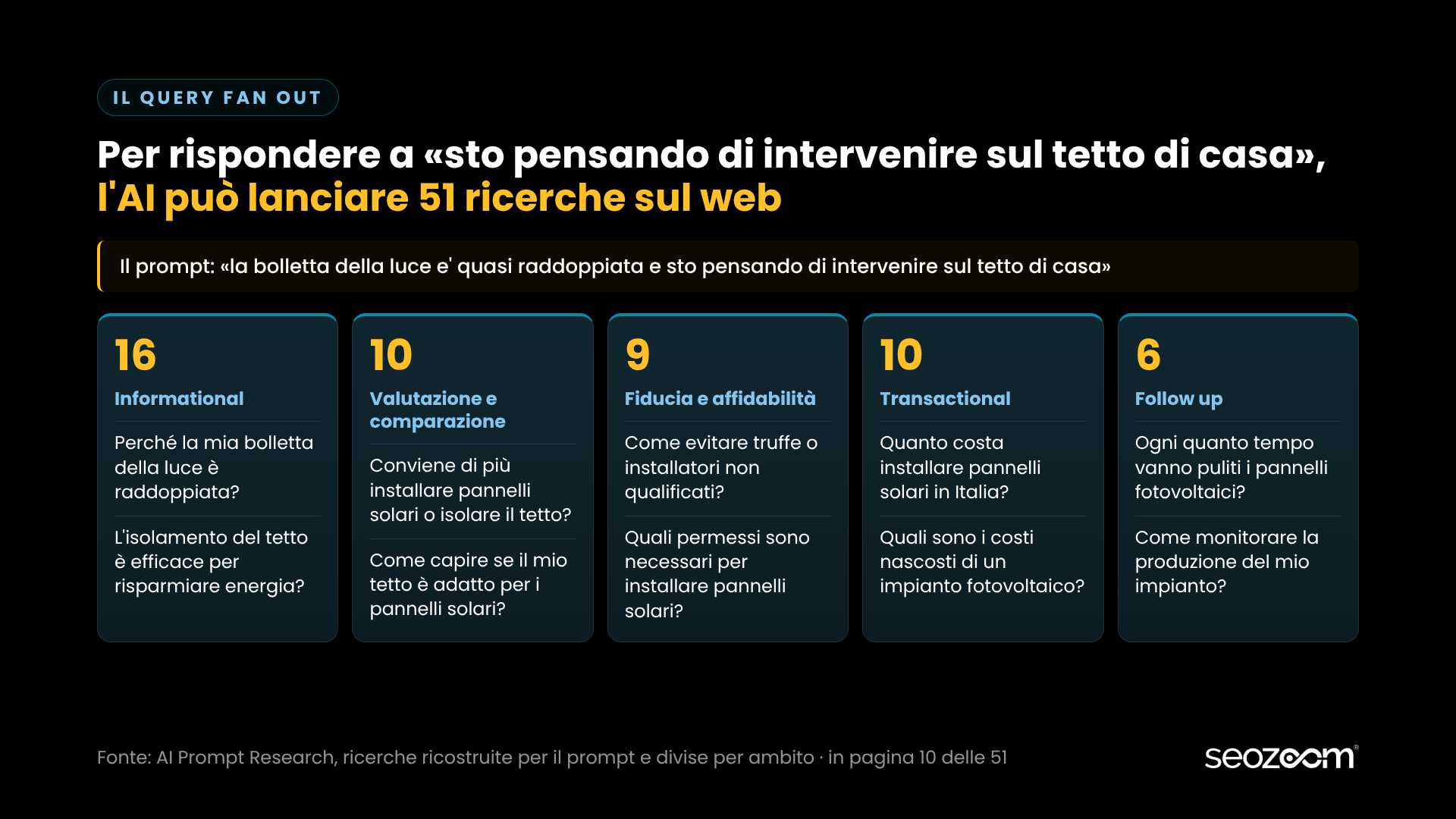
The customer has decided to spend money and doesn’t yet know on what, so they leave it to the engine to lay out the possible paths. One of these is roof insulation, which a solar panel seller wouldn’t count among the competitors, yet AI puts it right next to solar before the customer even knows the two need comparing. In every situation we tracked, the question with intent to act opens up into more searches than the one with just the problem, while the question naming the product mostly narrows the field back down, since by that point the biggest decision has already been made.
In the question about panels versus insulation, the customer still has to figure out whether solar is the right path; in “which solar system is best for a single-family home?” they’ve already picked the category and are comparing options. A page built entirely around the system answers the second question well but leaves uncovered the information that got the customer there in the first place: whether it’s worth it, what it really costs, who to trust, which permits are needed.
Where the race to become a source plays out
Each search in the fan out has its own results page, and that’s where your site competes to be among the pages the answer draws its sources from. Google spells this out in its AI features documentation: to show up as a supporting link in AI Overview and AI Mode, a page needs to be indexed and eligible for a snippet, with no requirements beyond standard SEO practices. The same holds outside Google, for the rewritten queries sent to other search providers: a page becomes a source if it shows up among the results.
That’s why we work on AI answer presence starting from rankings, then extending it to the searches the customer never types but that an engine searching live launches on their behalf.
ChatGPT, Gemini, and AI Mode facing the same question
No single site appeared in the answers of all three engines for any question. In most cases, not even two engines shared a common source. The exceptions were few: Enel and Idealista shared between AI Mode and Gemini on the doubled bill question, ARERA between AI Mode and ChatGPT on the oversized bill, and GSE and the Italian Revenue Agency between ChatGPT and Gemini on the condo and incentives questions.
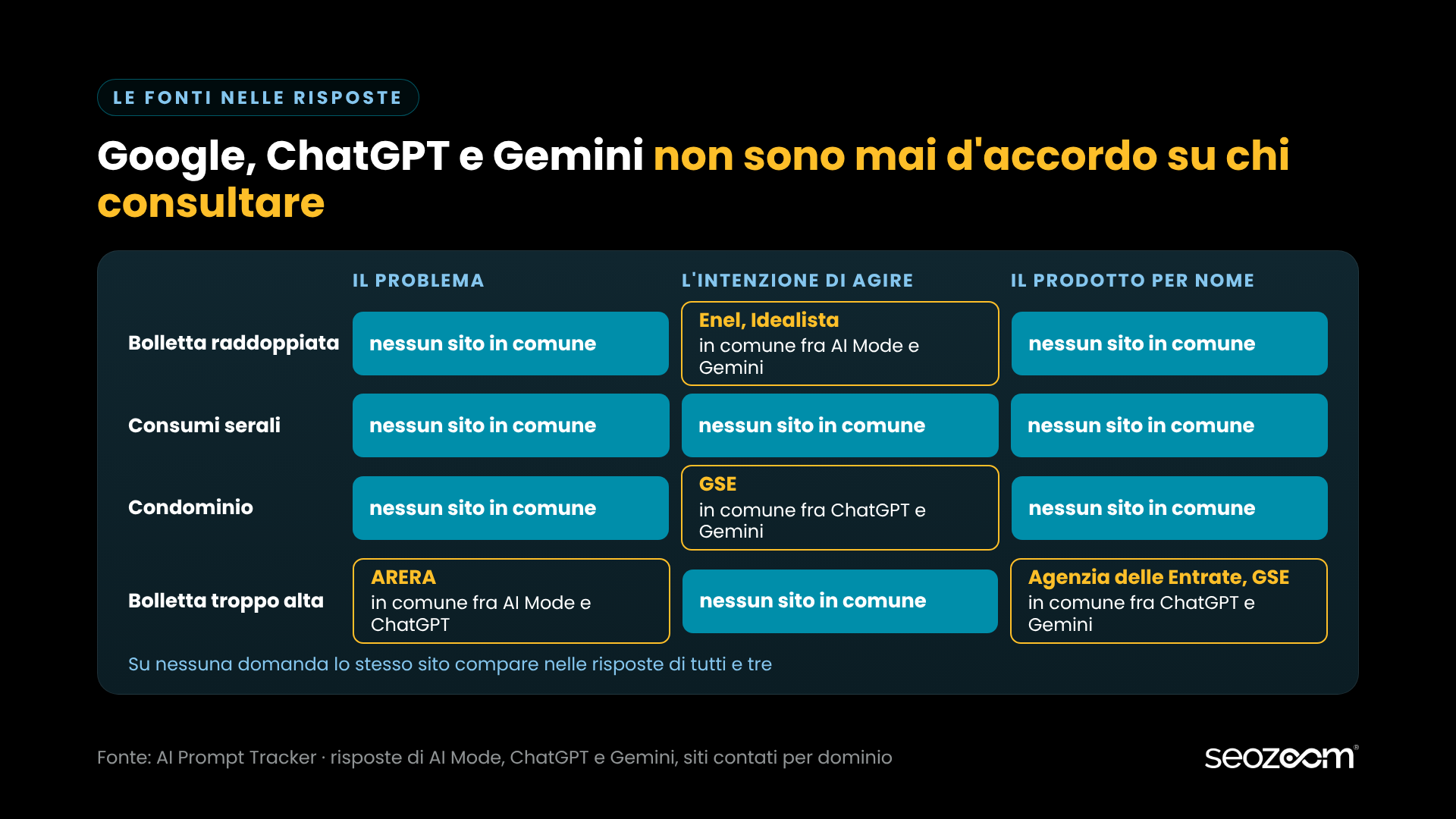
The real shift is in who explains things. ChatGPT leans on public agencies: ARERA for utility bills, GSE for self-consumption and condominium issues, ENEA for efficiency, and the Italian Revenue Agency and Normattiva for incentives and regulations. AI Mode and Gemini make room for others, from energy providers like Enel, E.ON, and Eni Plenitude to outlets like Il Sole 24 Ore, down to installers.
These different sources come from how each search works: ChatGPT rewrites the question for its own providers, Google breaks it down within its own Search, and different searches surface different pages.
For an installer, ARERA isn’t a commercial competitor, yet in the answer their potential customer reads, it takes up the space of a source. On ChatGPT, your page competes with the regulatory source; on the other two engines, it competes with operators and industry media. These are two different kinds of competition on the same topic. And being cited as a source isn’t the same as being recommended: a domain can explain a technical requirement without the brand being put forward as a company to contact. That’s why in the Tracker we keep domain citations and brand mentions separate.
Otovo: a source in AI Overviews, absent from other answers
We built the AI Prompt Tracker project around Otovo’s website, a Norwegian residential solar company also active in the Italian market, because it’s one of the most visible sources in the sector in AI Overviews: as of October 14, it ranked first for “tipi di impianti fotovoltaici,” third for “fotovoltaico individuale in condominio,” and fourth for “ammortamento impianti fotovoltaici.” On the main keywords, though, it stays far from the first organic page.
Its strength lies in pages that answer specific questions. In the SERPs from October 23, it ranks second on the first of those searches and fourteenth on the condominium one, while on the amortization search it doesn’t appear among the top results, yet it still gets cited. That’s fan out at work: sources come from related searches, not just from the first page the user sees.
Across the 36 responses we collected, Otovo never shows up, neither as a source nor by name. Google states that AI Mode and AI Overviews can use different models and techniques, and this case shows just how far that goes: visibility earned on short, specific searches doesn’t carry over to questions phrased as conversation, where fan out opens up other paths. This is visibility tied to those particular searches, not to AI answers in general.
The same question, repeated the next day
On repetition, Gemini changed its list: for the questions on the utility bill and the roof work, the first answer pointed to Enel, Solare Industriale, Idealista, and Fiscomania, the second to Bolletta Energia and BibLus. Same question, completely different sources, and for more than half the questions not a single site stayed the same.
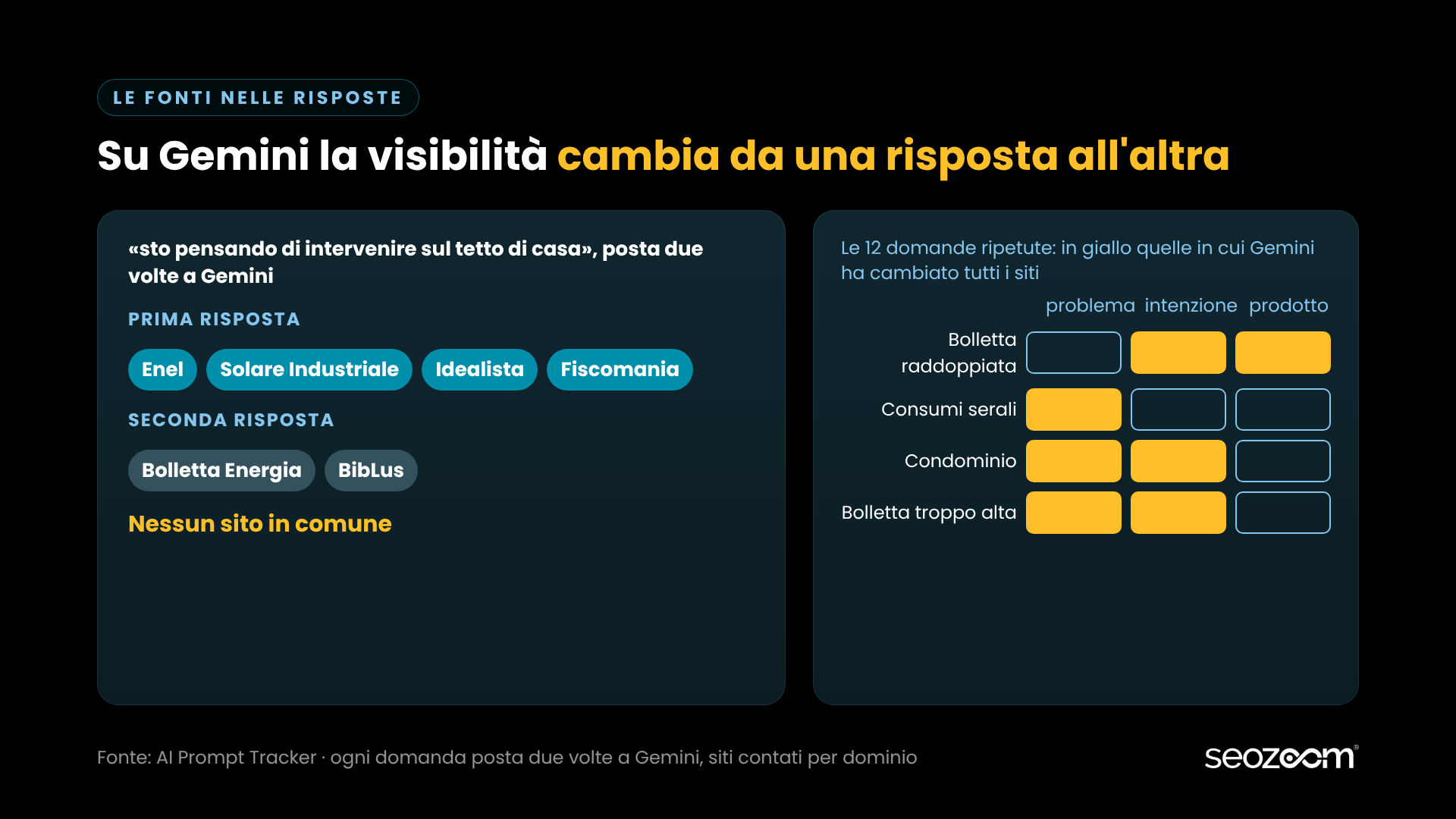
ChatGPT, by contrast, is stable. Repeated, a question keeps most of its sources, while across questions representing different moments in the customer’s journey, few sources carry over. Here, what changes the sources is the question itself, more than chance.
This difference matters for how you read presence. On Gemini, a citation spotted once is a snapshot of that particular answer, and the next one might already look different: you need to track presence across multiple scans, and a change between the problem query and the product query can’t be chalked up to the customer’s wording. For Money Prompts we flagged repetition as the signal worth watching, and its weight shifts from one engine to another: on ChatGPT, a single reading already tells you a lot, and comparing different questions becomes meaningful.
What shifts the sources on ChatGPT
The condominium example makes this clearest. “I live on the top floor of a condo building and spend a fortune on electricity in the summer” leads ChatGPT to ENEA, the building energy efficiency angle. “I live in a condo and want to know if I can produce my own energy” leads it to GSE, which handles self-consumption mechanisms. “Rules for installing a solar system in a condo building” leads it to legal sources, Brocardi and Normattiva, and back to GSE. When repeated, the three questions returned the same sites; Brocardi only showed up in the first check.
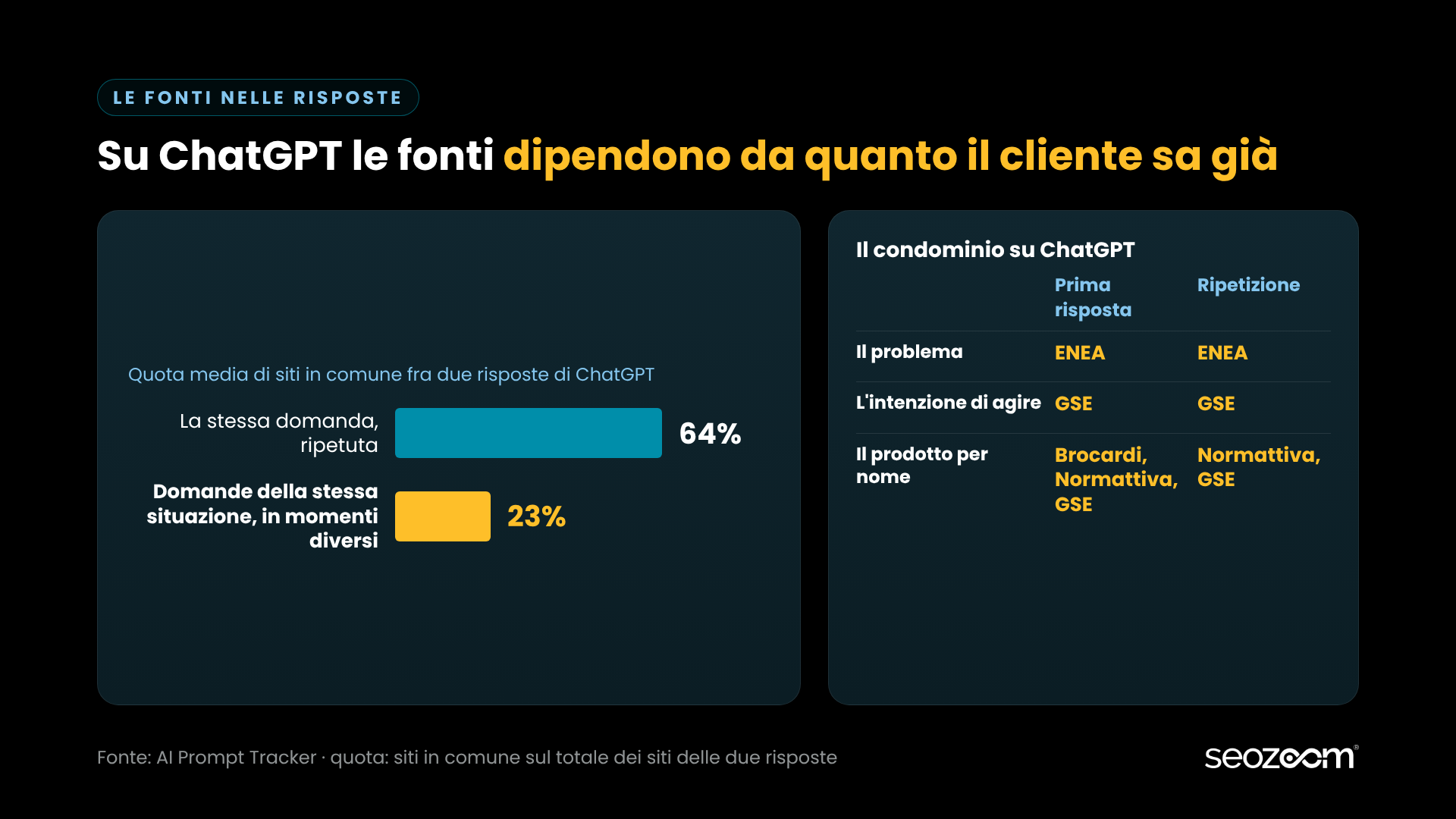
The customer moves from consumption to self-generation, then to installation rules, and ChatGPT shifts the information base of its answer right along with them. The problem, the intent, and the named product all stem from the same underlying need, but in ChatGPT’s answers they’re questions with their own distinct sources. A prompt set that includes only one version per need captures one moment in the customer’s journey and leaves the other two out.
How to work on fan out searches
The raw material to start from is the questions customers already ask you, in quote requests, in support chats, everywhere. For each need, it’s worth writing out three versions: the problem, the intent to act, and the product by name, because the product name alone leaves out the territory where most searches actually originate.
With AI Prompt Research you reconstruct the searches behind those questions, organized by topic, from informational ones to post-purchase ones, and line them up against your site’s pages. The first decision is editorial: do the issues that come up already have a page that answers them properly, or does the reader have to look elsewhere for costs, constraints, comparisons, and selection criteria? You don’t need a page for every query. You need pages that cover what someone needs to know to make a choice, including competing solutions the customer doesn’t mention by name, like insulation alongside solar panels. In the condominium case, efficiency, self-consumption, and regulations call for different pages and draw on different sources.
The next check is on organic search. The relevant fan out searches should go into the Monitored Keywords in your SEOZoom project, where rankings, changes, intents, and competitor positions update every 48 hours: there you see where your site already has competitive content and where it has none at all. That’s where your site builds its case for becoming a source, through relevance, depth of information, indexing, and internal linking.
There’s still the matter of looking inside the responses. With AI Prompt Tracker you can put questions to AI Mode, ChatGPT, and Gemini and read, in each response, the domain citations, brand mentions, and competitors, one check at a time, engine by engine. For AI Overviews, you use the AI Overview tool, which shows you the keywords for which your site appears in Google’s AI answers, along with visibility, mentions, and trends. An absence that keeps showing up on a significant question deserves a closer look; an occasional gap, especially on Gemini, calls for a new check first.
In the full study you’ll find the twelve questions exactly as we wrote them, the sources behind every answer, and the charts from our research.


 Verified reviews on Trustpilot