AI Overview takes over the SERPs, appearing in 1 search out of 2
How many Italian searches trigger AI Overview, which sectors are most exposed and which sites get cited: SEOZoom's December 2025 study.
More than half of Google searches in Italy today trigger an AI Overview box. This is the clear, unequivocal finding from our latest analysis of a sample of over 30 million keywords, which confirms that in 54% of cases the “above the fold” visual space is occupied by a machine-generated summary rather than traditional organic results. Google keeps pushing this shift in the architecture of the results page, inserting an increasingly frequent and pervasive layer of editorial mediation between the user’s query and your website – on top of which there’s also the AI Mode, which users can activate on request.
This occupation of digital public land changes the priorities of your SEO strategy. The presence of the AI block pushes organic links off the first visible mobile screen and drastically reduces CTR for anyone not among the cited sources, forcing you to secure a citation within the generative box: you must prove to the algorithm that you’re the most authoritative and relevant source to win the only visibility the user sees the moment they search.
AI Overview on Google, the story of an announced takeover
Italian SERPs changed face on 26 March 2025, the day Google began testing AI Overview. It was a first, timid appearance – in fewer than 1% of total searches – and seemed like an experiment confined to a handful of complex queries. Reality turned out to move far faster than expected: the massive rollout in July 2025 pushed coverage beyond 11%, turning the experiment into a trend.
Today, our study confirms the completion of this expansion, which has reached 54.15% total coverage across a sample of nearly 30 million keywords. And there’s another, more worrying figure: the sources chosen are extremely few.
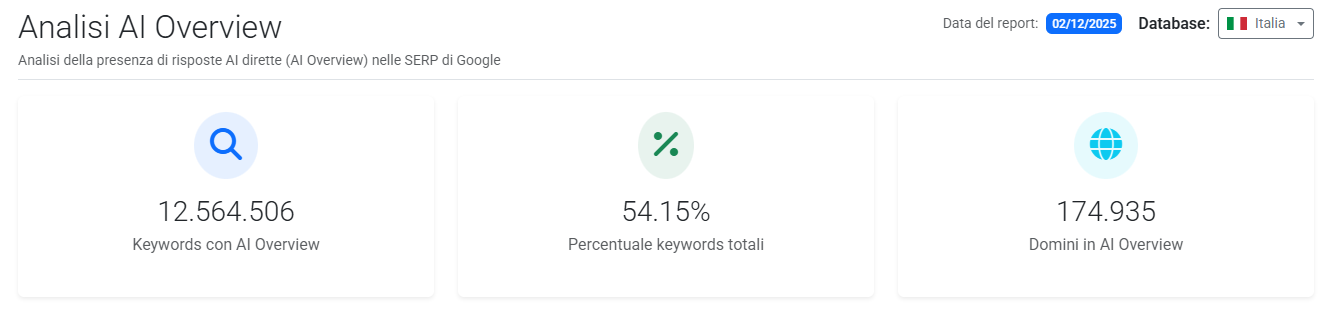
Our classic database tracks around 168 million domains visible on Google Italy, yet the algorithm has selected just 175,000 to build its summaries. The ratio is unforgiving: only 0.1% of the sites visible today manage to make it into the generative answer. In just eight months, Google has redrawn the architecture of online information, shifting the focus from the list of results to the generative answer and training users to find the solution without needing to visit the site. It has also cut the number of players involved, creating a narrow digital elite that monopolises user attention.
Who dominates AI Overview: the top ten sites chosen in Italy
The ranking of the most-cited domains gives us an exact map of what the algorithm considers “truth”.
Wikipedia (864,517 mentions) and YouTube (875,914 mentions) are the most used sites because they provide the two essential raw materials for the summary: the ontological structure of data (the “what”) and direct visual experience (the “how”).
However, looking at the First Result column reveals a clear qualitative hierarchy: Wikipedia is the primary source in 45% of cases (388,087 times), confirming itself as the structural backbone of knowledge for Google, while YouTube, despite having a higher absolute number of mentions, appears as the first result in only 25% of cases, a sign that the AI mainly uses it for elaboration or multimedia enrichment rather than as the foundational basis of the answer.
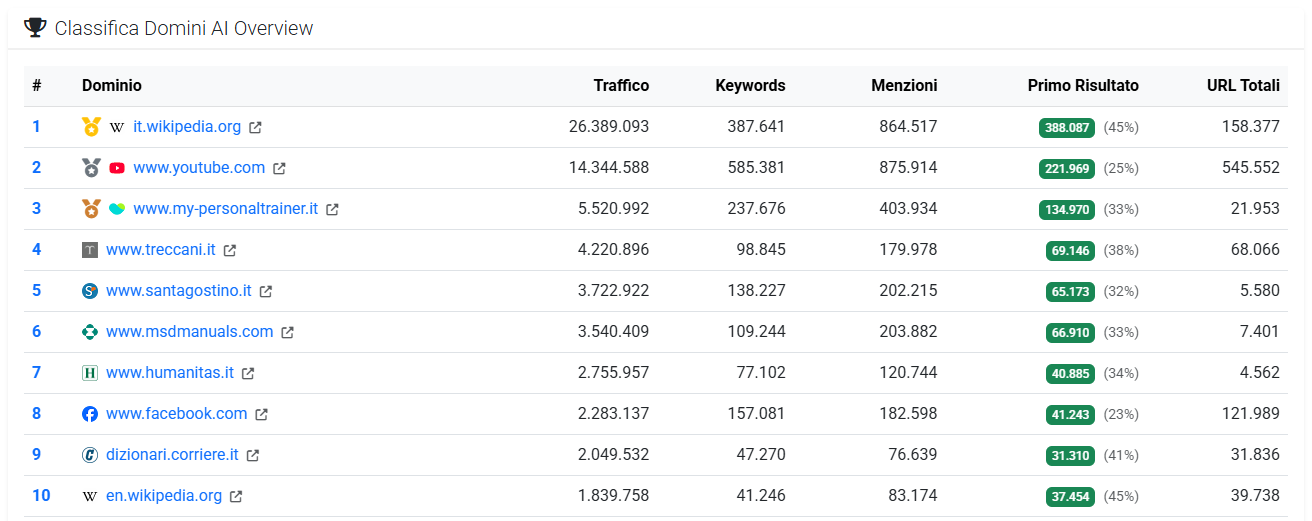
The strongest signal for the market comes from verticality and editorial efficiency: My-personaltrainer.it takes third place overall (403,934 mentions), outperforming generalist giants thanks to an extreme thematic focus on wellbeing. The surprising figure is the ratio between volume and pages: it achieves this result with just 21,953 total URLs involved, compared with over 545,000 for YouTube or 158,000 for Wikipedia. This shows that, for AI, a single well-crafted vertical page can be worth dozens of generalist pages.
The strong presence of real healthcare institutions such as Santagostino.it (5th place with 202,215 mentions from just 5,580 URLs) and Humanitas.it (7th place with 120,744 mentions from 4,562 URLs), or academic references such as Treccani.it (38% First Result) and MSD Manuals, confirms the new golden rule: to answer complex questions, Google ignores generic informational blogs and demands the guarantee of a clinical institution or a certified encyclopaedia. This marks the end of the era when writing a good article was enough to compete; now you need to be the go-to entity for that topic, capable of maximising the value of every single published URL.
Technical selection rewards vertical expertise over generic authority
Cross-referencing presence data with our Zoom Authority (ZA) we identified a clear entry threshold: no domain in the Top 10 AI sources falls below 76, which confirms that a very high level of structural Trust is needed to earn a seat at the table, but also that domain strength alone is not enough to guarantee citation.
Giants like Amazon.it (ZA 93) or Tripadvisor (ZA 88) have metrics higher than many of the AI’s preferred sources, yet are used very little to generate answers. Intent makes the difference: AI seeks Knowledge and structured information, whereas these sites offer transactions or unverified opinions that the machine discards for safety.
The competition shifts to Topical Zoom Authority (TZA), and the case of My-personaltrainer.it proves it in numbers. With a global ZA of 83 it would rank below many generalist portals, but in its specific niche it boasts a TZA of 96, a value nearly identical to Wikipedia’s (97). The algorithm applies a vertical meritocratic principle and ignores generic strength to reward focal expertise – in other words, for AI a vertical site with focused authority is worth more than a generalist giant covering the topic superficially, without direct experience or specific expertise.
The risk map: the sectors where AI replaces the publisher
This selection dynamic doesn’t affect everyone equally, though, as the algorithm adjusts its presence based on how critical the topic is, drawing an actual risk map.
You need to understand straight away whether your sector risks being replaced or whether you still have classic room for manoeuvre.
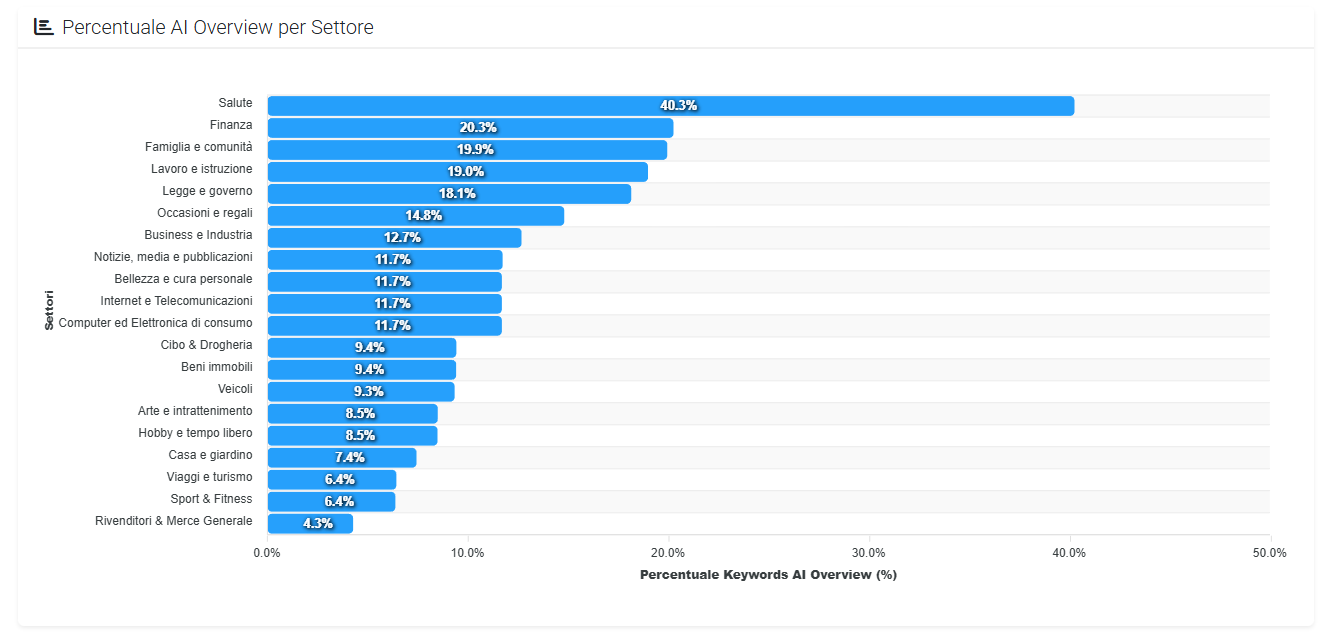
AI’s incidence is indeed widespread, but it follows a logic of surgical replacement in areas where incorrect information could cause harm. The Health sector suffers the heaviest impact, with 40.3% coverage, followed by Finance at 20.2% and Family and Community at 19.9%. These are YMYL informational areas, where Google has decided to stand in for the publisher to guarantee safe, immediate answers, drastically shrinking the space for traditional organic results.
At the opposite end you find Retailers & General Merchandise (4.3%), Travel and Tourism (6.4%) and Sport & Fitness (6.4%). Here the algorithm takes a strategic step back and, for now, continues to respect the transactional dynamics that guide your user towards a purchase – but, above all, it preserves the visual advertising spaces that support Google’s revenue.
AI fishes beyond the Top 10
There’s a further crucial aspect for your SEO strategy: the sites chosen by artificial intelligence don’t necessarily match the dominators of the classic SERP. The generation algorithm draws more broadly and meritocratically, and around 40% of links cited as sources in AI Overviews come from URLs that don’t appear among the top 10 traditional organic results for that query.
In short, AI Overview bypasses the established hierarchies and picks the sources it deems semantically most useful for building the answer, reshuffling the cards of online visibility. This opens huge opportunities for sites with high-value vertical content that had previously been overshadowed by generalist giants, but at the same time creates unexpected competitors for those who have always dominated page one purely through the strength of their backlinks.
Safety and revenue govern AI distribution in the SERPs
Even at first glance, the data from our study reveals the basis of the algorithmic logic, guided by two supreme principles: information safety (safety) and protection of revenue (revenue). Google applies a dual governance over the SERP, acting with varying intensity depending on the sector, turning the results page into a controlled editorial environment for sensitive topics, while keeping it a commercial showcase for transactional queries.

You need to read these numbers to understand the nature of the ground you’re operating on: in some markets Google is a publisher that replaces sites to protect the user, in others it’s a marketplace that needs your products to sell advertising. This distinction determines your budget: in the first case you invest in Brand Authority to get past the safety filter, in the second in structured data to compete for visual spaces.
The gatekeeper filter locks down answers on sensitive topics
At first glance it seems paradoxical that Google has entrusted automation with the most delicate sectors, but the short circuit is only apparent.
The AI Overview in the YMYL space isn’t “inventing” answers, it’s locking down information by acting as a genuine gatekeeper, the custodian of the threshold that serves as a security filter.
Google uses AI to generate an exclusive summary based only on sources considered to have extremely high Trust (such as My-Personaltrainer, Humanitas or government sites), cutting everything else out of immediate view, including minor blogs and unmoderated forums.
The key to understanding this is safety: AI becomes the ultimate E-E-A-T filter and moves upstream in the process.
The algorithm no longer trusts you to browse through ten potentially inaccurate links on topics like health or finance; it prefers to serve you a “pre-validated” and concise answer, drawn only from those who have already passed the strictest quality checks and hold unassailable authority, silencing the rest of the editorial long tail. What’s more, these sectors generate an enormous volume of how-to or comparative queries (such as “flu symptoms” or “difference between hybrid and electric”) which are the ideal fuel for language models (LLMs), perfect for aggregating scattered information into a single coherent text and making the click unnecessary.
If you operate in these sectors, algorithmic visibility becomes an exclusive club that requires certifications and authority, not just good content.
Defending the advertising asset in Retail and Travel
Be careful, though, not to make the strategic mistake of feeling safe just because you operate in Retail or Travel.
AI’s impact is low today only because Google is protecting its business model (Ads and Shopping) – a text box placed at the top of these SERPs would push paid ads and product carousels out of the first screen, cannibalising revenue precisely on the highest-CPC queries – and because at this stage users still want the direct visual experience.
Someone searching for a hotel or a dress wants to see, compare prices and buy, actions that a text summary hinders rather than helps. This delay gives you a temporary advantage to hold ground on transactional SERPs with classic formats, but the evolution is already mapped out towards AI Agents: the model will soon stop merely summarising text and start planning entire trips and recommending complex purchases by cross-referencing reviews and technical specifications.
You need to prepare your data today so you don’t disappear tomorrow. Anyone working in these sectors must structure their information (product feeds, semantic clarity, machine readability) to make it “readable” by future agents. Those who already speak the language of the machine will have a huge competitive advantage once Google unlocks AI’s transactional features (such as “find me a hotel in Rome under €200 with a spa”). It’s not a question of “if”, but of “when”.
Cognitive offloading: citation as the new validation
Fundamentally, appearing in the generative box introduces a new psychological dynamic into the relationship between user and brand: cognitive offloading. Being cited in the AI Overview is perceived as an absolute seal of approval. Psychologically, the user delegates to the machine the effort of choosing, of fact-checking and of verifying sources.
If artificial intelligence cites your brand, the user unconsciously assumes you’ve been “verified” and “validated” by a superior intelligence. Trust shifts: people stop trusting their own ability to search and start trusting the machine’s ability to select on their behalf. Being in there means having passed the web’s toughest entrance exam; being left out means being irrelevant to the final summary.
The checklist to avoid disappearing
The massive presence of AI Overviews on Italian SERPs confirms that search has become an “exclusive” system, where the algorithm decides upstream who gets a say and silences the rest. To avoid being left out of the summary that guides users, you need to stop producing “filler” content and apply this change of course right away:
- Measure your AI readiness. Don’t just look at rankings. Use GEO Audit or AI Overview Monitor to understand whether your brand is already perceived as a trustworthy entity by language models, or whether you’re invisible to the machine.
- Go vertical or die. If you operate in YMYL sectors, stop publishing about everything. Focus on a specific niche and become the absolute authority on that topic. AI rewards the specialist, not the generalist.
- Structure your data. If you want to be part of that 40% of sources AI fishes out beyond the Top 10, make your content “digestible”. Use tables, lists and Schema.org. Reduce entropy: provide direct, atomic answers the algorithm can extract effortlessly.
- Prepare your feeds for agents. If you’re in ecommerce, don’t get comfortable with the current truce. Clean up your product feeds, enrich your structured data, and get ready for when AI stops summarising text and starts shopping on the user’s behalf.
Visibility is no longer won with volumes alone, but with the trust you’re able to inspire in Artificial Intelligence. You have the data, and now you have the strategy too: it’s up to you to apply it before your competitors do.


 Verified reviews on Trustpilot