Everyone is reporting the news: you can find the angle that hasn’t been covered yet
Don't chase the news - read it. The AI Press Review shows you who has covered what, where there are gaps, and when it's worth writing about.
You run an industry blog, a niche publication, or a brand’s editorial plan. A story breaks in your field, and your first move is to open Google News to see who’s already covered it. Just like you always do. Just like everyone else.
Your instinct tells you to publish right away, but that’s the wrong move. When it comes to pure news coverage, you’re at a disadvantage from the start, because the major publications dominate that space.
Traffic, however, isn’t limited to breaking news. There are always those who aren’t looking for the story itself, but rather what they should do about it: how it affects them, what changes for them, and how to act accordingly. This is the reader that the major publications fail to serve – and the piece that you can write better than anyone else. On one condition: knowing exactly where the others have stopped. That’s where your angle begins.
News coverage is a structure, not a list
In journalism, coverage refers to how sources handle an event over the same period of time: who breaks the story first, who merely reposts it, which aspects the mainstream media focuses on and which remain uncovered, how much a story is still active and how much it is fading.
Within this framework, two games with opposing rules are played out. In pure news reporting, the event and its protagonists dominate the major publications, partly for “technical” reasons. To populate Top Stories and its news feeds, Google’s algorithms analyze a series of factors, including content relevance, prominence, authority, recency, usability, location, and language.
In particular, freshness rewards those who break the story early and keep the piece updated as the story unfolds; prominence measures the story’s impact – how widely and persistently news outlets cover it; and authority recognizes the credibility a publisher has earned on the topic over the years, including through transparency regarding site ownership, article authorship, and bylines.
When it comes to these factors, a smaller site has an advantage: if you publish early, freshness gives you a boost in the initial phase, because when a story is breaking, algorithms may determine that a story with up-to-date information is more useful than an older one. So, as long as the major outlets haven’t published yet, you can appear at the top and attract significant traffic. It’s a real opportunity – and sometimes a very lucrative one. The point is that this window closes quickly. As soon as the major outlets publish on the same story, their authority outweighs your freshness – this is especially true during the heat of the moment, when a story is unfolding – and pushes you back down the rankings. You can be just as fast, but the credibility built up over time can’t be regained in a single day.
Vertical in-depth coverage flips this logic on its head. The technical analysis of the event, its impact on a specific sector, the angle that a generalist overlooks because they write for everyone: here, the writer’s seniority matters less than expertise in a subject, and a specialized website has more of it than a national daily. The reader who has already seen the news scroll by in their feed isn’t looking for yet another rehash; they’re interested in what no one has explained to them yet. That’s your opportunity.

The ultimate rule, which applies across every industry: when it comes to what’s already been said, you compete with the strongest players; when it comes to what hasn’t been said, you have fewer rivals.
The moment you tackle a topic matters just as much as the angle you choose
Even the smartest angle, however, is of little use if your timing is off – that is, if you publish too early, when no one is searching for that topic yet, or too late, when everything has already been said.
The right moment lies in between; it’s fleeting and can be identified by cross-referencing two signals – how much a topic is spreading across the media and how much people are searching for it – which move independently and, without proper attention, you risk overlooking. A topic may gain traction in the media without underlying search demand, or it may see rising search volume while the press is still giving it little coverage. That’s what you need, because it confirms that demand already exists, and few have tapped into it yet.
SEOZoom lets you focus your efforts, and with Trending News, it monitors industry categories, highlights growing topics and terms that recur in the news along with their estimated search volume, linking them to trends on Google Trends. With the free search feature, you can also choose what to search for (a brand, a name, an event) to check if and how the media is covering it.
Case Study: Analysis of News Coverage in the Health Category
The most challenging step is the last one: understanding how a topic has already been covered. This is best illustrated with a concrete example, so we’ve chosen Health.
It is the quintessential YMYL territory, covering topics that affect people’s health, and therefore the importance of authority stands out even more in news coverage. Yet it is also a category where vertical specialization carries significant weight: clinical analysis, the impact on a specific patient group, and explaining what a study truly means. Here, reviewing the coverage before writing matters more than anywhere else.
There’s also a reason related to continuity. We had already investigated this sector from an organic perspective, where we found one of the most stable SERPs ever, with low volatility and a strong foothold for established publishers. On the news side, the balance is shifting, and timing is once again decisive. The same sector, viewed through two opposing lenses: while organic search rewards the longevity and reliability of the source, news opens the door to those who can move quickly and be in the right place at the right time.
What Our Study Reveals
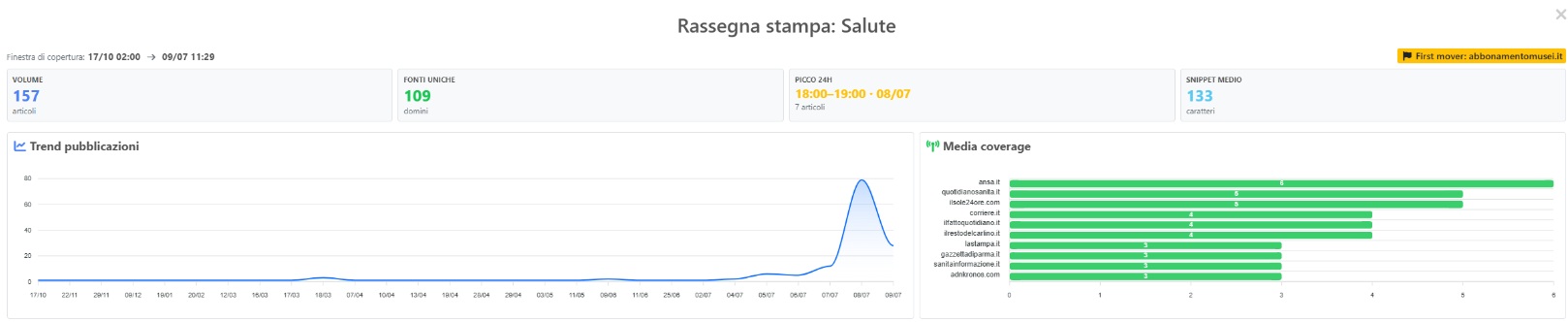
On July 9, 2026, we analyzed the Health category using Trending News on the Italian market and generated an AI Press Review. The analysis collected 157 articles from the previous week, published by 109 different outlets, including national newspapers, news agencies, specialized health portals, and local news sources.

When narrowing the time frame, the number of daily posts drops to 31, and over the past 24 hours there have been 65 posts from 52 active sources. The overall corpus, the daily data, and the data from the past few hours paint three different pictures, which – when scrolling through a feed at a glance – blend into a single mass.
The predictable names are consistently at the forefront. Quotidiano Sanità leads in the number of daily posts, followed by Adnkronos, ANSA, and Il Resto del Carlino; further behind are Corriere, La Stampa, and healthcare-focused publications such as Sanità Informazione. This reflects the deep-rooted presence one would expect in a YMYL category and serves as concrete confirmation of the value of having an established name.
The analysis, however, goes beyond simply identifying who publishes the most. It groups the 157 articles into 8 main topics and measures, for each one, how many publications cover it. The distribution is uneven: some topics are covered by four or five publications, while others by just one or two. The least covered topic – the alert regarding the resurgence of certain infectious diseases, rat typhus, and a case of West Nile virus in the Novara area – was covered by only two out of 109 sources: La Stampa and Il Fatto Quotidiano.
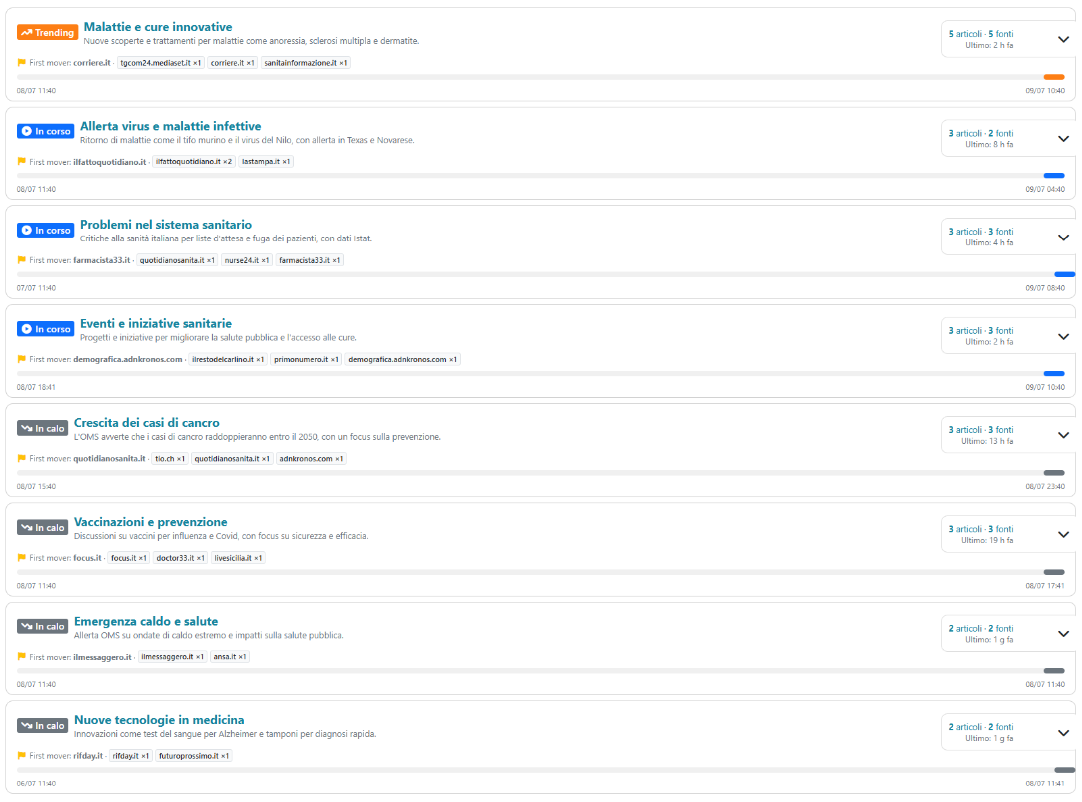
It’s the gap between apparent volume and actual coverage. In the flow of headlines, the alert blends in with everything else; on the coverage map, it stands out for what it is – a concrete health issue that almost no one has covered, while other sources crowd around the hottest topics. The press review doesn’t determine whether it’s worth covering: it points to sparser coverage, and the decision ultimately depends on your expertise, the sources you can verify, and the relevance such a piece has for your project. When it comes to health issues, source verification matters more than speed.
In addition to the matrix that cross-references topics and publications, the AI Press Review reports the peak in publications over a 24-hour period – which, on that day, occurred between 6:00 p.m. and 7:00 p.m. on July 8 with 7 articles – as well as the hourly distribution, the sources that break the story first, and the evolution of coverage over time. It also assigns each topic a status: ongoing, declining, or trending. Reconstructing the same picture manually – by opening and comparing over a hundred sources – would consume the very hours needed for writing.
It’s the same work that AI is streamlining in newsrooms: according to Orbit Media, producing an article in 2025 took just under three and a half hours, compared to four hours and ten minutes in 2022. With one difference: here, the time saved isn’t in the writing itself, but in the research that precedes it.
A data structure, not a chatbot summary
The most immediate objection is that even an AI connected to the web can provide such a summary, including cited sources. The difference lies not in the summary itself, but in what you build upon it. With a general-purpose assistant, you define the scope from scratch each time, choosing which sources to include, how many articles, what time frame, what to discard, and then verifying the results.
The AI Press Review starts with a predefined set – the news items that Trending News has collected on the category in question at the time of the analysis – and does not limit itself to a textual summary.
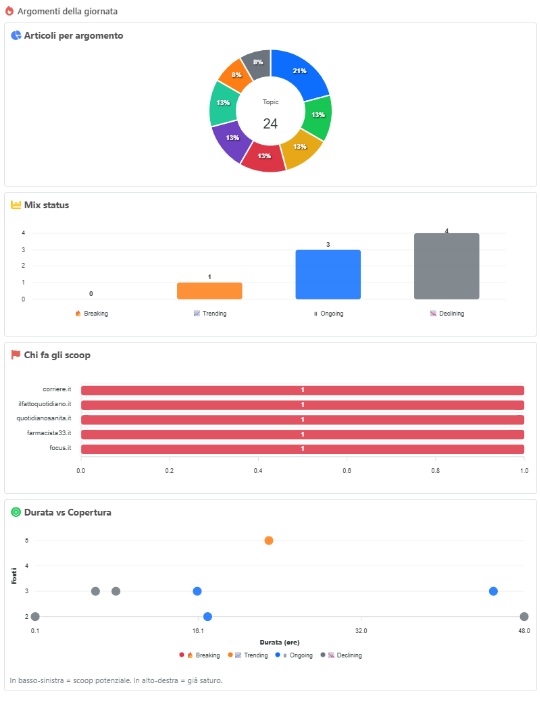
It provides a searchable framework where you can see how many sources there are, which ones, in what chronological order, how extensively each topic is covered, and which angles remain uncovered. A summary tells you what’s being discussed; SEOZoom shows you how the coverage is distributed – and that’s the data you use to decide whether and how to take action.
What to Write – and When It’s Better Not to
When looking at the map, the question is no longer just whether to write, butwhich approach to take, and the answer changes depending on the state of coverage. On a developing topic that few publications are covering, timely news still makes sense. On a topic that’s already crowded, a piece identical to the others is a waste of effort, and the paths diverge: if you have content covering that topic, updating it is the right move; if you have vertical expertise, the right move is to provide the in-depth analysis that generalist outlets have overlooked; if there’s stable search demand behind it, the right move is to dominate the query, which lives on even beyond the news cycle. And for a topic on the decline, with attention already waning, it’s often best to let it go.

The tool provides the data that enables you to make an informed choice; deciding what’s worth your time is still up to you. Trending News identifies trending topics and the accompanying search signals; the AI Press Review analyzes the coverage and organizes it into a map; and from there, the selected topic is passed on to SEOZoom’s other editorial tools: content management, Article Keyword Suggestions, and the Editorial Assistant. The news feed continues to flow identically for everyone.
Only one thing changes: before you start writing, you already know which angles are over-covered, which remain unexplored, and which are worth investigating.


 Verified reviews on Trustpilot